Participating in a grand battle or siege, either as an attacker or as a defender, is one of heroic fantasy's staples. Thousands of nameless faces staring death in the face, and you are one of them. This is what this document is attempting to provide: a way to easily integrate mass combat into 5e. Whether you plan to run mass combat only once per campaign, or run an entire campaign about waging a war with an enemy nation, these rules are designed to fit.
This system is based on Trekiros' Mass Combat Simplified, partly modified by me.
Running Mass Combat
Here are guidelines for how to run the actual mass combat encounter.
Armies and Commanders. An army is made up of units, lead by commanders. A unit is a collection of tens or hundreds of soldiers, while a commander is a single creature. Each army has a maximum unit cap equal to the total proficiency bonus of every commander plus any unit cap modifier.
Before combat begins, each commander chooses a number of units equal to their proficiency bonus which are under their control. Any leftover units are divided between the commanders as they wish.
Deployment. Place the armies on opposite sides of a battlemap, each side separated by around 600 feet. In some contexts, such as an ambush or encirclement, alter the start.
Initial advance. Before rolling initiative, let the armies approach one another. Only roll initiative when it becomes necessary: when the timing of an action becomes too important not to handle without turn-based rules. Typically, this happens when one of the sides declares they want to make an attack, such as when archers reach their missile range.
Commander initiative. In a mass combat encounter, only the commanders roll initiative. The units act on initiative count 0 (see below), and units allied with the player characters act before enemy units.
Orders. Units starting their turn within 120 ft. of a commander which it can hear can act freely as determined by the player. Units not within this range follows the last order they were given, unless they have a condition which prevents them from doing so. Orders can be simple, such as hold this position or attack that unit, or complex, such as attack any enemy advancing on this area or continuously charge then retreat. Units allied with the player characters act first, in whichever order they desire, and then enemy units act.
Some commanders have access to special orders and commands that they can issue to their troops as an action. Martial characters (fighters, barbarians, and paladins) and characters trained in warfare (such as having the warfare lore skill), can issue orders to two units with one action
Being Engaged in Combat. Once two units are within 5 ft. of one another, both units gain the Engaged condition. The Engaged condition is used in various abilities, most commonly in attacks of opportunity.
Fronts, Flanks, and Rears. Every unit has a front, where its weapons and attention is aimed. To either side of the front are the flanks, and on its opposite is the rear. Attacks against a unit's rear are critical.
Repositioning. When a unit moves or turns, this is referred to as repositioning. While moving, a unit can reposition for free as long as it is not engaged. Repositioning (moving or turning) while engaged, allows all enemy units within 5 ft. to make an attack of opportunity as a reaction. A unit can use Disengage to prevent such attacks.
Resolving attacks. When a unit attacks another unit, or forces another unit to make a saving throw, do not make an attack or a saving throw. Attacks hit automatically, and saving throws fail automatically.
For damage, use the average instead of making a damage roll. If the attack had advantage, it deals critical (double) damage. If it had disadvantage, it deals half damage.
A unit can only target a creature (such as a commander) with an attack if the creature is within the space of the unit, unless the creature is huge or larger. If a unit targets a creature that is large or smaller with a ranged attach, the damage is halved.
If a commander attacks or is attacked by a unit (or another commander), roll attacks, saves, and damage as usual. If a commander attacks a unit, damage from attack rolls is halved.
PC and Commander Spells. When a non-unit creature casts a spell with an area of affect, the number of units it can target depends on the diameter or side of the spell.
Spell Diameter/Side | Effect |
|---|---|
Below 60 ft. | Target 1 unit |
60-89 ft. | Targets 2 adjacent units |
Above 90 ft. | Targets all units fully within the area |
Diminished. When a unit is below half its max hit points, it is diminished. While diminished, the unit deals half damage and has disadvantage on morale tests.
Group Morale. While a unit is not diminished, it has advantage on saving throws against being charmed, frightened, paralyzed, stunned, restrained, and knocked prone.
Morale Tests. Certain events trigger morale tests, a wisdom saving throw with a DC equal to 8 + the number of units the army has lost or that are routing. On a failed morale test, the unit begins routing, using all its actions and movement to flee the battle.
The following events trigger morale tests:
When a commander dies within 90 ft. of a unit
When a unit is reduced to half its max hit points for the first time
When the last commander dies (then the test is made with disadvantage)
When a unit is below half its max hit points, it makes morale tests with disadvantage. This does not apply to the morale test triggered by the unit being reduced to half HP.
A commander can force a routing unit to make a new morale test by using the Rally action within 30 feet of it.
Win Conditions. Battles between armies aren't typically fought until the total extermination of the other side. Typically, once all the commanders of an army have been defeated or routed, and the army is outnumbered 2-to-1, the battle is lost.
Typically, once all of the commanders of an army have been defeated, or were forced to flee the battlefield, their army is routed and the battle is lost. Here are a two other common scenarios:
Protect/Destroy: One side must protect a certain creature or object for 10 rounds. The other must destroy it. Example targets: the gate of a castle, a mage performing a ritual, hundreds of hostages being sacrificed to an evil god.
Escape/Chase: One side starts surrounded by the enemy on all sides. They win if their commanders escape from the battlefield.
Battle Aftermath
Unit Experience. After a battle is concluded, on the card of each unit that took part, mark that it has taken part in the battle. After a certain number of battles, the unit will increase in experience and get a new unit card.
Destroyed Units. Units brought down to 0 hit points during Warfare have a 50% chance of being completely destroyed. Roll 1d20. If they are not destroyed, its remnants flee the battlefield and regroup. For the next month, it cannot regain HP past half its max HP and is always diminished in this period.
Battlefield Duels
If two commanders, champions, or creatures are within 30 ft. of each other, one of them can choose to initiate a battlefield duel. Duels take place on a separate battlemap called a Duel Pocket, using regular D&D combat rules and scale. If they do so, it counts as taking the Dash action and they can move the remainder of their speed.
Units cannot target creatures engaged in a duel.
The Battlefield
The last part of the equation of how to make a fun mass combat encounter is to make the terrain itself interesting and have it create tactical decisions.
The battlemap uses a 30-foot per cell scale, or 5 cm = 30 ft., and should incorporate a few of the following elements:
Slopes. High ground can be used to see more of the battlefield, or to give the arrows of your archers more range.
Forests/Ruined Structures. Entire units can hide inside of thick vegetation, or behind the crumbling walls of a ruin. Creatures inside this terrain are heavily obscured to other creatures 90 or more feet away from them.
Swamps/Mud/Uneven Grounds. Armies are slowed to a crawl by the muck: it counts as difficult terrain.
Cliffs/Rivers/Ponds/Lakes. These obstacles are practically impassible by units, unless they're a unit of druids.
Caves/Tunnels. Sometimes, the battle can happen not just on the ground, but also beneath it, in three dimensions. By incorporating a network of underground tunnels into the battlemap, you give more potential vectors of attack to both armies.
Fortifications. The walls of a city or of a castle are an important defensive position during a siege. They provide siege equipment such as ballistas and cauldrons of boiling hot water, as well as crenalations to hide behind.
Creatures on the wall have advantage on attack rolls made against creatures who are not on the wall.
Creatures not on the wall have disadvantage on attack rolls made against creatures who are on the wall.
Fortifications can be destroyed: they might have anywhere from 100 to 500 hit points, depending on how important the fortress is.
Units
All units have a class type, an experience level, an armour level, and an ancestry. The below tables show how each element modify various attributes. When a "+" sign is shown, add together the modifier from each relevant table.
Experience, Armour, and Ancestry
Experience. All units have an experience tier, impacting how effective it is. For each experience tier it gains, all the ability scores of the unit improve, as well as its HP, AC, damage, and upkeep cost. The levels are inexperience, regular, veteran, elite, and master. As the units take part in battles, they gain experience. Most newly formed units start as inexperienced, unless they are formed from specialised populations. Below is a table of how standard units are affected by experience level.
Experience Level | HP | AC | Attack Damage | Ability Score Modifier | Upkeep Cost | Nr. of Battles to Upgrade |
|---|---|---|---|---|---|---|
Inexperienced | 10 | 1 | ||||
Regular | +20 | +5 | +1 | +10 | 3 | |
Veteran | +40 | +1 | +15 | +3 | +20 | 10 |
Elite | +70 | +2 | +25 | +5 | +60 | 20 |
Master | +100 | +3 | +40 | +7 | +100 |
Armour. All units have an armour level: light, medium, or heavy. A unit's armour level can be upgraded by paying the cost below. Below is a table of how standard units are affected by armour level.
Armour Level | HP | AC | Attack Damage | Speed | Upkeep Cost | Cost to Upgrade |
|---|---|---|---|---|---|---|
Light | +25 | +5 | +15 | 45 ft. / 7.5 cm | +25 | 250 |
Medium | +50 | +10 | +20 | 30 ft. / 5 cm | +50 | 250 |
Heavy | +75 | +13 | +40 | 15 ft. / 2.5 cm | +75 |
Ancestry. All units have an ancestry, like Human, Elf, or Orc. All ancestries impact the units, granting abilities or modifiers.
Some common ancestries are shown below
Ancestry | Ability | Ability Score Modifiers |
|---|---|---|
Human | -25 upkeep cost | +2 WIS |
Elf | Bonus action Dash (1/day) or Eternal trait, +10 ranged damage | +2 DEX |
Dwarf | Bonus action Brace! (1/day), Stalwart trait | +2 STR |
Orc | (1/day) Bonus action Charge!, +10 melee damage | +4 STR, +2 CON |
Hobgoblin | Warbred trait | |
Goblinoid | Guerrillas, Mobile, or Scout trait | +2 DEX, -2 WIS |
Undead | Undead Servitude trait |
Unit Class
Core Units
The three core unit classes make up the bulk of almost every army. Each of them has their own strengths, and weaknesses.
Infantry are good against immobilised cavalry and archers in melee, but suffer to both if outmanoeuvred. Archers pick off infantry at range but are at risk of flanking cavalry. And cavalry excel at hunting archers or charging infantry flanks, but suffer when immobilised. A skilled tactician uses all this to their advantage.
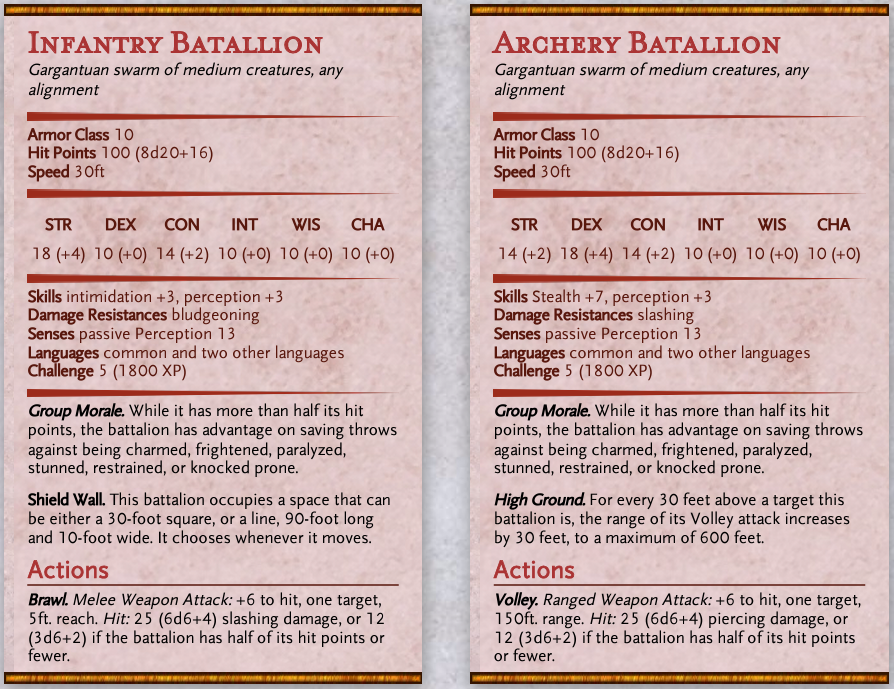
Infantry. A unit specialized in melee combat.
Archers. A unit specialized in ranged combat, especially great if they can lord over the battlefield from an elevated position.
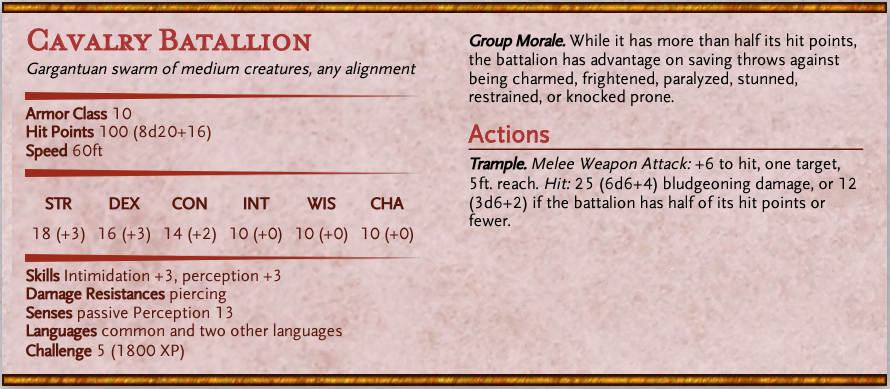
Cavalry. Mounted combatants specialized in fast charges and manoeuvrability, to take out important targets hidden in the back of the enemy lines or to strike into flanks.
Unit Type | HP | AC | Damage Output | Speed | Upkeep Cost |
|---|---|---|---|---|---|
Infantry | +50 | +5 | +25 | +25 | |
Archers | +25 | +2 | +25 | +25 | |
Cavalry | +40 | +4 | +25 | +5 cm | +50 |
See unit traits for the abilities of the unit types.
Support and Special Units
These secondary types of battalions provide utility to the army, enabling tactics which wouldn't otherwise be possible. They are the cornerstone of an army's strategy, and must be protected at all cost.
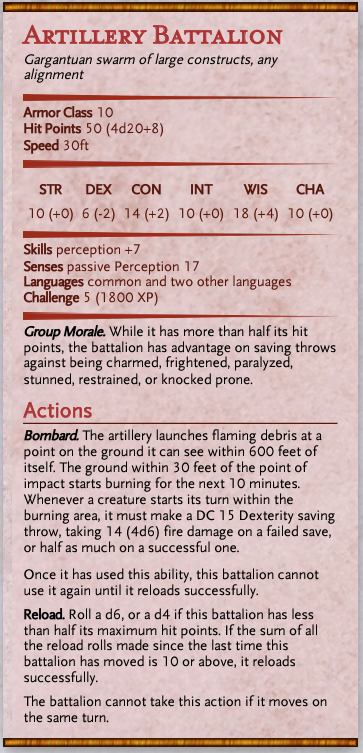
Artillery. Mangonels and catapults are easily destroyed and must reload after each shot, but they can change the face of a battlefield by setting it on fire. Use them to target chokepoints and retreat paths, throwing a wrench in your enemy's plans.
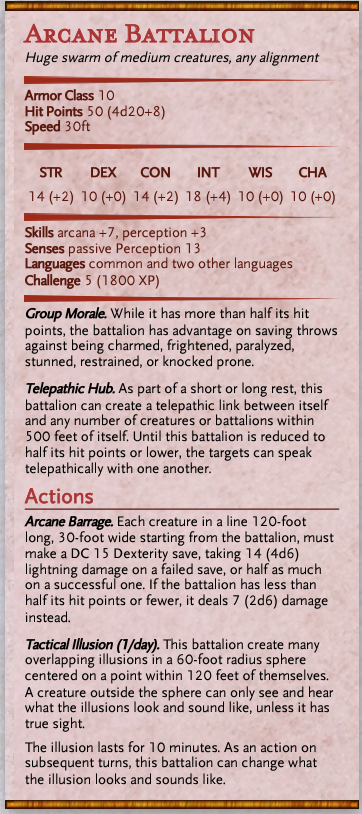
Arcane. Wizards provide a lot of utility on the battlefield. A good tactician will find endless creative uses for their spells. Arcane units can only be light.
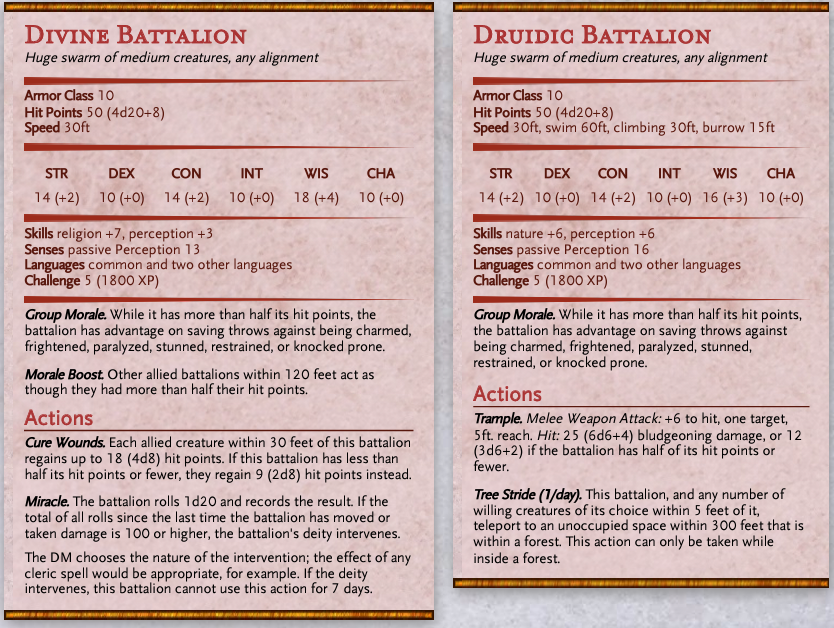
Divine. Clerics and paladins can bolster their allies' morale and heal the wounded. They can also perform complex rituals to have their gods turn the tide of battle, though this can make them a target. Divine units can only be light.
Druidic. With a strong bond to the natural world, this battalion can navigate even the roughest terrain, and outmaneuver armies in the wilderness. However, in urban environments, their abilities are much more limited. Druidic units can only be light or medium.
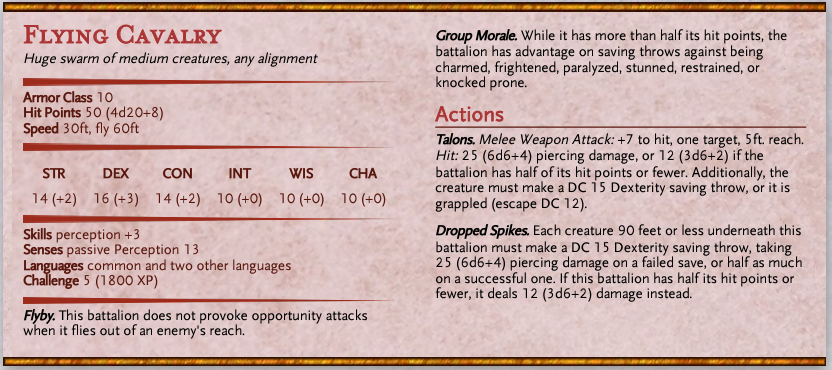
Flying Cavalry. A cavalry unit mounted on flying creatures. If enemy archers are dealt with, griffon riders or drake knights can become nearly unstoppable. Otherwise, it is best to keep them on defense.
Unit Type | HP | AC | Damage Output | Speed | Upkeep Cost |
|---|---|---|---|---|---|
Artillery | +2 | 15, over 10 rounds S | +100 | ||
Arcane | +25 | +2 | 15, 120*30 ft. line S | +100 | |
Divine | +25 | +2 | 20 healing S | +100 | |
Druidic | +2 | +10, grapple | Swim, Climb, Burrow, Teleport | +100 | |
Flying Cavalry | +25 | +4 | +25 | Flying 60 | +100 |
S Special. Rather than adding this with the modifiers of other tables, this replaces it.
Army Traits
To make armies feel more unique, each army should have one of the following additional traits. Every unit in that army gains the benefits of the chosen trait.
For story reasons, it might be possible for a single army to include units with different traits. But be careful, as too many traits can quickly become difficult to keep track of.
Aggressive. As a bonus action, the unit can move up to its speed straight toward a hostile creature that it can see.
Amphibious. The unit can breathe air and water, and gains a swimming speed equal to its walking speed.
Berserkers. Every light and medium unit can use the Charge! ability as a bonus action once per battle.
Crusaders. Each unit of this army has the Holy trait, making them unfazed by Undead and Fiends.
Demonic Horde. This unit's maximum hit points are halved, but it has the following action: Summon (1/day). Flip a coin. On heads, an identical unit is summoned within 30 feet of this unit. The summoned unit doesn't have this action.
Disciplined. Each infantry unit of this army has the Testudo trait, letting them adopt a defensive stance.
Draconic Legion. Each unit of this army has the Dragonkin trait, giving them advantage on attacks and morale tests while within 90 ft. of an allied dragon.
Elemental Army. Choose one damage type other than bludgeoning, piercing, or slashing. The unit is immune to that damage type, and its attack always deal damage of that type.
Eternal Guardians. Each unit of this army has the Eternal trait, making them better at fighting undead.
Fearless Veterans. Each veteran tier or above unit of this army has the Fearless trait, making them automatically succeed on morale tests.
Giant Army. The unit's maximum hit points are increased by 50.
Guerrilla Fighters. Each light unit of this army has the Guerrilla trait, letting them leave melee without attacks of opportunity after attacking the enemy.
Incorporeal Movement. The unit can move through other objects as if they were difficult terrain. It takes 15 (3d10) force damage if it ends its turn inside an object.
Infernal legion. Units of this army has the Infernal trait, meaning magical darkness doesn't impede the unit's vision and it is immune to fire damage.
Light Assaulters. Every light infantry unit in the army gains the Mobile trait, letting them Dash as a bonus action.
Made for War. All units of this army that are the same ancestry as their leader has the Warbred trait, giving them a chance to attack a second time after attacking.
Nimble Escaper. Every light and medium unit of this army can take the Disengage or Hide action as a bonus action on each of its turns.
Poison Splash. When this unit takes damage of any type but psychic or poison, each other creature within 5 feet of it takes 9 (2d8) poison damage.
Terrifying. Each veteran tier or above unit in this army has the Fearsome trait, letting them force enemy units to make morale tests.
Undead Army. Each undead unit of this army has the Undead Servitude trait, making them always succeed on morale tests while being immune to being frightened or charmed, but all these units also die if their leader dies.
Unit Traits
The following are some traits that many common units have.
Archers. The unit is equipped with bows and projectiles. For every 30 ft. above a target this unit is, the range of its ranged attack increases by 30 feet, to a maximum of 600 feet. To make an attack against a target, the unit must have line-of-sight to it. This unit always has advantage on attacks against infantry without shields.
Cavalry. This unit is mounted. The unit gains Charge! as an action. After using the Charge! ability, the cavalry unit is not engaged until the end of its next turn. Additionally, the unit always has advantage against archer and artillery units.
Infantry. This unit is on foot, armed with melee weapons. The unit always has advantage against archers.
Shields. This unit is armed with shields in one hand, preventing archers from having advantage on them when attacking their front. Archers still have advantage against teir flanks and rear. (Increases upkeep by 25)
Polearms. This unit is equipped with spears, pikes, or other polearms. This unit has advantage against cavalry units. If a cavalry unit attacks its front, this unit can immediately attack the enemy as a reaction before taking damage. (Increases upkeep by 25)
Reload. After making an attack, this unit must use its action to reload. Roll 1d6, or 1d4 if the unit is diminished. Once the total reload number reaches 10, the unit can attack again.
Special Traits
Some units have special traits granting abilities, as noted below.
List of Special Traits
Battle Hymn. This unit and any allied unit within 30 ft. of it has a bonus to morale tests equal to the stronghold level of its owner.
Burning. Any unit within 5 ft. of this unit takes 10 fire damage at the start of its turn.
Corrode. When this unit hits an enemy unit with its attack, the target deals -10 damage with its attacks. A unit can only be affected by corrode once each battle.
Corrosive Breath. As an action, this unit can force up to three adjacent enemy units to make a CON saving throw, taking 10 damage on a fail. Recharge 5-6.
Create Undead. If this unit diminishes or destroys another unit, it can use a bonus action to create an allied inexperienced light undead infantry unit.
Daylight Weakness. While in direct sunlight, this unit has disadvantage on all attacks.
Dragonkin. While within 90 ft. of an allied dragon, this unit has advantage on attacks and morale tests.
Eternal. This unit has advantage on morale tests when fighting undead units and is immune to the Harrowing trait.
Fearless. This unit automatically succeeds on morale tests.
Fearsome. After attacking an enemy unit, this unit can use a bonus action to force that unit to make a morale test. Recharge 5-6.
Feast. After attacking an enemy unit, this unit can use a bonus action to regain 15 hit points. Recharge 5-6.
Flyby. Thus unit does not provoke attacks of opportunity when it flies out of an enemy's reach.
Guerrillas. When this unit deals damage to an enemy unit, the target loses its reaction.
Harrowing. Any enemy unit must succeed on a morale test in order to attack this unit. Once an enemy has succeeded on the morale test, it is immune to this trait for the rest of the combat.
Holy. Undead and fiend units have disadvantage on attacks against this unit.
Infernal. This unit is unaffected by magical darkness and is immune to fire damage.
Into the Breach! As a reaction to destroying an adjacent enemy unit or to an adjacent routing unit moving away from it, this unit can move into its space.
Invisibility. This unit cannot be attacked until it has made an attack itself.
Mobile. This unit can Dash as a bonus action. (If not playing on a grid, this instead gives +15 ft. speed.)
Morale Boost. Allied diminished units within 120 ft. of this unit act as if they are not diminished.
Protector. When an allied unit within 5 ft. of this unit is targeted by an attack, or an enemy unit within 5 ft. of this unit targets another unit, this unit can spend its reaction to become the target of the attack.
Quadruped. As an action, this unit becomes cavalry and gains +30 speed. As an action, it can return to its original unit type.
Ram. After making an attack, this unit can use a bonus action to push the target back 30 ft. if it fails on a STR saving throw.
Reckless. When attacking, this unit can choose to gain advantage until the start of its next turn, but then all attacks against it have advantage.
Regenerate. On the start of its turn, this unit regains 10 hit points.
Righteous. This unit has advantage on morale tests.
Scouts. During deployment, this unit can start anywhere on the map and immediately make a stealth check at advantage.
Siege Engineers. This unit has advantage on attacks against fortifications and artillery.
Stalwart. When this unit is below half its max hit points, it does not have disadvantage on morale tests and as a reaction to being attacked it can give that attack disadvantage.
Steadfast. While an allied unit is within 30 ft. of this unit, this unit cannot be frightened and has advantage on morale tests.
Stupid. When attacking, roll a d4. On a 1, target a random unit within range.
Swordsmen. No matter its unit class, this unit can attack as if it was infantry.
Testudo. As an action, this unit can cause its rear and flanks to become fronts and ranged attacks against it have disadvantage, but the unit makes all attacks with disadvantage and its speed is halved. As an action, the unit can return to standard form.
Undead Fortitude. If damage reduces the unit to 0 hit points, it must make a Constitution saving throw with a DC of 5 + the damage taken, unless the damage is radiant or from a critical hit. On a success, the unit drops to 1 hit point instead.
Undead Servitude. This unit always succeeds morale tests and is immune to being frightened or charmed.
Vampiric. Whenever this unit hits with a melee attack, it regains hit points equal to half the damage dealt.
Warbred. (3/day) As a reaction to attacking, this unit can make a DC 10 morale test, attacking again on a success.
Zealous. After succeeding on a morale test, the next attack this unit makes has advantage.
Note: Each special trait a unit has increases its upkeep cost by 50, unless it is granted by the army trait
Special Actions, Bonus Actions, and Reactions
The following are certain special actions that can be taken during warfare. Any option marked with a can be taken by any unit, the other can only be taken by units that have access.
a Attack of Opportunity. When a unit moves or turns while Engaged, any unit within 5 ft. of it can make one attack against it as a reaction.
Brace! If the unit's front is attacked before the start of its next turn, that attack has disadvantage.
Charge! If the unit moves 30 ft. straight at a target, it can use Charge! as a Bonus Action to gain advantage on its attack.
a Disengage. The unit does not provoke attacks of opportunity if it moves or turns on this turn.
b Order. Direct another unit, telling it what to do. The unit will continue to follow the order until being given another order, being destroyed, or being routed.
b Rally! All routing units within 30 ft. may make a morale test. On a success, it stops routing.
Cure Wounds. One allied creature or unit within 30 ft. of this unit regains up to 18 (4d8) hit points. If this unit is diminished, others only regain 9 (2d8) hit points.
a This action can be taken by any unit
b This action can be taken by any commander and certain units.
Commander Abilities and Special Orders
As commanders gain experience, they may gain special abilities or orders based on their class features or stronghold.
Commander Abilities and Special Orders
Battle-magic Defence. As a reaction once per day, every unit controlled by the commander can automatically succeed on a saving throw from a spell.
Cavaliers. Every cavalry unit controlled by this commander has +10 damage and can Dash as a bonus action once per day.
Divinely Anointed. Every unit controlled by this commander gains the Holy trait.
Evasive Maneuvers! As a reaction to an allied unit within 120 ft. being targeted by a ranged attack, give that attack disadvantage.
Heavy Training. Every medium and heavy unit controlled by this commander gain +10 melee damage.
Infiltrator. Every unit controlled by this commander gains the Scout trait.
Inspiring Leader. When this commander uses the Rally! action, the morale check gains advantage.
Nature's Soldiers. Every unit controlled by this commander is immune to non-magical difficult terrain.
Repair. As an action, cause a fortification or artillery unit to regain 3d8 hit points.
Songs of Battles Won. Every unit controlled by this commander has advantage on morale checks.
Tales of Heroes Bold. Units within 30 ft. of this commander have advantage on attacks when adjacent with atleast two enemy units and no friendly units.
War Skalds. Each unit controlled by this commander gains the Battle Hymns trait.
Watch the Flanks! As a reaction to an enemy unit using the Charge ability on a unit within 120 ft., allow the target of the attack to move 30 ft. before the enemy charges.
Zealous Leader. All units controlled by this commander gain the Zealous trait.
Examples of Standard Units