The Daerim
The Chthonians, also called Daerim in the complex Haedisian tongue, are a mixed group of evil fiendish beings inhabiting the Lower Planes, especially Gehenna. As opposed to the ordered devils and the corruptive demons, the Chthonians are known for their fiendish pragmatism. Whether they follow law or act through chaos does not matter, so long as the reach their own goals.
The Chthonian fiends are not a single unified type of species, but include a range of fiendish beings. Hags, succubi, mariliths, and azuragoths are all counted as Chthonians, despite their big differences. Chthonian as a term encompasses all the fiendish and evil beings that inhabit the lower planes without being devils or demons.
Many Chthonians take part in the Blood War as mercenaries to the devils or demons, whichever offers more. Said to be the most self-serving of fiends, the Chthonians are infamous for backstabbing when presented with greater payment than was given by their previous patrons. Naturally, such self-serving beings are quarrelsome, regularly bickering and perfectly willing to rip each other to pieces and sell one another out. They gleefully cause pain and misery to those around them, often taking the opportunity to indulge in their violent instincts, but always acting in their own best interests
All Chthonians seek to use others to serve their will and satisfy their own ends or whims, the specific motivations often varying greatly both between and within individuals, but their egocentrism goes beyond mere pride. The Chthonians are driven by a sense of superiority, that they are the perfect being for which even the laws of the multiverse shall one day bend and shift. All Chthonians have an instinctive sense of their own relative power however, and the less powerful or intelligent ones have correspondingly modest ambitions. For some this merely meant being free to follow their own desires, while other, more ambitious fiends have intentions on a wider scale. Others still find that serving a stronger Chthonian is in their best interest.
A core principle driving the Chthonians is their relationship towards the concept of evil. In their minds, evil is perfection. The petty considerations of law and chaos are meaningless to them, distractions that prevent consideration of the possibilities of pure evil. Accordingly, the Chthonians perceive themselves as above the demons and devils that were corrupted by this petty dichotomy. In their pursuit of perfect evil, Chthonians also drive themselves to be totally emotionless and act with callous pragmatism. Of course, these are just the virtues of the Chthonians, their view of what it means to be strong, and many Chthonians often cannot live up to them.
Many Chthonians are great deceivers, their plots described as spinning wheels within wheels, enacting their will through trickery, bluffs and misdirection. Contributing to the deceptive nature of the Chthonians is their individualistic nature and unpredictable patterns. Most of the time they simply manipulate their foes, but their levels of civility towards a random stranger can range from wanton murder to unbridled praise. They hold demonic levels of spiteful wrath and devilish degrees of calculated cruelty. Their evil is the opposite of other fiends and yet paradoxically includes both methods of their more ethically extreme counterparts. They are both devious and direct, intelligent and impetuous, acting with civility when others showed savagery and, sometimes, offering a gentle hand where others employ an iron fist. Always keeping their true feelings and thoughts shrouded, Chthonians are, perhaps more than any other fiend, the most difficult to understand.
Chthonic Lords
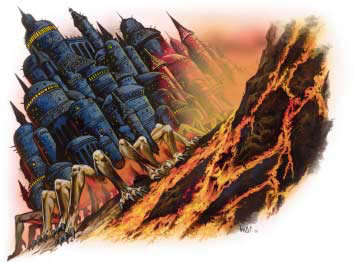
While no strict hierarchy exists in Gehenna and no deities truly rule it, there are bands of Chthonic lords and self-titled princes that make their home there. Many of these Chthonians are of near deific power, able to mold the land around them. Others yet are simply strong and cunning Chthonians. Many Chthonians pledge their service to such Chthonic Lords, working on their behalf and by their orders, at least so long as this relationship serves them as well. Some of these Chthonic Lords have created moving citadels for themselves, massive castles held aloft by thousands of massive fiendish arms.
A quartet of the most powerful Chthonic Lords are the Four Horsemen. Each represents the physical personification of one of the four concepts of apocalyptic events: War, Pestilence, Famine, and Death. Only four Horsemen exist at any given time, and Horsemen can and have died and been replaced, slain by vengeful gods, Chthonic Lords, challengers from within their own courts, or even — in rare cases — their fellows among the Four. Among the Horsemen, only Charon, the Horseman of Death, rumoured to have been a Saint of Kelemvor, has held his position from the beginning. The Horsemen have reached such power in Gehenna that they are near deific.
Other Chthonic Lords include:
The General of Gehenna
Fraz Urblu
Malcanthet
Origins of the Chthonians
The origins of the first Chthonians are shrouded in mystery. Some believe the Chthonians were once followers of Asmodeus who not only rejected good, like the devils, but also rejected law. Thus when the fiends were thrown into Baator, the Chthonians formed their own home in Gehenna. Others believe the Chthonians were formed by the original Four Horsemen, truly ancient beings of evil, predating Asmodeus' fall from grace. A third belief holds that the Chthonians are rather a mixed race of those Devils and Fiends who rejected law and chaos in pursuit of pure evil itself. The pragmatic secrecy the Chthonians hold in place seems to exacerbate the uncertainty about their origins, no doubt serving the Chthonians.
Even the nature of the creation of new Chthonians comes with a certain level of uncertainty. Devils are formed of lemures, the husks of damned souls, slowly working their way up the ranks. Demons are formed by their corruption of humanoid souls. Meanwhile, the details of Chthonic propagation is largely unknown and is a matter of academic discussion. Gehenna itself does not draw damned souls, and such will not spawn beings from them. And its nature is far too stable for chaotic production. One theory holds that as part of their payment for mercenary service in the Blood War, Chthonic Lords demand souls from the Devils to turn into new Chthonians. Another theory, which assumes that Chthonians are the result of mixing between Devils and Demons, holds that Gehenna has infused its fiends with the power of sexual reproduction. A third theory holds that there exists more layers beneath the lowest layer of Gehenna in which an unknown source spawns the Chthonians.
Chthonic Traits
In terms of appearance, the Chthonians hold far more of a unique form than most devils and demons. While devils are reformed when promoted and demons ever mutate, the Chthonians primarily retain their form as their abilities grow stronger. Many Chthonians appear perfectly adapted to the task or environment they exist in. They embody both devilish and demonic features. Some appear beastly and animalistic, while others like beautiful humanoids.
Though varying individually, certain categories of Chthonians can be described.
Hags. Hags are foul and deformed witches, appearing as hideous old crones. They use their magical powers and potioncraft to pursue their own twisted and mysterious designs. Hags are known to offer bargains to people in difficult situations, but twist their promises in petty and malicious ways to destroy the one that sought their help.
Mariliths.
Succubi/Incubi. Succubi are beautiful fiends who seduce mortals only to drain their life force.
Hydrogoths. Amphibian Chthonians and the only beings immune to the river Styx, these Chthonians traverse the waters collecting the memories stolen by the river.
Merren. The pilots of the river Styx, these Chthonians are one of few beings capable of traversing the deadly river running through the lower planes, loyal only to their boats and the high price of passage. They appear as pale, emaciated humanoids wearing rotted, hooded robes and burial wraps, their eyes glowing red.
Yagnogoths. Humanoids of 10-15 ft. with red skin. Their left arm is monstrously large while the other is weak and puny. The yagnogoths work as the scribes and negotiators of the Chthonians, adept at drafting contracts for most other Chthonians and mercenary companies.
Nycagoths. These strong flying Chthonians are sought-after mercenaries, 8‒9 ft. tall and heavy. With tough, leathery red or green skin and thick muscles on their two to four arms and a horned head, these Chthonians most resemble other fiends and strike fear into their enemies.
Arcanagoths. These great scribes, sly and greedy for information and arcane power, resemble tall humanoids with the heads of fanged jackals, dogs, or foxes. At least when not disguised.
Ultrogoths. These are known as enigmatic visionaries and manipulative masterminds. Ultrogoths are faceless humanoids with their only features being one to three pairs of eyes like fire opals. They are lithe and slender, standing roughly between 6‒6.5 ft. As powerful mages, they are known for illusion, telepathy, and domination.
Azuragoths. Believed to be one of the oldest lineages of Chthonians, the Azuragoths appear as humanoids with red, pale, ashen, or human-like skin and a pair of wings. Highly unique, some Azuragoths have batlike wings, others birdlike. Some have horns, others perfectly beautiful faces. Some are even said to be four-armed.
Life-Span
Longevity: Immortal
Single: Chthon / Chthonian
Plural: Chthonians
Adjective: Chthonic / Chthonian