There is much talk about the people of Ekh Oron (or Vetus Mundi to Osterrans). As the Osterans become more curious about the native nomads of this land. The text written will contain the histories and customs about the various tribes as an appeal to the Osterrans who have recently become more curious about the native nomads around the strange new Western lands.
~Vidar Khan
Out of game notes: The Nomads of the New continent are inspired by the nomadic groups of history; such as the Huns, Scythians, Tartars, Merkits, Mongols, Cumans, Gokturks, etc.
Contents:
Nüüdelchid - The Nomads and their customs
One of the oldest groups in the “new” continent are those of the nomadic horse people who roam the plains of the world. There are many different pastoral nomadic tribes in the continent. All of whom speak a multitude of various different dialects.
Many of the horse tribes in the continent have combined into confederations to assist in each other's survival against the dangers of Vetus Mundi, or as they say Ekh Oron. Two of the most significant confederations are named Merghits and Arghans. Although their cultures are similar, they differ in many critical ways. The southern and more savage of the two, the Arghans, dwelled in the barren lands of the continent on the eastern side of the Khusagaan mountains. These desert nomads are in lesser numbers and poorer than their Northern Cousins; some clans speak a different, more ancient language than the Merghits. Most Arghans are raiders and mercenaries.
The Merghits are the Western most and more numerous of the two groups and have mixed in with various other peoples. The Merghits are seen as more reasonable than the Arghans and are often merchants and pastoralists, trading with towns and cities. Both Arghans and Merghits are great warrior class people who are often bought utilized as elite mercenaries by other factions and kingdoms.
Three generations ago there was a war between the Arghans and Merghits which ended in a fight known as The Battle of the Great Winds,. The battle led to the death of half of the populations of both sides and scattering the remaining survivors. Since then most nomads roam freely, raiding small villages or trading with other merchants as the individuals see fit.
However, the nomads seem split when it comes to the opinion of other factions in the continent like the corsairs of nuln, Knights of Valon, dwarves, orcs, and elves. One thing all tribes agree on, is that other civilizations can be a great source of income. Some tribes like to raid them while others like to trade with them. At times nomads raiding a village will face off against nomads paid by a faction to defend the same village. A few intermingle with other peoples. Most other factions look down upon the nomads and their way of life. The opinion varies with each nomad.

Nomad Religion and beliefs
Most of the nomads are environmentalists who practice shamanism. Their main tenants include:
The spirits of nature and our ancestors inhabited the world. When a person dies their spirit is lifted and joined with the spirit of their ancestors in the Blue Sky. Sometimes the spirit of the ancestors are brought down to help guide their kin. Shaman elders are needed to help clarify and read the signs given by the spirits.
The Great Sky Bird and the Mother Wolf are the greatest of all deities. The Great Sky Bird is the greatest god and noblest of all Deity who looks over all the world. The Mother Wolf is believed to have adopted two children in a cave, Merghai and his sister Arghai who would go on to create the tribes of the Merghits and Arghans. The Wolf taught them to survive and ever since then the wolf has been a respected part of nomad culture.
The folk story of Arghai and Merghai says that the first humans were taught by the great mother wolf how to hunt. It is a famous story told by the tribes describing how humans learned how to hunt.
There is a balance of good and evil spirits in the world and the nomads respect this balance. Where there is good there is bad and where there is bad there is good.

Life style
There are numerous nomadic tribes around the Western Continent. These tribes migrate seasonally to various areas where their domesticated animals can graze and feed. These animals include mostly sheep, cattle, yaks, camels, and of course horses. The nomadic culture of the Arghans and Merghits are very similar as both live harsh lives in the steppe. These groups would often fight each other and themselves, mostly over territory.
Social structure and hierarchy
Where there is a clan, there is a leader. And in the culture of the nomads, chiefs are held in the highest respect as they are responsible for the well being and success of the group. However, when a leader is seen as unfit to rule by the clan, the people have the right to oust the leader and replace them with a new one or leave to serve a new clan. A leader is picked in a semi-meritocratic way in that the successor is picked based on who is the best-qualified and most competent candidate, rather than picking a blood relative of a previous chief. This could mean a simpler herder could rise to a chief if they were the most qualified. But most often leaders were selected from among members of a chiefly house.
A clan leader is called a Noyan. Groups of clans make up one tribe which is led by a Khan, to which Noyan’s pay homage to. Both men and women can hold the position of a Noyan or Khan..
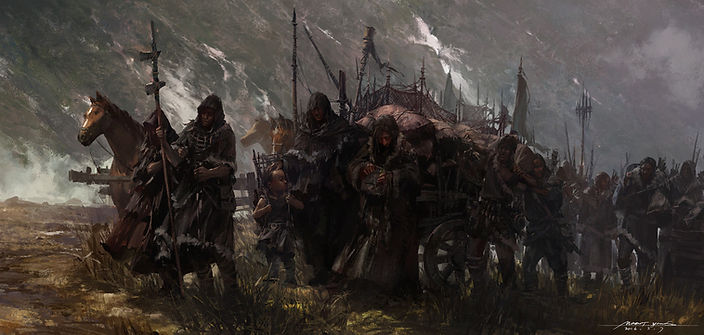
Vidarian Khanate
As a child the Khan’s given name was Baidar, but was later changed to Vidar after being called that by other people on his travels. The Vidarians were a small clan of the Merghits whose people struggled for generations. Vidar’s grandfather was one of the great leaders that fought in the great battle between the Arghans and the Merghits. For years they have been pushed to the brink of starvation, shunned by other clans and peoples who would not bat an eye to their suffering.
Seeing the suffering of his people, Vidar exiled himself to find answers to help his people. Vidar used his skills as a warrior to serve as a mercenary, even serving as a mercenary in the continent of Osterra for some time. It is said that he arrived in Osterra after falling through a latrine hole. After gaining riches from his time as a mercenary across the sea, Vidar decided it was time to return home and spent around a year to find a way to get back to his people. He returned to his tribe as a hero. Now wiser in the ways of leadership and the world around them, Vidar was ready to lead his clan as his ancestors did.
Gaining much renown, several clans either allied or pledged allegiance to the house of Vidar. Not just of his own culture; but of other faiths and cultures. He allowed other faiths and cultures to flourish in his lands as long as they prayed for the success of the khanate (kingdom). He states, “I care not for what gods a person worships in their yurt if I can hunt with them afterwards.”
Many tribes despise Vidar’s acceptance of foreign faiths and cultures saying that it would corrupt and anger some of the spirits, bringing unknown horror onto the lands. Other tribes are just jealous of the Vidarian’s wealth and power, raid around the lands of Vidaria in hopes to hinder the power the young Khan has.

The History of our great empire
It is known among the peoples of these lands that there once ruled a great empire centuries ago called the Kazarkat Khanate. This empire spanned almost all of the continent led by the great leader named Bataar Khan. Accounts vary as to how the empire fell. Some say after his death, Bataar’s sons waged wars with one another over who should rule the kingdom. Others say it was due to cataclysmic events that destroyed the empire. Whatever the case, Bataar remains as one of the most respected and praised figures even among other peoples.