“I don’t want your gold, laddie! Come, help us pull in the harvest before break-hour and you earn yourself a warm bed and good meal. Sovereigns will it, we’ll be home at dusk.. and then it’s sandwich time!”
-Ludd Slumberhill, Zlathin Farmer
Mosa-Zlathi is a massive outstretch of fertile floodplains/grasslands, covered in its totality by farmlands. Three great rivers bring freshwater from far northern mountains and nourish said farmland till their estuaries meet the ocean in the far south. The Sovereigns Rehamon and Kematuk -two benevolent, godlike and gargantuan Elementals of Storm and Nature- rule the land and have successfully maintained peace over the land since the dawn of time. Inhabitated by workaholics who consider smoothies, sandwiches and (student)noodles the most elevated culinary accomplishment on the entire planet. The rest of the world sees their accomplishments as absolute culinary warcrimes, except for one thing; Mosa-Zlathi being the world’s largest -and cheapest-exporter of alcohol.
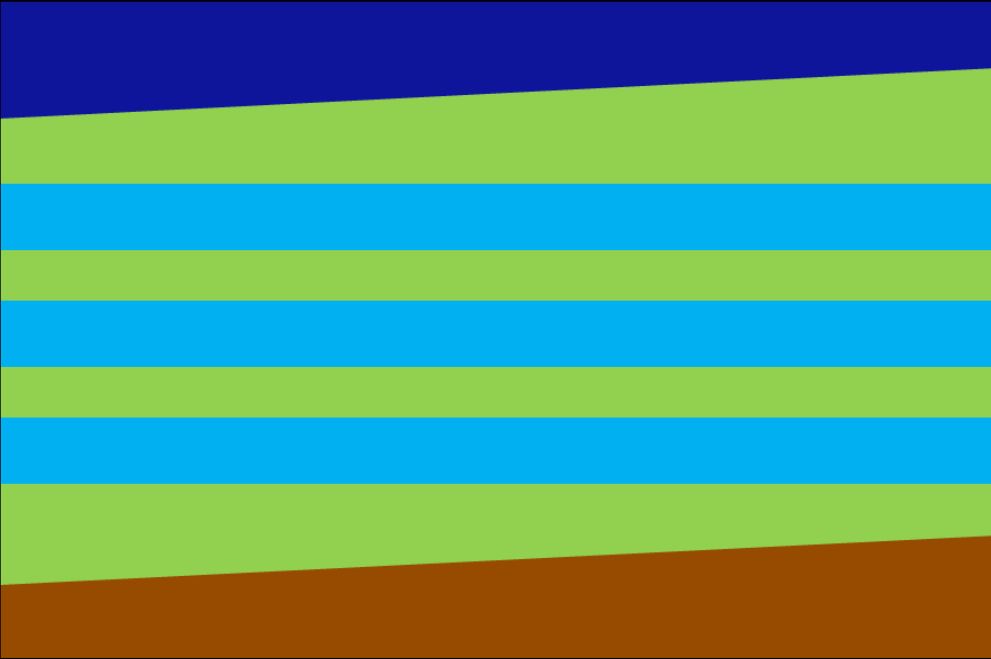
“Work hard, lunch hard!”
-Zlathi motto
The Twin Sovereignty of Mosa-Zlathi
Right between the eastern mountains of the Orgûllian Kingdom and the Northwestern naval territories of Playa da Fausolia lies a wide stretch of cultivated floodplains and nutritious grasslands called Mosa-Zlathi. Receiving fresh water from three massive river estuaries and blessed by ancient magic applied daily by two benevolent landgods, the smallest nation on Domus produces roughly 2/3 of the entire continent’s edible commodities.
Providing both the Dragon Triad Emirates, the Kingdom of Orgûll and the Yu-Shu Dynasty with an overflowing supply of food, and the pirate of Playa da Fausolia with a substantial amount of alcohol, has caused most of Domus’ inhabitants to view Mosa-Zlathi as the Breadbasket of the world. Controversially, they are also widely considered to have the worst cuisine.
"In fields we work~ in rain we dance~ in lunch we feast!"
Government
The Twin-Sovereignty
Two immense elementals called the Sovereigns rule over Mosa-Zlathi. Each holds the scepter of rule for exactly 12 hours per day, exchanged at dusk and dawn. The nature elemental Rehamon overlooks all of Mosa-Zlathi during the day; the storm elemental Kemetuk controls the nation during the night.
Too massive in size for thrones and detailed vision, the Sovereigns delegate their micromanagement to the Equinox (more colloquially known as Fragments of Night and Day), mortal Zlathins who are manually chosen by Rehamon and Kematuk to rule locally in their stead, with Wellspring as the capital, Nahaya Al-Nahr the nation’s only port, and Lummelhill as the religious epicenter of the land.
Fragments rule for 10 years in teams of four, consisting of two Day- and two Night Fragments. After their rule, they advise their successors for another ten years, and then may choose to either return to their previous farming lives, or join the Lummelhill Clergy, the nation’s diplomatic wardens and ambassadors.
The Cycle of Night and Day
Rehamon and Kematuk follow a cycle that dates back to the dawn of time itself, although its occurrence saw an extreme increase after the Dragon Wars. What used to be an event seen once every century, has become a cycle that can be witnessed daily when visiting the nation of Mosa-Zlathi, as the landgods tirelessly carry out their mysterious gargantuan labor. It is a cycle of renewal and healing, perfectly timed to the last second. At dawn, Rehamon wakes by the sea at the furthest outstretch of Mosa-Zlathi, where he burrows into the ground like a gargantuan mole, pulling along a sleeping Kematuk.
From there, a landwave visible from the heights of dragonflight moves ever towards the western mountains, infusing farm- and grassland with druidic energy to instill absurd growth and augment already abundant harvests to monumental quantities. Once Rehamon arrives at the foot of the Skybreakers –the Zlathin name for the eastern Orgûllian mountains, he falls into a slumber near Wellspring, waking up Kematuk in the process. At dusk, she lifts up his spiritual body upon the storm she embodies, and travels back to the distant sea, delivering a downpour of healing rain to all of the land, curing all that bathes in it of disease and blight. On the minute of dawn, she arrives at the easternmost coast, falling into slumber in the cradle of Rehamon’s claws.
A break of the Cycle
When the cycle breaks, a historic documentation.
Before the council of eight pirate's controlled and sailed the archipelago of Playa da Fausolia, a now extinct nation nested on it that sought to conquer Mosa-Zlathi for themselves. When its armies landed on the shores of the estuaries, the Sovereigns responded not with war but with fear, and went into hiding; burrowing deep underground, and drifting out over the far oceans to the northeast. The nation –its name forgotten or struck from history- occupied Mosa-Zlathi for all of three days, before departing the peninsula after losing eighty percent of its entire army in the blink of just one (day).
Famine, coldfire, blight and any known violent disease had obliterated food reserves and soldiers alike, as if the land itself wished to destroy all that walked upon it. The survivors claimed a dark power had taken hold after they so foolishly scared off its holy protectors, and swore to never set foot on the accursed grounds again. Yet when the last foreign soldier left the borders of the presumed doomed nation, the Sovereigns returned and resumed where they had left off. Within less than a day wealth and health returned, forever reminding all neighboring nations why Mosa-Zlathi doesn’t need a standing army, and why invading it will always be more costly than simply doing trade.
When the cycle breaks, a story of ancient myth.
Historians however debate whether there may have been another time in which the cycle was uprooted, long before the invading nation even existed. The cause of this debate lingers to this day upon the highest peaks of the Skybreakers, where Aarakocra, Dragonlings and winged Tieflings claimed to have seen the carcass of a Black Greatwyrm, in size the twin of the Dragon Triad, its back broken and its acidic blood seeping into the very rock it rests upon.
The Zlathins call the afflicted mountains Azam Al-wahsh; the Blackened Bones. The story goes that during the Dragon Wars this Black Greatwyrm had come to Mosa-Zlathi to claim the lush lands as his own territory, but soon met with the Sovereigns. The myth would have you believe that unlike in the more known story where they fled, the Elementals responded with primordial rage and waged war against the Wyrm, ultimately ripping the beast from the skies and throwing it down upon three lethal spires of the Skybreaker mountains, tearing off a complete wing, breaking its back, and finally rendering it stuck until it bled to death.
Unfortunately the spires upon which it rested were also the spires from which three great rivers sprung, and thus the beast’s poisonous blood was soon spread to the furthest reaches of the peninsula, rendering it less hospitable to life than Biem crater today. Presumable this is the actual reason why the Cycle of Night and Day saw such an extreme increase during the Dragon Wars, and why the Sovereigns are so relentless in pursuing it. Nobody really knows, but it makes for a great tourist attraction, and Wellspring makes gold bricks off it every year.
Landmarks
Tarik al-Amlaq, the Giant’s road.
The three rivers that bring water from the western mountains to the eastern shores all share the same title, namely the ‘Giant’s road’, as it is believed that Rehamon and Kematuk use the rivers as pathways during their cycles.
Wellspring, the capital.
Resting at the feet of the Skybreakers lies a terraced city. The three rivers from here, hence the name of the city. Roughly one mile before it enters the city, water is contaminated and deadly. In the city it is purified by the magic of the Sovereigns where turns the purest. Wellspring is the capital of Mosa-Zlathi, and is the spiritual throne of the Sovereign Rehamon.
Lummelhill
At the perfect center of Mosa-Zlathi lies a small town populated mostly by Ghostwise Halflings, supposedly the descendants of the first Halfling Tribes to settle the great floodplains, and equally the suspected founders of the twin-faith of Day and Night, a major religion in the Bread-Basket. Lummelhill is also the location of the Twin-Temple, a sun- and rain-temple dedicated to respectively Rehamon and Kematuk.
Nahaya Al-Narh, the port.
At the mouth of the estuaries lies Nahaya Al-Narh (River’s End), Mosa-Zlathi’s largest port. It notably lacks large wooden ships, as the nation lacks the crucial resource called ‘trees’ to make them. Instead, Zlathin seavessels are thatch Trimaran, rafts and canoes. Nahaya Al-Narh also sports a division of the A.R.C; the Agricultural Research Collective, a group of researches looking into all matter of agricultural scientific developments, ranging from augmenting existing seeds to rejuvenating deserts to fertile grounds.
Absolute Hazard Landmarks
Azam Al-wahsh / The Blackened Bones.
High atop the Skybreakers the carcass of a great Blackwyrm lies punctured on the peaks, its petrified claws reaching out the sky, and a hateful glare still there in its dead eyes. Not unlike Biem Crater, the peaks and nearby airspace are hostile to all life, with the exception of few elementals and some brave –or very stupid- adventurers. Its acidic blood has seeped into the spires themselves rendering them black, bent and crooked. The water that seeps from these mountains is murky and spoiled until it reaches Wellspring where the magic of the Sovereigns purifies it to a drinkable and harmless quality.
Ecological Dead Zone
Roughly six miles from shore to deep sea, the naval waters of Mosa-Zlathi have become the dumping grounds of the acidic and poisonous blood the Sovereigns filter out of the the land and rivers. Unfortunately they didn’t include their naval waters in the cycle, and so the entire underwater region is as lifeless as a wasteland, safe for encroaching merfolk tribes putting in great effort to terraforming the deadly waters.