A Brief History of the Kingdom of Keoland (to 576 CY)
Keoland: A Realm of Legacy
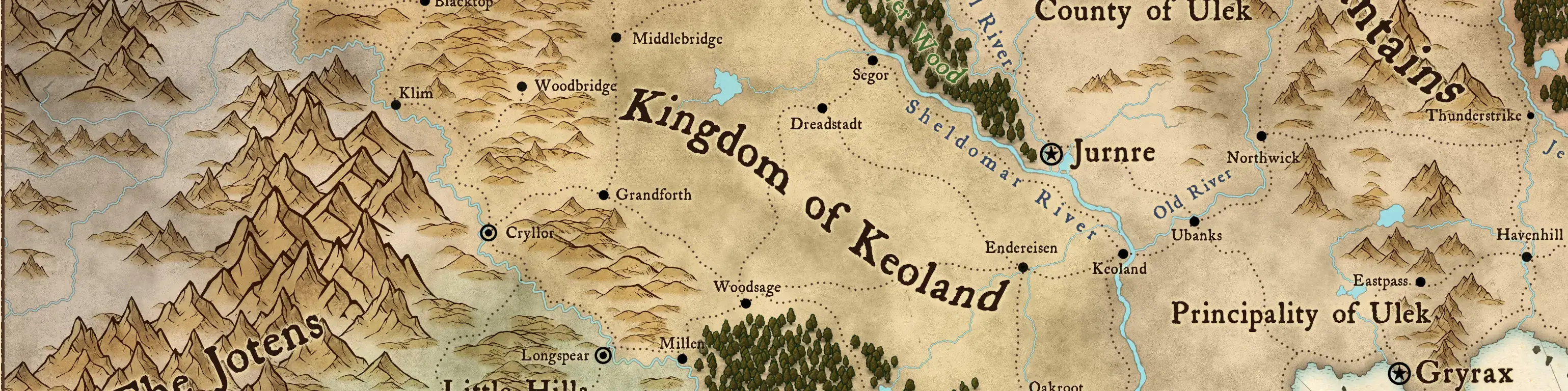
Keoland, the oldest continuously ruled human realm in the Flanaess, boasts nearly a millennium of unbroken succession. Located in the Sheldomar Valley, it has evolved from a modest alliance of noble houses to a major regional power. Its history is defined by cycles of expansion, consolidation, and recovery.
Ancient Origins
The region that would become Keoland was once part of a prehistoric Flan empire, whose artifacts—tomb paintings and bronze weapons—hint at a sophisticated culture. By -485 CY, peaceful Flannae tribes had spread across the Sheldomar Valley, but dramatic changes came with new migrations.
During the catastrophic wars between the Baklunish Empire and the Suel Imperium (-485 to -447 CY), Suloise refugees fled eastward over the Crystalmist Mountains. Among them were the noble houses of Rhola and Neheli, who settled in the valley and founded cities such as Gradsul and Niole Dra. These settlers clashed with native Flan populations and incoming Oeridian tribes but eventually forged alliances and expanded their domains.
Founding and Early Expansion (-342 to 250 CY)
Keoland was officially established in -342 CY as an alliance between the Rhola, Neheli, and several Oeridian states. Niole Dra became the capital, and Nyhan I of House Neheli was crowned the first king. Early rulers, such as Malv the Defender and Lorgyr the Seer, focused on consolidating the Sheldomar Valley. By -242 CY, the kingdom’s borders resembled their modern extent.
Keoland’s growth during this period was steady and often achieved through peaceful annexation. The Yeomanry joined the kingdom while retaining its unique democratic traditions. The Ulek States (Dutchy of Ulek, County of Ulek, and Principality of Ulek) allied with Keoland to address shared threats, particularly from humanoid incursions and the dangers posed by the Pomarj. However, these alliances emphasized shared governance rather than direct annexation.
The Imperial Age (287 to 453 CY)
In 287 CY, Tavish I of House Rhola ascended the throne, inaugurating Keoland’s imperial age. Known as Tavish the Great, he expanded the kingdom’s influence through diplomacy and conquest. By 356 CY, Keoland’s reach encompassed most of the Sheldomar Valley. However, his successors, particularly Tavish II, pursued aggressive policies that led to internal strife and resistance.
The reign of Tavish III (414–453 CY) marked the decline of Keoland's imperial ambitions. Efforts to expand northward and suppress the growing power of the Sea Princes culminated in the disastrous Siege of Westkeep, where Tavish III was killed. In 453 CY, the Yeomanry and the Ulek States (Dutchy of Ulek, County of Ulek, and Principality of Ulek) asserted their independence, formally breaking away from Keoland’s direct control.
Azure’s Tide (434 to 464 CY)
The conflict known as Azure's Tide epitomized the struggle between Keoland and the Sea Princes, lasting over three decades. Beginning in 434 CY, pirate raids escalated into a full-scale conflict. The Sea Princes, united under a common banner, seized key locations like Port Toli, Westkeep, and Port Monmurg, disrupting Keoland’s southern territories, forming the Hold of the Sea Princes.
Keoland’s efforts to reclaim control peaked with Tavish III’s campaign, culminating in the Siege of Westkeep in 453 CY, where he met his end. The turning point came in 464 CY at the Battle of Jetsom Island, where Keoland’s navy dealt a significant blow to the pirates, sinking their flagship, Sea Prince. Although the Sea Princes remained a threat, this victory shifted their focus toward exploration and the slave trade along the Amedio Coast. Keoland fortified its maritime defenses, particularly in Seaton, to deter future threats.
Decline and Stabilization (488 CY to Present)
The late imperial era marked a retreat from expansionist ambitions. The reign of Tavish IV concluded in 488 CY without an heir, ending the Tavish dynasty. The throne returned to House Neheli, whose rulers prioritized internal stability over foreign adventures. Nyhan IV’s reign (488–510 CY) focused on recovery from the costly imperial campaigns.
By 576 CY, under King Kimbertos Skotti, Keoland is a key power in the Sheldomar Valley, renowned for its long history, thriving trade, and cautious governance. Known as “The Commoner”, Kimbertos has sought to bridge the divide between Keoland’s noble and commoner populations. The events of Azure’s Tide remain a reminder of the perils of unchecked ambition and the ongoing challenges of maintaining control over the southern seas.