Ancient Foundations
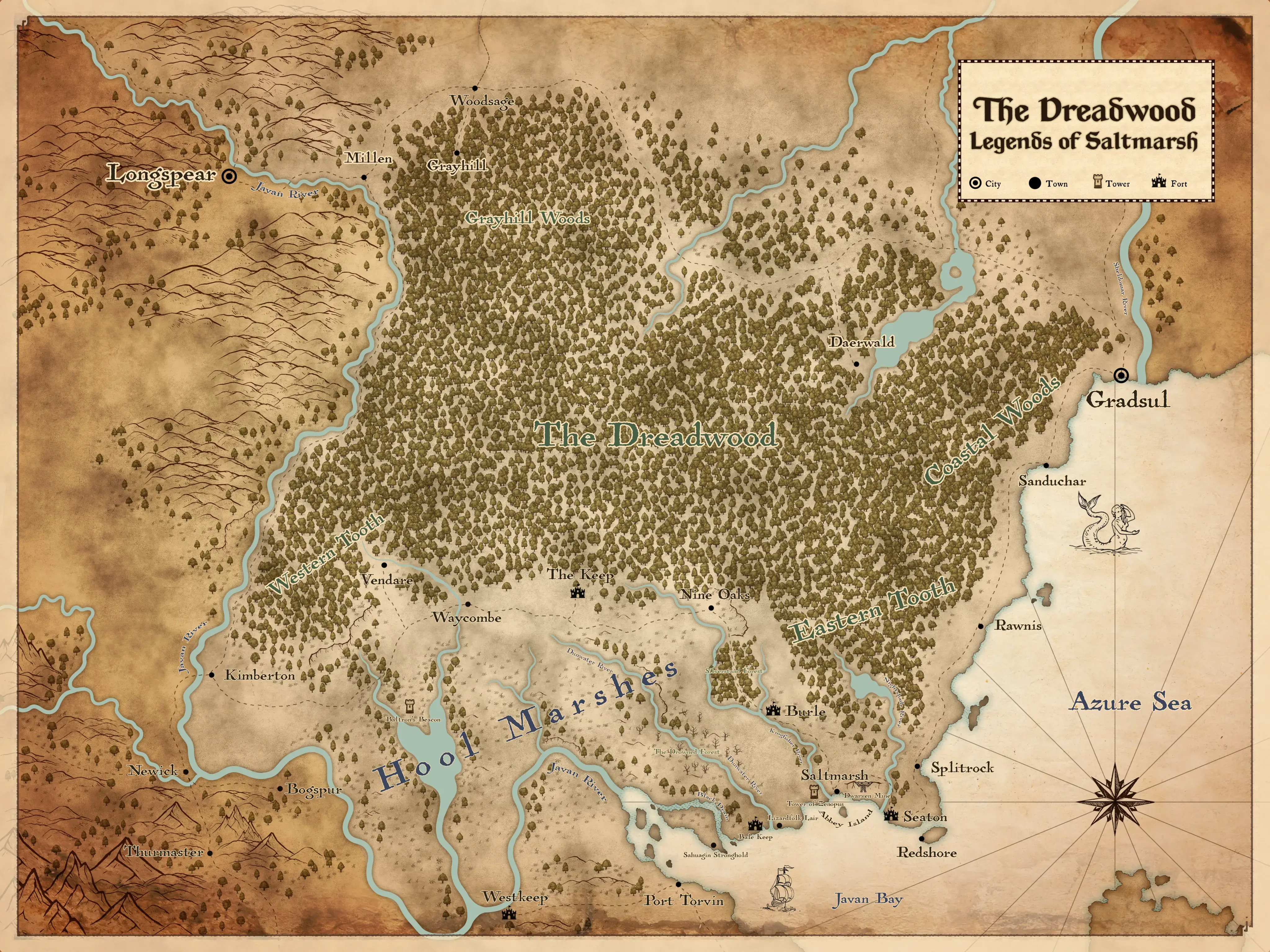
The ruins scattered west of the Kingfisher River indicate that the area was once home to an ancient civilization. Over time, these remnants became a silent backdrop to the bustling fishing village that grew on the eastern bank. Known as Saltmarsh, the village thrived quietly for generations, shaped by its proximity to the marshes and sea.
Azure’s Tide (434–464 CY)
Saltmarsh gained prominence during Azure's Tide, a protracted conflict between Keoland and the Hold of the Sea Princes. The town served as a vital supply hub for Keoland’s naval and ground forces, particularly during the Siege of Westkeep in 453 CY. The strategic importance of Saltmarsh brought King Tavish III to the town, solidifying its role in the war effort.
Following an unofficial truce in 465 CY, Saltmarsh was officially incorporated into the Viscounty of Salinmoor. Recognizing its value, the kingdom fortified the town with defensive walls, barracks, and a garrison, making it Keoland’s southernmost defended outpost. This marked a turning point in the town's history, establishing it as a critical military and economic asset.
The Plague of 496 CY
The year 496 CY brought devastation as a plague swept through the Viscounty of Salinmoor, claiming over 30% of Saltmarsh’s population. The disease’s impact was so severe that the garrison abandoned the town, leaving it vulnerable for five years. This dark period tested Saltmarsh’s resilience, as survivors struggled to rebuild amidst fear and loss.
The Witch Hunts (501–502 CY)
Fear and suspicion, fueled by the memory of the plague, erupted into the Salinmoor witch hunts. Many blamed the disease on dark magic, turning their anger toward the town's elven, halfling, and gnome inhabitants, who were associated with druidic pagan practices. These non-human residents fled to the safety of Silverstand and the Dreadwood, leaving Saltmarsh scarred by intolerance.
A tragic incident involving a half-elf fisherman, unjustly accused of witchcraft and executed, ignited a revolt. United in outrage, the townsfolk drove the garrison out in a bloodless coup. By 502 CY, the witch hunts subsided, and Saltmarsh began a slow process of healing.
Formation of the Town Council
In the aftermath of the witch hunts, the townspeople demanded self-governance. A town council was formed, with one seat reserved for a garrison representative to maintain ties to the Viscounty of Salinmoor. Decisions affecting Saltmarsh were now made democratically, though control reverted to the garrison during times of war or crisis. This balance of power fostered a new sense of autonomy for Saltmarsh.
Emergence of Factions
The establishment of the town council gave rise to two factions:
Traditionalists: Advocates for preserving the town’s customs and resisting outside influence.
Loyalists: Supporters of Keoland’s authority and the garrison’s presence.
The rivalry between these groups continues to shape the town’s political and social dynamics.