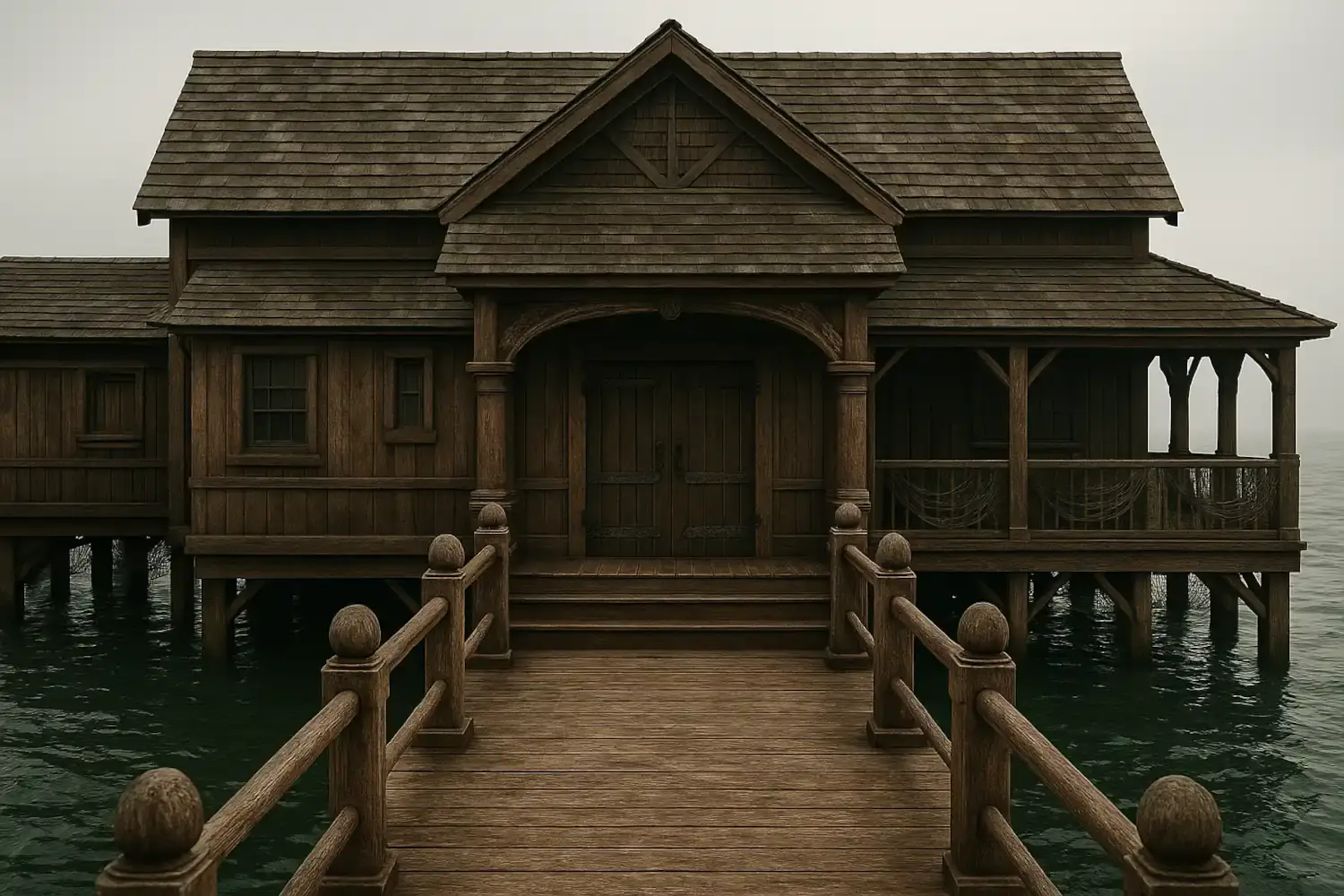
Fishmonger Plant - 1st Floor
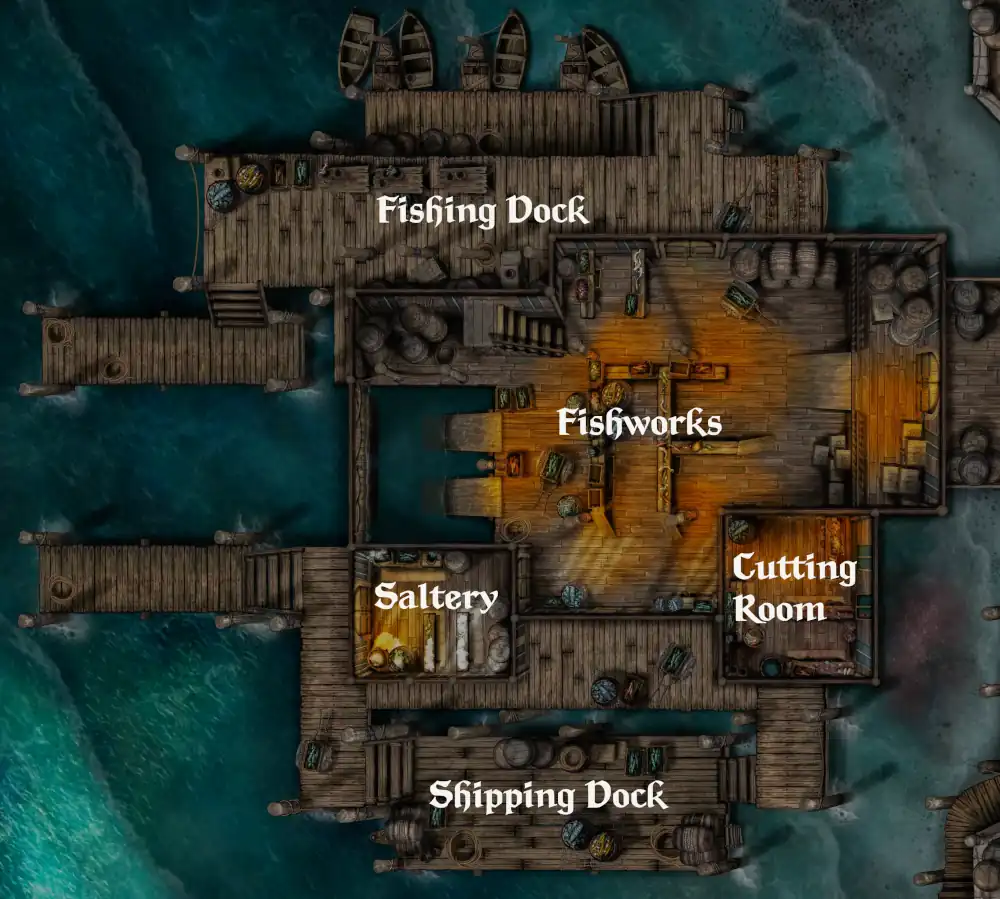
Fishworks
The smell of fish is sharp, salty, and overwhelming. The wide hall bustles with activity. Several long tables dominate the center, where workers in stained aprons sort the day’s catch by size and species, tossing fillets and whole fish into waiting baskets and barrels.
Along the north wall, rows of stamped barrels are stacked to the ceiling. On the far side, two wide ramps descend directly into the water, slick with brine and scales, used for hauling fresh catches straight into the hall. A half-dozen workers move with practiced efficiency, calling out weights, species, and orders as they work.
The Briny Barrel Fishery
All barrels are marked with the guild’s crest and name: “The Briny Barrel Fishery.”
This mark is well known across the Keoland coast—especially in Seaton and Gradsul—where Saltmarsh salted fish is a staple trade good.
Who’s Here
Donall Oweland is often on the floor, barking orders, helping haul barrels, or checking quality.
Gitta Primewater may be present with her ledger, overseeing inventory, weighing shipments, or quietly evaluating the crews.
Either one can be encountered depending on the time of day.
Random Encounter
Saltery
A sharp briny scent hangs in the air. Along one wall, rows of barrels stand ready, while a long table holds tubs of brine and heaps of coarse salt. Fresh fish are dipped, salted, packed tight, and sealed into barrels with heavy mallets. You see two workers here, their aprons dusted white with salt, intent on their tasks.
The Saltery is kept locked whenever unattended. The two workers inside immediately stop what they’re doing if strangers walk in and eye visitors with obvious suspicion.
Secret Loyalty: Both workers are quietly on Primewater’s payroll. They monitor shipments, alter barrel counts, and handle certain “special” cargo.
False Bottom Barrels: A careful inspection (DC 16 Investigation) of the finished barrels reveals that some contain false bottoms, used to smuggle contraband out of Saltmarsh.
Gitta’s Position: Gitta Primewater is unaware that her uncle has begun using the Saltery barrels themselves for smuggling.
If she discovers this:She is furious, not because she opposes smuggling, but because doing it here risks the entire fishing trade and undermines her authority.
She will confront Gellan, insisting that this crosses a line and endangers the livelihoods of everyone in the Fishworks and guild.
Cutting Room
The sharp smell of blood and raw fish fills this cramped room. Two or three workers in stained aprons stand over long tables, rhythmically splitting and filleting fish with practiced strokes. Neatly stacked trays are marked for local sale in Saltmarsh, while others are labeled for transfer to the Saltery. Buckets overflow with heads, bones, and guts, and a cleaning barrel sloshes quietly in the corner.
Hazardous Floor:
The floor is slick with blood, scales, and seawater. Movement requires care, but the workers pay no attention to anyone who enters—they’re too busy to notice or care.Nothing to Find:
There is nothing of investigative value here. It’s a noisy, chaotic workspace dedicated solely to processing fish.Lingering Smell:
If the party spends more than a few minutes inside, the scent of dead fish clings to their clothes and skin. They will smell strongly of fish until they bathe and launder their clothing.
Shipping Dock
The air here smells of salt, tar, and wet rope. Barrels are stacked in neat rows along the edge of the dock, each stamped and ready for transport. Two dockhands move among them, rolling barrels into position and preparing for the next outbound ship. The water is deeper here, dark and quietly shifting beneath the pilings.
Deepwater Dock:
This dock is built for larger vessels. Most days, coastal schooners and shallow-draft traders pull alongside to load salted fish and supply crates.Weekly Brig:
Once each week, a large brig from Gradsul anchors offshore. Longboats ferry barrels back and forth until the hold is full. This is the biggest shipment of the week and a major event for the Fishworks.Primewater’s Influence:
One of the dockhands is on Primewater’s payroll.Gitta knows, but keeps quiet.
She is often present during loading and oversees inventory with meticulous precision, clipboard or ledger in hand.
Routine but Important:
There is little to discover here unless the party watches the loading process closely or questions the dockhands.
Fishing Dock
Small fishing boats row up constantly, bumping gently against the pilings as crews unload their catch. Buckets of fish are hauled onto the dock where workers immediately begin sorting and weighing them, deciding what should be taken inside to the Fishworks. Larger hauls—especially net pulls—are rowed around to the water doors and brought directly into the Fishworks for processing.
Seagulls wheel overhead in a noisy cloud, swooping low in hopes of stealing a meal. Their cries echo across the docks, blending with the splash of oars and the thud of buckets hitting wood.
Always Busy:
This area is almost never quiet. Two to four dockhands work continuously, unloading boats, weighing the catch, and recording totals.Haggling Tradition:
Fishermen keep a close eye on the fishmongers who weigh their catch. Small arguments often break out—part tradition, part pride—but rarely escalate beyond grumbling and posturing.Local Color:
Fishermen here love to talk. They swap stories freely and are eager to share rumors, tall tales, and complaints about the sea, the weather, and—inevitably—the council.