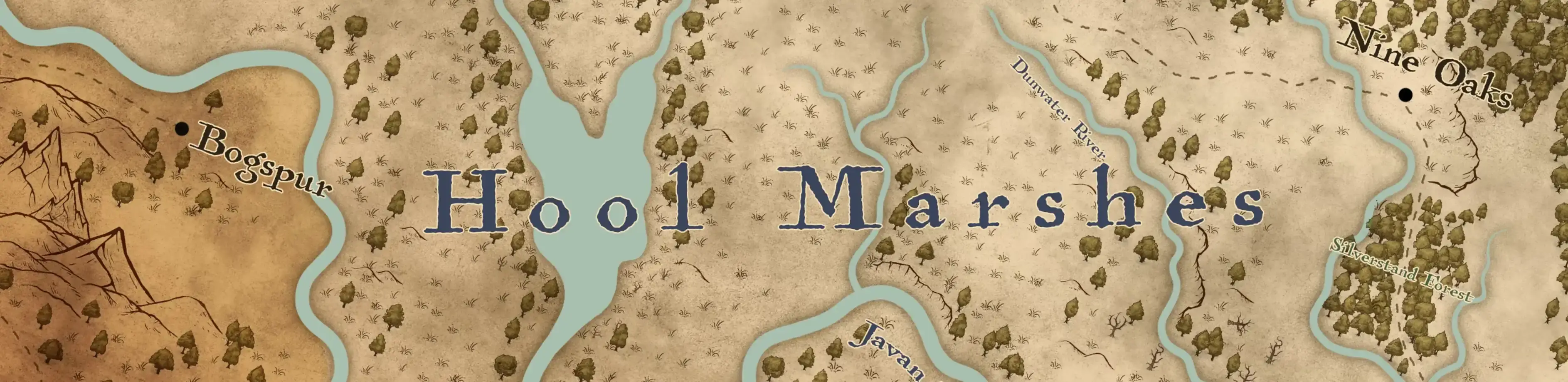
Notable Features

Major Rivers
Javan River – The largest and most powerful river of southern Keoland.
Dunwater River – A slow, winding waterway feeding the eastern marshes.
Black Drain – A foul tributary of the Javan Delta.
Hool River – The heart of the marshlands, sluggish and wide.
Other Areas
Swamps – Dark, tree-choked wetlands filled with insects, decay, and hidden predators.
Bogs – Peat-heavy floating basins where gases bubble up from below.
Marshes – Open, waterlogged reeded plains alive with birds and amphibians.
Fens – Grassy wetlands fed by cold groundwater and mineral springs.
Brackish Waters – Coastal deltas where river and sea mingle, forming shifting tidal zones.
Quicksand Pits – Treacherous, soft patches that swallow the unwary.
Reed Islands – Floating mats of vegetation drifting slowly across the waterways.
Salt Flats – Cracked, gleaming plains near the coast that flood during storms.
Muck Channels (“Dead Runs”) – Narrow, stagnant waterways thick with rot and foul air.
Peat Beds – Ancient layers of compacted marsh matter hiding relics, bones, and buried barrows.
Cypress Groves – Small, elevated stands of moss-draped trees rising from the mire like islands.
Description
The Hool Marsh stretches across a vast, low-lying basin between the Dreadwood and the Hold of the Sea Princes, where two mighty rivers descend from the Tor and Crystalmist Mountains. These rivers spill into a chain of shallow lakes before merging into the Javan River, whose slow and silt-laden waters feed the marshlands.
This sprawling wetland is a labyrinth of bogs, fens, reed-choked waterways, and dead cypress swamps. The air is heavy with the scent of peat and decay, and the ground trembles with hidden pools and sucking mud. The waters are brackish, though freshwater springs and the constant flow of the Javan create shifting gradients of salinity that shape the marsh’s diverse ecosystems.
During heavy winters and spring thaws, the Javan River floods its banks, submerging great portions of the Hool Marsh. Entire stretches of land vanish beneath the waters for weeks, creating temporary lakes and submerged hazards known only to locals and the amphibious creatures that dwell here.
The Hool is home to bullywugs, lizardfolk, giant reptiles, will-o’-wisps, and darker things that hide in the mists. Few humans venture far beyond its edges; even the hardiest hunters and smugglers know the marsh can swallow the careless whole.
Old tales speak of sunken ruins, half-buried druid circles, and temples swallowed by the mire, remnants of ancient peoples who once ruled these lands before the seas rose.