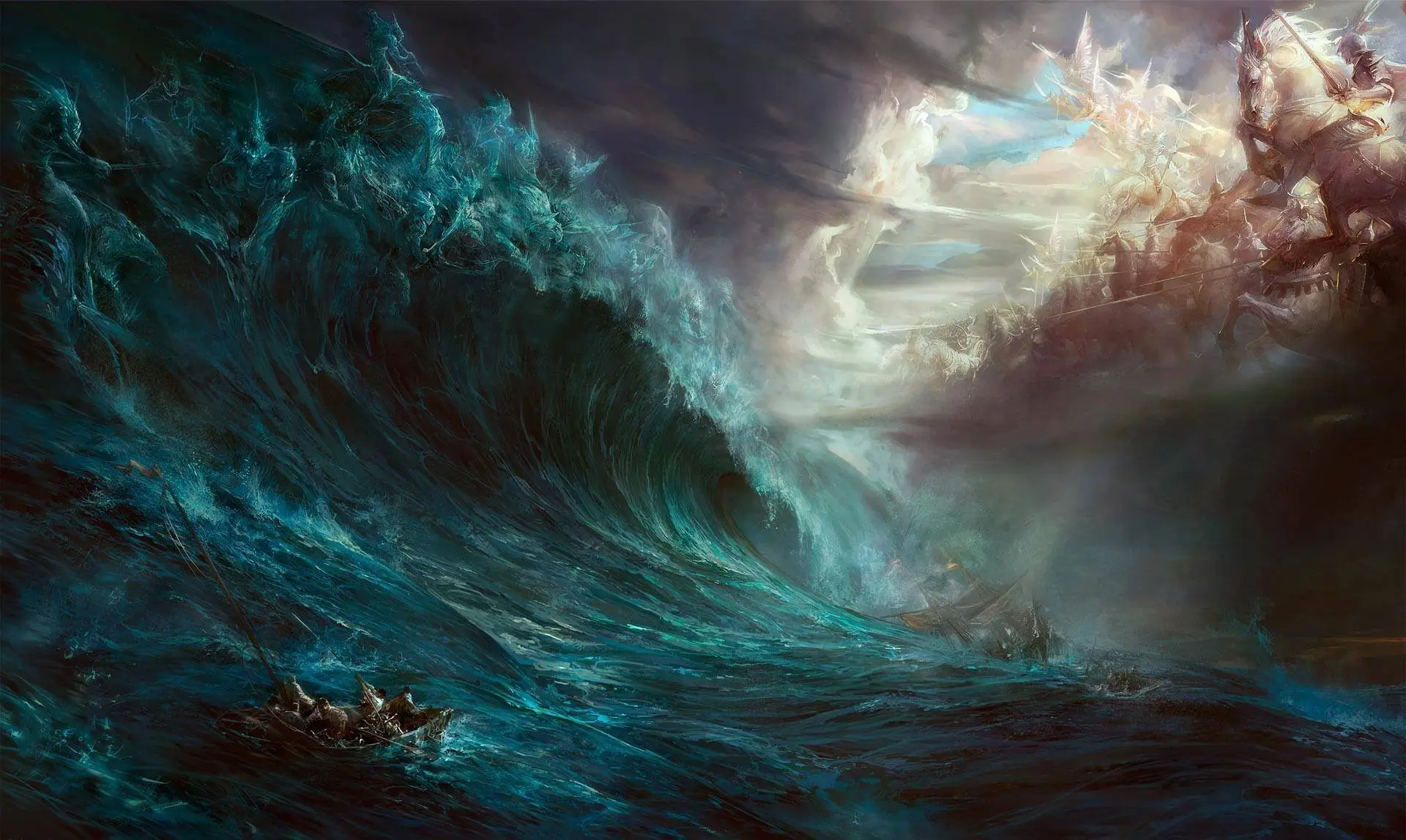
"When the banks of Abyssos burst, all are washed away. Fear not the general but the crone to his right, for that is where you will meet your end. - Melldrit'th, Wizard of the Concilium, 212 AUE
Table of Contents
What is the Abyssos Arcanum?
What can it do:
Abyssos is an endless roaring tide of raw and untamable arcane power, the presence of which can be felt by those who truly listen to the world. Guided by a mentor, or simply cursed by poor luck, one may open themselves to this force and become its conduit—a lethal vessel of its treacherous, addictive magic.
The arcane forces of Abyssos flows best through the living, but can be poured and refined into artefacts through intense rituals and artifice, creating enchanted objects of wonderous abilities. The Helm of Aethelred was rumoured to clasp a frozen droplet of the Abyssos Arcanum itself.
What can't it do:
Despite endless hours, failed attempts and lost wizards, no-one has successfully managed to teleport more than 500ft without serious consequences.
Only in the last century or so has long form communication through The Arcane Confluence been possible, and even now, such methods must be performed by Court Wizards. Before this (even now, among common folk), dove was the primary form of communication; messages would fly attached to the feet of their carriers. This shift of communication power has severely effected certain power dynamics.
What does it feel like:
Mages describe Abyssos not as something they use, but as something that flows through them. A riverbank does not "use" the water; the water shapes its path and flows wherever it desires.
The feeling of casting with Abyssos is that of an almighty rushing feeling, like wind or blood speeding through the ears of the Conduit and into their veins, it flows from their fingertips with a beautiful current.
How does your character cast their magic? How is Abyssos channelled through their bodies?
Arcane Power
Magic in Azure is constantly flowing, a ceaseless swirl within what academics call "Abyssos" and its constant spills into tangible existence.
Arcanum is unstoppable inertia given form, a frothing energy found in the movement of clouds, the ocean's waves, and the blood in veins. It cannot be controlled, but it can be harnessed, much like a farmer redirects a stream.
However, a talented Conduit's skill isn't in redirecting this flow, but in withstanding its immense might—the alternative is to be swept away, a terrible fate called Drowning.
Wizards learn through careful study of the behaviours, movements, reagents and power words required to guide Abyssos; Clerics and Warlocks rely on mightier beings to act as the funnel and they as the conduit of the flow; Bards use the unadulterated power that lies in the emotions of living beings, where the flow is most powerful; Artificers construct careful crystals and devices to stabilise and trap the flow; until a specified and controlled release and Sorcerers have the flow running more potently through their veins, a dangerous condition that can be a curse or a blessing depending on the soul it effects. Druids and Rangers use the flow of Abyssos through all living things to fuel their magic.
Conduits
As lifeblood courses through the veins of the living, Abyssos is the undercurrent of all Azure. Some marked or learned creatures can tap into that raging flow, using their bodies and souls as a conduit for immense power.
All Arcane and Primal Conduits (spellcasters) gain the Arcane Aestaurium feature at the level that they gain the Spellcasting feature.
Arcane Aestaurium
When you cast a spell of 1st level or higher or if you are Concentrating, you begin receive the Channelling condition for 1 minute. While you have the Channelling condition, you experience the following effects:
Compelling Cascade.
If you cast another spell of 1st Level or higher whilst you are channelling, the time remaining on the condition resets to 1 minute.Rising Maelstrom.
For each spell that you cast while you have the Channelling condition, make a Deluge Test.
A Deluge Test is a d20 test with a bonus equal to your Spellcasting Modifier.
The DC of the Deluge test is 10 + 1 for each spell you have cast while Channelling.Turbulent Release.
Each time you fail a Deluge Test, gain one Deluge Level.Rupture.
If you are reduced to 0 hit points whilst you are channelling with a level of 5 or greater, roll on the Consequence Table.
If you die, flip a coin. If it lands Tails, Drown.
Deluge Table
If you cast a spell while you have any number of Deluge Levels, refer to the table below.
The Boon and Bane columns stack to provide powerful buffs and debuffs to your spellcasting, mirroring the power and risk that a Conduit can feel when the Eagre is surging through them.
Deluge Lvl. | Boons. | Banes. |
|---|---|---|
1 | You are affected by the Thaumaturgy spell (no action required) | Disadvantage on saving throws against magical effects. |
2 | When you cast a spell, add your Spellcasting Ability Modifier to one damage roll of that spell. | Decrease your AC by 1 and reduce your movement by 10 ft. |
3 | Flip a coin. If it lands Heads, the cast spell is treated as casted one level higher (if possible). | Flip a coin. If it lands Tails, a different spell with the same level and targeting method (Save, Spell Attack, etc.) is cast at random. |
4 | If a creature causes you lose Concentration by dealing damage, causing you to failing your Concentration Saving Throw, that creature takes Xd6 Force damage, where X is the level of spell on which you were Concentrating. | You automatically fail all saving throws against magical effects and SOMETHING ELSE |
5 | Once per turn, when you kill an enemy with a spell of Level 1 or higher; regain a spell slot of the same level as the spell. | You cannot take the "End Concentration" free action. Additionally, if you are Concentrating on a spell, you cannot cast another Concentration spell. |
6+ | If you are chosen as the target of a spell while the caster is within 60ft, the caster is moved to Deluge Level 4. | Roll on the Consequence Table when casting any spell above 1st level, including the one cast to bring you to this Deluge Level. |
Consequence Table
Result. | Consequence. |
|---|---|
01-50 | Gain 1 Exhaustion Level. |
51-69 | The energy that flows through you becomes too much for your body to handle as another soul near you is dragged into your arcane riptide. The spell "Harm" is cast at the nearest Humanoid as its soul begins to meld with your spells. |
70-84 | While overtaken by the confluence as it surges through you, a part of your soul is taken with it. Reduce your Spellcasting Ability by 1d4+2. |
85-94 | The veins in which the Eagre flows through burst, flooding your extremities with arcane energy. The pain is unrivalled and you are unable to cast any spells until healed. |
95-00 | Your soul is destroyed, leaving behind a husk of your body through which the Eagre flows freely. A violent and confused corpse of pure power. |
Drowning
The existence and possibility of The Drowned is enough to scare most of the population from even attempting magic, and more and more is creating a worrying distaste and distrust for those that practice it.
The danger of becoming swept away in the Eagre is more of a danger for Wizards, Sorcerers and other Conduits, who shape and redirect the Eagre to their desires using their own souls and bodies as collateral. Those that are more of a focus for the arcane power of another entity or source such as clerics, druids or warlocks are at less risk.
Arcane Classes in The Chronicles of Lythran
Wizards
The least common class of adventurer in Lythran is the Wizard. Not because of any weakness of the Flux, but because the practice and teaching of the arcane arts is often a guarded secret and not one oft handed out to the commonfolk.
This does not mean that Wizard Adventurers are not present, just that if they do, they would have likely learned their craft outside of the controlling institutes of the Council Mages.
The most common form of wizard in Lythran are those serving lords and lieges, as it is a powerful position coveted by those in power without the time or talent for arcane studies.
Sorcerers
Sorcerers, known to Azure as the Saturated, are created by some external force and do not study the Eagre like wizards do. Some children for example are born under an uncanny moon with a supernatural affinity to sap from the Eagre, causing havoc even as youths. Some sorcerers are created even later in life however, and whether they be blessed or cursed, some external force has marked them without their knowledge or consent. Either way, their very tendons become saturated with Eagre that can push and pull their body like a puppet to perform arcane feats.
Unfortunately for the saturated; Eagre imbued tendons are powerful alchemical reagents, and some amoral artificers pay generously for fresh specimens.
Warlocks
Warlocks are the antithesis of the Sorcerers of Azure, where the Saturated have an innate connection to the Flux, Warlocks have made an unnatural pact with a powerful being who has gifted them a portion of their power.
Bards
Artificers
The secrets of artifice are closely guarded by the Mountain Dwarves of the Duervin Honurium,
Limitations
Due to the stories I would like to tell in Azure and the tones I would like to evoke, the following spells from 5th edition have been affected in one way or another.
Some more will probably be added to this list, but these are the major ones.
Try to remember that Azure is a soft-magic world, but D&D has a rather hard-magic spellcasting system.
Spell | Level | Limitation | Comments |
|---|---|---|---|
Sending | |||