“Oh how the crow doth watch, doting on mine soul. Let her have it, this body is auld and frail.” - King AetheIred I on his death bed, 281 BUE
Basic Information
The Eight Saints, also referred to as simply "The Saints", is the dominant religion in Lythran.
The Saints are each representations of a specific ideal and factor of daily life, the saints themselves are not deities, but they are the current, past and future icons of them.
The Saints each take the visage of a Martyr from the History of Lythran. These Martyrs have changed over time, with the saints taking new visages when a suitable soul makes a big enough devotion to their patron.
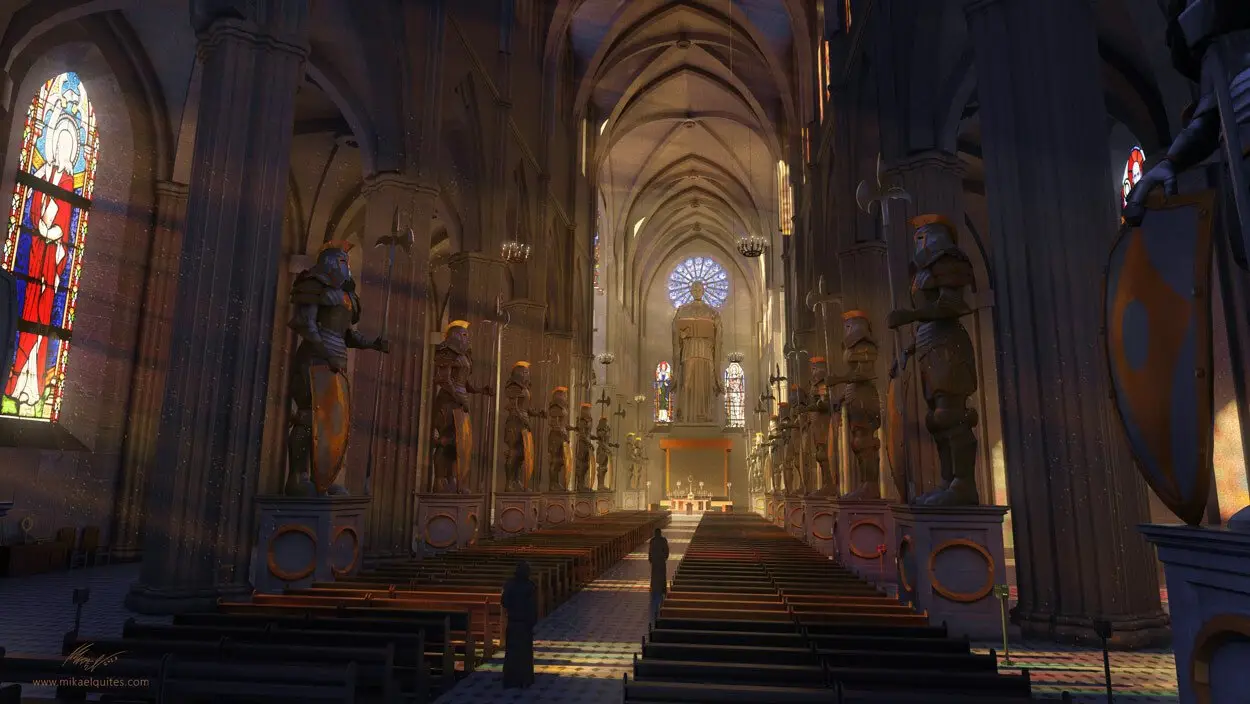
The symbol of The Eight Saints is an eight sided shape; an octagon or shattered star, often with the specific worshipped saint portrayed in its area. The Saint-Halls are holy grounds that pay worship to their eight deities. In the saint-halls, offerings will be left at altars for each saint, whether their visage is a masterfully chiseled statuette, or a crude charcoal image of their symbol, it does not matter.
Saints are often worshipped individually depending on the situations at hand. For example, before battle, a warrior may pray to The Hammer for strength, and his wife may pray to The Shield for his protection. His general may pray to the Scholar for wisdom and after the battle their widows shall pray to The Crow, to wish them onto the next life.
Iconography

Each point of the star represents a different saint;
Saint Cyril the Hammer - Strength in actions.
Saint Ignatius the Shield - Protection from forces.
Saint Andrej the Scholar - Wisdom in hardship.
Saint Kateri the Crow - Peace and burial.
Saint Tomas the Dutiful - Duty to others.
Saint Cecilia the Pure - Innocence of children.
Saint Josef the Just - Justice for wrongs.
Saint Selene the Flame - Passion in life.
Holy Text
Organised Religion
While hypothetically seperate, the Eolder Council and the Church of Eight are inexplicably tied. The Church's laws are
The Saints
The Hammer - Saint Cyril
The Hammer is the saint of strength in actions. They are typically represented by a great warrior, war hammer in hand and with a stern and reserved expression.
While often worshipped in the presence of conflict and battle, they are not limited to physical conflict and strength. If a worshipper is crossing a dangerous stretch of ocean, with a storm approaching, they may pray to The Hammer for strength in the coming ordeal.
The Hammer's visage is that of Saint Cyril, a great hero of old that was said to have knocked Thrala - She Who Slumbers back into the belly of the globe during the age of monsters.
The Shield - Saint Ignatius
The Shield is the saint of protection from forces. They are usually represented by a gentle giant, a harbinger of safety and warmth, Always accomponied by their signiature shield.
The Shield is often worshipped during times of uncontrollable danger, such as during a great storm or before the invasion of an unknown enemy. He is often invoked before undergoing a perilous task, whether crossing a deep ravine or undertaking a risky financial venture.
The Shield's visage is that of Saint Ignatius, a broad and gentle dwarf who welcomed and harbored King Leopold II after his losing battle during the dwarvern war for independance in 284 AUE. He was found and tried as a traitor by the dwarvern revolution and flayed alive.
The Scholar - Saint Andrej
The Scholar is the saint of knowledge and wisdom in times of uncertiancy. They are usually represented by an aged being with kind but troubled eyes. The Scholar is often signified by his iconic quill.
The Scholar is usually worshipped around a moment of confusion or enlightenment. One might invoke The Scholar upon being presented with an almost impossible choice, or thanking The Scholar when coming to the realisation that there is only one true way.
The Scholar's visage is that of Saint Andrej, a powerful mage who gave up their arcane strength in service of The Saints before him. He served with King Micah and acted as his advisor, advising him to evacuate the then town of Lustrkeep in 253 AUE during The Wild Revolt. Micah's other advisors refused to accept the threat of the orcen horde. As an offer, Andrej offered to stay in the town and recieve judgement if they did not attack. The orcs attacked, killing Andrej but losing many in the process. Andrej was raised as a saint for his wise and sacrificial advice.
The Crow - Saint Kateri
The Crow is the saint of peace and burial. They are usually represented by someone who faced death with exceeding grace or acceptance. The lythranic crow is tied with this Saint closely, and is often used an icon for them.
The Crow is often worshipped around burials of loved ones or before the possibility of death. In the lores of the eight saints, death is taught as not something to be feared nor embraced, but accepted. Death cannot claim you until it is time, and when it is time, you will cease need of your body.
The Crow's visage is that of Saint Kateri, a healer and cleric of the previous visage of The Crow, who spent the final year of her life healing those afflicted by Sickle Lung, an evil illness that darkened the bright realm of The Heartlands from 431-434 AUE until her inevitable demise from the same illness. She is said to have saved towns-worth of common folk from a gruesome death.
The Saints
The Dutiful - Saint Tomas
The Dutiful is the saint of duty and honour. They are typically represented by a hardworking and calloused member of the common folk, wielding a hand scythe.
The Dutiful is worshipped around bonds and promises but is also represented as a bastion of hard work and graft, often worshipped before harvest time or by craftsmen of all kinds. A person may invoke The Dutiful in any number of situations, from awaiting payment for a blacksmithing contract or being drafted for war. A common blessing is to draw ones thumb across their neck during a promise or deal as a reference to Saint Tomas' martyrdom.
The Dutiful's visage is that of Saint Tomas, a baron who dared to defy the orders of the invading foreign lord, Lord Alfonso Verys in 141 BUE. Alfonso ordered him to hand over all the excess grain they had grown that year. Tomas knew that that grain would go to his leige lord Morten Briarhill to feed his Common Folk due to a pox that had taken most of the grain in the west. He refused and was put to death with his farmhand's own scythe. His death caused an uprising in Alfonso's own ranks, leading to his eventual loss on the Red Fields of Strength. For his honour and loyalty, he was raised to sainthood.
The Pure - Saint Cecilia
The Pure is the saint of innocence and children. They are historically represented by a notable child put to death or killed unjustly, often holding a sheaf of wheat, a common symbol of life and purity.
They are often worshipped around either the birth of the hardships and death of children. A common birth practice in Lythran is to bless a newborn with a sheaf of wheat between each ear, and those born in autumn are considered closer to The Saints than others.
The Pure's visage is that of Saint Cecilia, the daughter of the last king, King Gustav II. She was the only child of the king and known and loved by his kingdom, for she was also Moon-Marked by The Martyr. In 357 AUE, at only 19 years old, she contracted an illness that took her in a matter of months. From a vibrant hunter and athlete, she was reduced to death. It is said that the realm mourned so deeply that they in turn ascended her to sainthood.
The Just - Saint Josef
The Just is the saint of justice for the wrongs of others. They are often represented as tall hooded figure holding a long hanging noose.
They are important in many aspects of the judicial life of the Lythranic government, worshipped not only around the prosecution of the guilty but the avenging of the innocent.
The Just's visage is Saint Josef. Before his martyrdom, Josef was a gallant knight and leal servant of King Gustav I. During the Thësösian Independance, House Stobridge revolted against the king by aligning themselves with Thësös. After a brutal seige with no result, Josef and a few of his knights snuck into the castle, 3 hours later, the gate opened and Alek Stobridge was found hanging from his gatehouse. For his service, Josef was raised to a lord and was renowned as an extraodinarily just and honorable lord. He was murdered in 200 BUE by a descendant of Stobridge and traitor to the crown.
The Flame - Saint Selene
The Just is the saint of passion for life. They are usually represented as a bright eyed youth full of vigour and energy weilding a grand flaming sword.
The Flame represents the passion and vigour that a devotee of the saints must give to their existance. Those flames who shine the brightest shall become recognised in the sainthalls of eternity.
In life, Selene was a trusted knight of House Pyre, who charged into Wharfdale in its seige of 322 AUE. During the battle, House Duskridge released "The Beast of the Wharf", a monster of a man, bred for war. Selene and the beast dueled until they both landed killing blows, Selene crushing the monster's throat as she was speared through the heart protecting her brother.
Life after death
Those who follow in the footsteps of the eight saints are, upon death, welcomed into the sainthall for The Choosing, where the true representations of the saints embrace the deceased with open arms. It is something that it's followers are told not to fear, although the mortal mind
Myths and deeds
A great monolith and honour to Selene the Flame stands in the docks of Wharfdale. Selene was raised to sainthood after defeating The Beast of the Wharf at that spot, offerings are left daily.