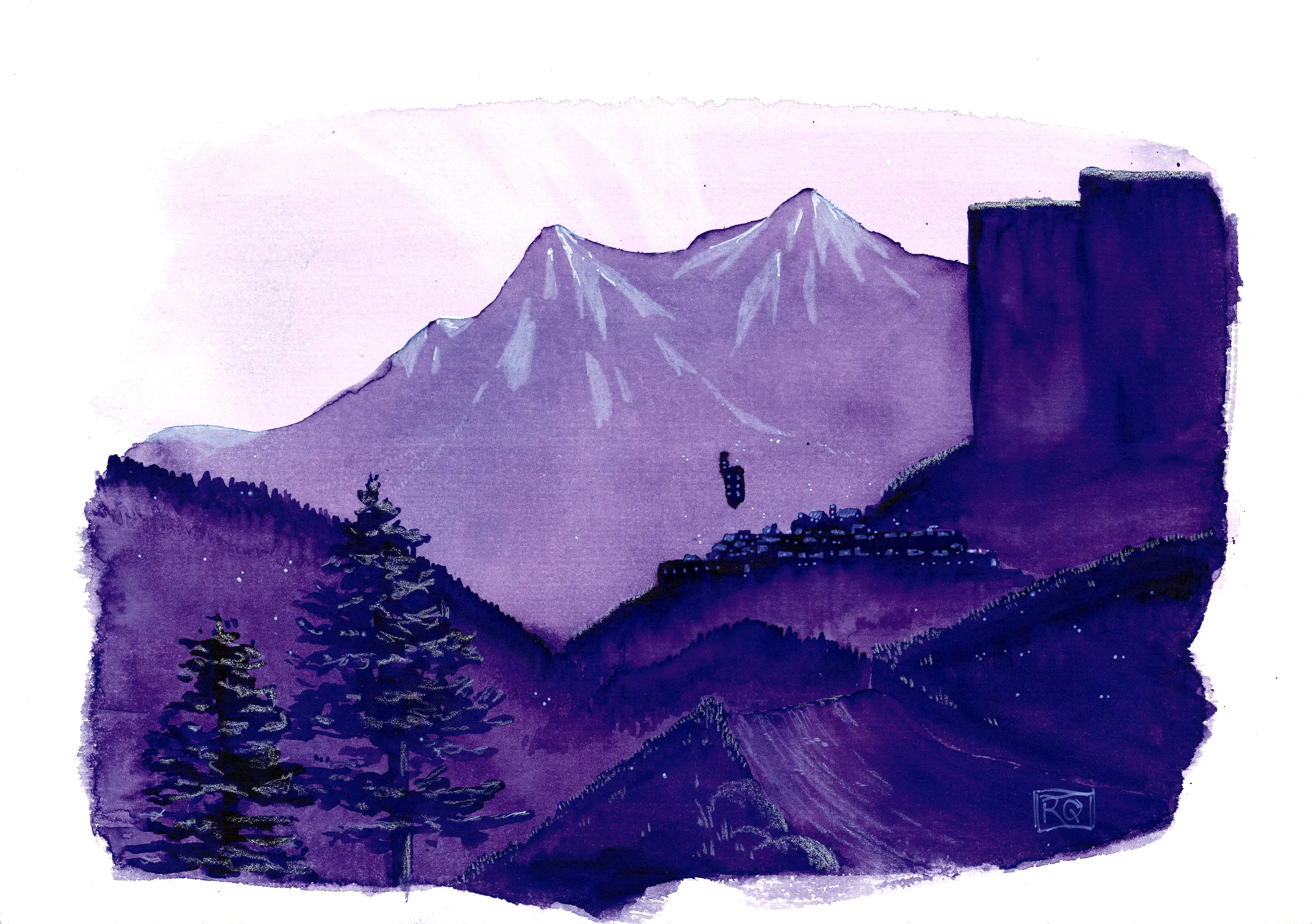

Firbost, where the trees speak in sighs and the mountains keep their secrets well. A man could ride through the Corrogate Woods for a lifetime and never glimpse all the ruins swallowed by roots and time. This land does not forget.
-- Sir Francis de Marr, knight
The Duchy of Firbost is a land draped in mist and mystery, where the rivers carve through deep valleys and the forests whisper of things long past. It is one of the kingdom’s oldest territories, home to legends that predate even the first kings. The Moonwash River winds its way through the land, cutting a silver path between the trees, joined by the River Dwarrow, whose waters hold reflections of an age before men.
Settlements of Firbost
Due to the dangers of the deep forest and the creatures from the mountains, settlements stick close to the watercourses and roads:
Firbost is a land of rugged beauty, where moss-covered ruins stand silent, the last remnants of the giants who once ruled these lands. Their great fortresses—Agdu-Stein and Agdu-Ise - cling to the peaks of the Iron Mountains, as cold and unyielding as the stone from which they were hewn. These monoliths of a forgotten age loom over the valley, reminders that Firbost was not always a place for men.
The Gateway to the North
The heart of Firbost beats in Endon’s Pass, a city perched within the only traversable route through the Iron Mountains for sixty miles in either direction. It is a place of trade and transition, a confluence of cultures where merchants rub shoulders with scholars from the famed Academy of Endon’s Pass. The city’s high walls and watchful towers guard more than just roads; they stand sentinel over centuries of knowledge, magic, and war.
The Academy itself is a wonder of learning, where spellcasters and scholars alike seek to unravel the mysteries of the land. Some come in search of knowledge about the giants, others to study the peculiar magic that lingers in Firbost’s woods. The city is alive with ideas and ambitions, a beacon of light in an otherwise brooding land.
Further down the Moonwash lies Lunaris, a town draped in intrigue. Its towering Castle of the Moon stands like a sentinel against the night, its spires clawing at the sky. The townsfolk speak in hushed tones of things unseen, of old rites and strange disappearances, of lights flickering in the woods when the moon is full. There is an old saying in Firbost: “Lunaris is as strange as the Moon it loves.”
Despite - or perhaps because of - its reputation, Lunaris remains a place of fascination. Travelers with a taste for the arcane often find themselves drawn here, as do those who wish to disappear from the eyes of the world. The castle, its origins uncertain, remains a fortress of secrets, its halls echoing with whispers that never quite fade.
The Wild Lands of Firbost
Beyond the cities and towns, Firbost is a land of hunters and herders. The village of Whitehill, perched beside the Moonwash, is a place of quiet resilience, its people shaping their lives around the river’s steady flow. The shepherds of the Corrogate Woods and Firbost Forest know their paths well, but even they tread carefully, for the land has moods of its own.
To the north and east, the Iron Mountains rise, their slopes home to more than just the wind. The dwarves of Heimglah, an ancient and proud people, have carved their home into the heart of the stone, their forges forever aglow with the fires of industry. The halls of Heimglah are a wonder, a testament to craftsmanship beyond the reckoning of men. Here, steel is shaped, gems are cut, and legends are forged.
To the south, the Mannic Woods form a natural boundary, their dense thickets marking the end of Firbost’s dominion. The forest is old, once the capital of the Ssthessic Vrasa, and its depths remain largely unexplored. It is said that those who enter too deep may find themselves walking paths unseen by men before them.
A Land of Memory and Mystery
Firbost is not a land of easy comforts. It is a place that demands respect, where the past lingers just beyond the veil of the present. It is a land where old stones remember, where rivers carry the echoes of forgotten ages, and where the wind through the trees may sometimes carry a voice not wholly of this world.
For those who pass through, it is a place of wonder and unease, of beauty wrapped in shadow. But for those who call it home, Firbost is something greater—it is the heart of an ancient world, beating still beneath the boughs and the mountains, waiting for those who dare to listen."
On Arrival to the Duchy of Firbost
"The scent of moss and undergrowth is strong between the mountains and the White Downs, and the days are short here. The sun has little grip in this place, where the peaks towering above, the mists rising from the rivers, and the trees shouldering for what little light they can, all crowd away at the blue. There is a sense of ancient patience here, that the tracks and roads that cut through the wilderness are a razorblade of civilisation: interlopers in another's domain, quickly discarded and sooner forgotten."
The Moonwash Vale
Nestled between the rolling White Downs, the Vale of the Moonwash is a land of golden fields and emerald pastures, watered by the gentle flow of the Moonwash River. The twin towns of Lunaris, perched high on the downs, and Lodban, resting in the valley below, mark its northern and southern edges, their histories intertwined with the rhythms of the land.
Scattered farmsteads and grazing flocks dot the landscape, and at the heart of the vale lies the quiet village of Whitehill, named for the pale limestone ridge that rises beside it. The air here is thick with the scent of wildflowers and fresh-turned earth, and on clear nights, the moonlight spills across the fields in a silver glow, as if the land itself remembers some ancient, celestial secret.
The river itself is the lifeblood of the vale, a silver ribbon winding through the fields, bringing fertility to the land and prosperity to those who work it. Fishermen cast their nets in its gentle waters, and small river barges laden with grain and wool drift lazily toward Lodban, where the goods are taken southward to Endon. Though peaceful in appearance, the vale has not always been untouched by strife - old cairns and barrows dot the landscape, testaments to skirmishes fought in ages past when warbands clashed over its bounty.
Firbost Forest
The Firbost Forest is a vast, brooding expanse of towering pines and shadowed glades, where the scent of resin lingers thick in the air and the whisper of the wind through the branches carries secrets of ages past. Scattered through the dense woodland, ancient stone circles stand in silent vigil, their purpose long forgotten but their presence undeniable.
Some say they mark the burial sites of lost kings, others believe them to be places of old magic, where druids once called upon the spirits of the earth. But those who wander too far from the beaten paths have more immediate concerns - beasts from the Iron Mountains prowl these woods, from great black wolves with ember-like eyes to creatures older and stranger, half-seen through the mist, watching from the dark.
Stone Giants Marsh
A landscape of shallow valleys and scattered copses, the Stone Giants’ March is a place where the earth itself seems to remember the weight of titanic footsteps. Legend holds that this was once the meeting ground of the Steinmoot, the great council of the Stone Giants, where their elders would gather beneath the open sky to settle matters of law and blood-feud.
Though no giants have come down from Agdu-Stein and walked these lands in an age, great weathered stones still stand in quiet formations, some resembling toppled thrones or crude circles where fires may have once burned. Shepherds who pass through the March speak of a lingering presence, a feeling of being watched, as if the land itself waits for the return of its ancient keepers.
The Ssthessic Woods
A place of deep shadow and tangled roots, the Ssthessic Woods stretch across the northeastern wilds beyond Endon, their name a whisper of an age long past. Beneath the towering canopy, half-buried ruins linger like forgotten bones—crumbling temples swallowed by creeping ivy, shattered columns etched with curling serpentine script, and cavernous halls whose stonework seems too smooth, too precise, to be the work of mortal hands.
These remnants belong to the ancient snake-folk, a civilization lost to time, their legacy now little more than eerie carvings and the unsettling stillness that pervades the forest. Hunters and herbalists speak of strange sounds in the depths of the woods—the rustle of scales against leaves, the low hissing of voices unheard for a thousand years. Some claim that not all of the Ssthessic are gone, that something stirs beneath the ruins, waiting for the world to forget so it may rise again.