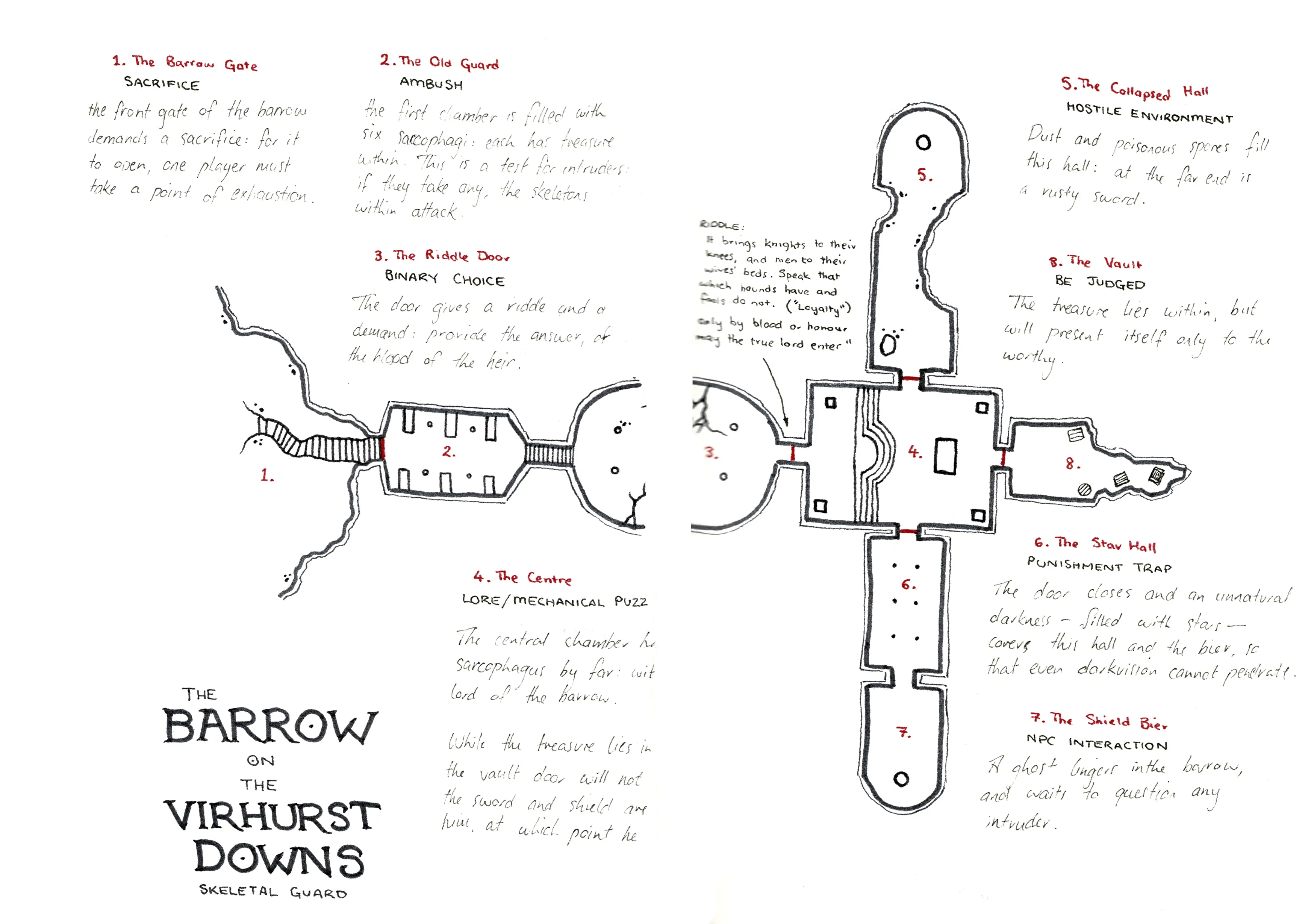
"A grassy hill rises from the fog-slick moor, too round, too smooth to be natural. Stones circle its base, weathered and marked with runes. A black door yawns open in the side of the mound, and cold air spills from within — stale, damp, and touched with rot. No birds sing here. No animals stir. The wind avoids this place."
The Barrow on the Virhurst Downs is a tomb, trap, and test — a dungeon designed to showcase a Wight's cunning, memory, and dominion over the undead. Unlike monsters that rush into battle, the Wight uses its barrow as a puzzle-box of death: each chamber reveals a little of the Wight’s former glory, slowly building dread. Players will sacrifice, solve, and explore before they can confront the Wight itself — and only by understanding the being it once was will they unlock its final vault. This dungeon balances atmosphere, tactical danger, and narrative depth — encouraging thoughtful exploration and tight decision-making.
Beginning this Encounter.
The encounter begins when the party is tasked with recovering a powerful relic said to lie beneath the Virhurst Downs — a hill grave older than the kingdom that surrounds it. Locals fear it, and animals won’t go near it. Those who enter are rarely seen again, and when they are, they scream until they die.
The barrow is silent, sealed, and buried beneath layers of symbolism and sacrifice. No door opens without cost. The tomb does not yield easily — it watches. The Wight within cannot roam far, but its presence saturates the halls. The deeper the players go, the more it knows of them — and the more it prepares.
Arrival at the Barrow Gate
"A low stone arch frames a passage down into darkness. The lintel is etched with curling runes: 'That which would disturb the dead must pay the price of the living.' The air is still. The only sound is your own heartbeat."
The barrow demands a price before entry. A character must willingly take a point of exhaustion, symbolising the weakening of life in exchange for access to death. Magic that attempts to bypass this toll falters. Only humility or sacrifice allows entrance. Once paid, the door grinds open, and the dark beyond swallows sound.
The Old Guard
"You descend into stillness. Six stone coffins line the walls, each carved with the relief of a warrior. The air is heavy with dust and age. Then, with a low grinding sound, the lids begin to shift. Eyes glint in the dark."
This is an ambush chamber — the Wight’s first test. The skeletons are not mindless; they fight in formation, flanking, blocking exits, and working to corral the players. This fight is meant to feel eerie and rehearsed, as though the dead have drilled this choreography for centuries.
Additional Difficulty. The skeletons will rise again after a certain amount of time, bound to service as long as the Wight has not been slain.
Tactical Rehearsal. These skeletons don’t just attack — they herd, they delay, and they gauge. The Wight observes through them, learning the party’s tactics for later. A hasty party will be punished later. A clever one will find a pattern in their movement.
The Riddle Door
"A smooth black door bars the passage. Upon it is carved a knight on bended knee, and a lover with clasped hands. Beneath, words read: 'It brings knights to their knees and men to their wives’ beds. Speak that which hounds have and fools do not.'"
The answer is Loyalty. Saying it aloud causes the door to hiss open; failure may trigger a pulse of necrotic energy or summon another skeletal guardian. The riddle plays into the themes of the Wight’s former life — honour, betrayal, and the weight of oaths.
A Test of Insight. This is less about punishment and more about tone-setting. The barrow is not simply a trap — it is a judgment. Understanding the answer is key to understanding the Wight itself.
The Centre
"The heart of the barrow is a round chamber, domed and silent. In its centre lies a stone altar, etched with the image of a broken crown. Two recesses lie in the altar’s surface — one shaped like a sword, the other like a shield. Murals line the walls, showing a man becoming a king, and a king dying betrayed."
Here the players learn who the Wight was: a lord betrayed in life, buried with his honour broken. To awaken him — and unlock the final vault — the sword and shield must be placed in the altar’s hollows. Doing so does not just wake the Wight — it tells him who came, and what they’re willing to risk.
The Puzzle of Memory. This is the thematic and mechanical centre of the dungeon. The players must find and bring the sword and shield here. Returning only one results in a partial awakening: a confused, half-aware Wight. Bringing both brings his full awareness — and full fury or conversation.
The Collapsed Hall
"A cracked corridor sinks beneath the barrow’s earth. Dust clogs the air. Chunks of ceiling litter the ground, and fine powder covers every surface. Breathing is hard here. Something glints half-buried beneath a fallen beam."
This is where the sword lies, buried in the rubble. The air is toxic with centuries of rot and mineral dust — players may need to hold breath or make Con saves to avoid poison effects. The sword is ancient, and inscribed with the Wight’s name — once lost, now found.
Environmental Hazard. This is less about combat and more about attrition. The barrow drains the living. Light sources sputter, and time feels slower here. If players are careless, they may lose more than just hit points.
The Star Hall
"You enter a chamber of perfect darkness — deeper than torchlight, darker than night. The air here is void. Your steps echo as if the room is far too large."
This room is under the effects of magical darkness. Something waits in the centre — a forgotten celestial map carved into the floor. Feeling it out gives clues to the barrow’s layout and the Wight’s lineage. Without sight, players must cooperate — or fumble alone.
Darkness and Lore. There are no enemies here, only isolation. The darkness tests the party’s unity, memory, and trust. Used cleverly, this space can foreshadow the Wight’s final power: smothering light and hope.
The Shield Bier
"A bier rests beneath a beam of cold light. Upon it lies a tarnished shield, engraved with a stag and sunburst. Beside it sits a ghost — not hostile, but watchful. Its eyes are hollow, yet it offers a slow, solemn nod."
This spirit is the Wight’s brother-at-arms, or perhaps the knight who betrayed him. He may speak if approached respectfully, or attack if the party desecrated other parts of the barrow. If questioned, he may offer insights into the Wight’s motives — or warn of what’s to come.
Parley or Peril. This is the one chance to understand the Wight’s heart. A ghost’s sorrow might reveal the vault’s secrets or hint at a way to put the Wight to rest rather than destroy him. But tread without honour, and the ghost will ensure only silence remains.
The Vault
"The door opens without a sound. The room beyond is ringed with tomb treasures: broken banners, goblets, ancient armour. At its centre, a stone throne. Upon it sits the Wight, his eyes flickering like dying stars. He speaks your names — names you never told him."
This is the final confrontation. If both sword and shield were placed on the altar, the Wight has fully awakened — and knows who disturbs him. He may speak before fighting, offering terms, warnings, or accusations. The fight is deadly: he summons past warriors, drains life with his blade, and curses those who break oaths mid-battle.
The Price of Legacy. This isn’t just a fight — it’s the weight of unfinished history. The Wight fights with purpose, recalling tactics used by the party earlier. If they fought dishonourably, he exploits that. If they showed mercy, he may offer it too.
Finalising the Quest
"The Wight’s final breath fades, and the chill recedes. Light flickers back into the stone. The barrow no longer feels watching. Only still. At your feet, the sword and shield lie untouched — polished once more. The altar glows faintly. Peace, at last."
Whether the Wight is slain, redeemed, or bound once more, the barrow closes behind the players. The relics they recover are powerful, but heavy with legacy. Their names may become part of the tomb’s next cycle, whispered to those who dare to enter again. In laying the Wight to rest — one way or another — the players have sealed a story hundreds of years old.