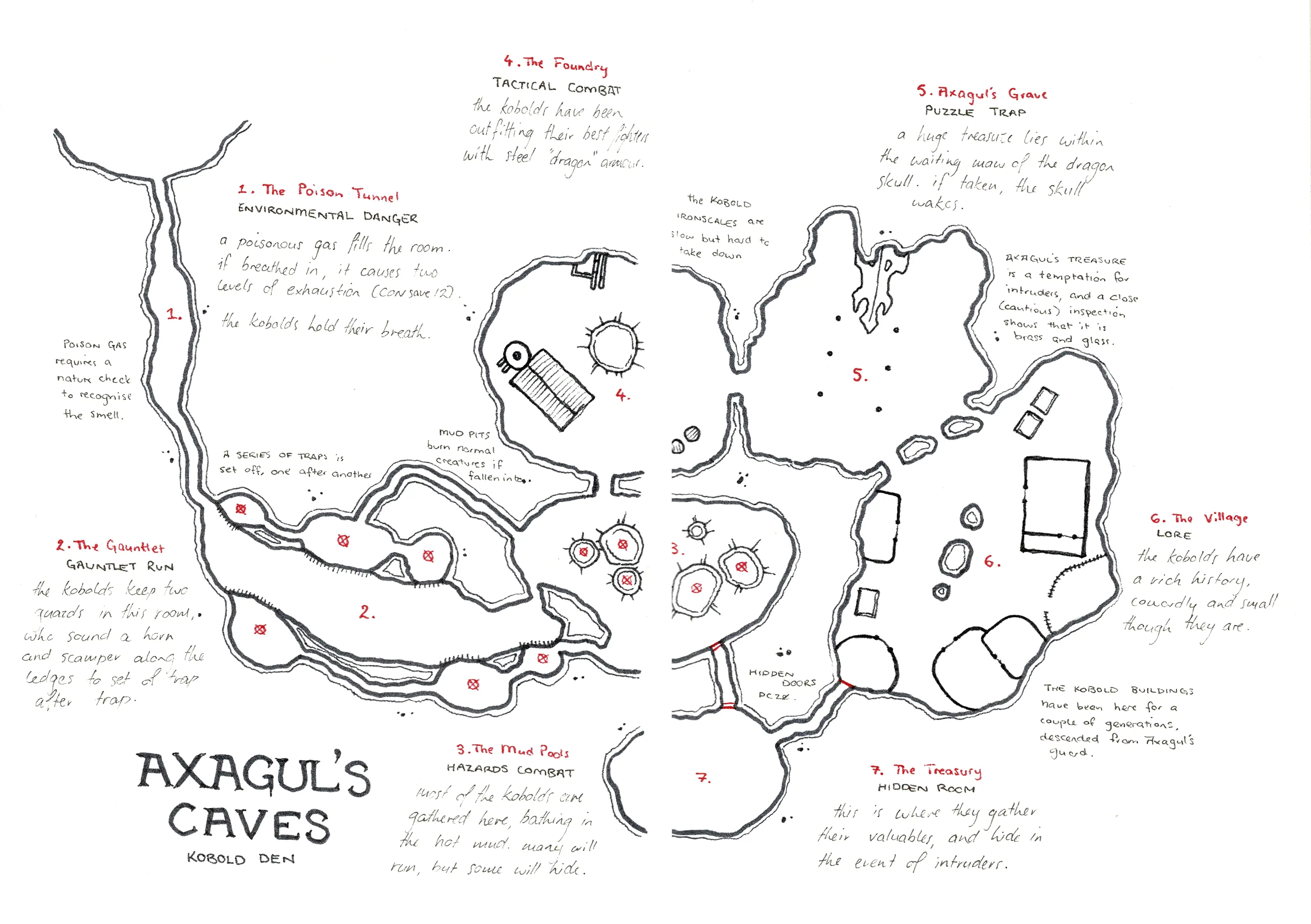
Deep in the shale cliffs of the valley, a network of narrow tunnels and stinking pools conceals an ancient truth: the kobold tribe here once served a dragon. The bones of their master, Axagul the Brass, lie in a cracked stone chamber at the heart of the warren, and the kobolds haven’t forgotten their purpose. They’re paranoid, clever, and unusually coordinated for their kind. Every chamber reflects a legacy of draconic servitude, turned now into a blend of myth, mechanical ingenuity, and ruthless defense.
The party is drawn into the caves to investigate strange attacks - merchants stung by poisoned darts, scavengers disappearing into mud pools, and rumors of a dragon’s ghost. What they find is a fully functioning trap-lair built by kobolds who remember what it meant to serve a godlike master - and who will not give up their territory lightly.
Beginning this Encounter.
The entrance to Axagul’s Caves is hard to spot. A narrow rock shelf winds behind a waterfall, leading into dark stone with strange chalk marks - spirals, dragon claws, and warning symbols. Inside, the tunnels quickly become labyrinthine. Air grows humid, tainted by sulfur and rot. Small clawed footprints crisscross every dusty surface.
Arrival at the Warrens
The opening is no more than four feet high - a jagged crack in the shale, just wide enough to crawl. Beyond it, the walls shimmer with mineral deposits, and a foul, almost metallic stink hangs in the air. A faint click echoes from deeper within.
The valley is quiet, but the caves pulse with life. Faint chittering and the distant clunk of mechanical contraptions suggest the kobolds are always listening. At least two escape tunnels exit higher up the cliffs, though only the kobolds can fit through them. Entering the cave is a commitment - and the kobolds know it.
The Poison Tunnel
The air grows thick and yellow-green, stinking of rotten eggs. A thin haze hovers near the floor, swirling with every step. You hear a skittering noise, then a sudden, suspicious silence.
This narrow corridor is flooded with a low-hanging poisonous gas. Kobolds watching from slits in the walls wait until intruders step inside, then hold their breath and attack. Any creature that breathes in the vapor must succeed on a DC 12 Constitution saving throw or suffer two levels of exhaustion. Even on a success, they feel sick and sluggish.
Toxic Legacy. The kobolds have learned to navigate this place without breathing—through discipline, training, and perhaps magic. Their ability to function while others suffer gives them an enormous edge. Clever players may try sealing their mouths, casting purification magic, or finding other ways to navigate. This is a trap by environment - no levers, no blades, just cruel ingenuity.
The Gauntlet
The tunnel opens into a long, narrow corridor lined with jagged carvings, rope-pulley mechanisms, and metal frames. At the far end, two kobolds crouch behind a crude barricade, eyes wide with anticipation.
This chamber is a trap-run built with military precision. Two kobolds wait at the far end and flee the instant intruders enter. As they sprint, they trip a series of traps behind them - falling rocks, dart volleys, pit covers collapsing underfoot. The players must either rush through under fire or disarm traps while the kobolds make their escape.
Tactical Retreat. This room showcases classic kobold mischief. The traps don’t aim to kill outright but to stall, wound, and separate the party. Players who split up may fall into hidden pitfalls or get stuck behind falling debris. The kobolds’ coordination and use of space are key - this isn’t random chaos, but engineered warfare.
The Mud Pools.
A humid cavern opens before you, thick with steam. Bubbles hiss and pop in waist-deep pools of grey-brown muck. Shadows dart between the rocks - small, quick, and watching.
This chamber is a nightmare of concealment and ambush. Scorching mud pools deal 1d6 fire damage per round to any creature submerged. Kobolds use the pools for cover, darting in and out to fire slings or stab with spears. They’ll try to push players into the hot mud using pack tactics and mobility.
The Terrain is the Weapon. This is a running combat - not a brawl. Kobolds split up, retreat, double back, and disappear into the mud. They have small underwater tunnels connecting parts of the pool. Players who rely on sight or brute force will struggle, while those who plan, corner, or lure enemies will succeed. This is a test of adaptability and movement.
The Foundry
A glow spills from the next chamber - reddish, flickering. The air is hotter here, and the clang of metal echoes from inside. You smell oil, ash, and something like… melted copper. Shapes move in the firelight - armored, kobold-shaped, and draconic.
This is the tribe’s pride and joy: a small forge where they’ve repurposed scrap metal into fearsome dragon-faced armor. Several kobolds wear this armor into battle. Though it offers little protection, it terrifies enemies with its resemblance to a dragon’s visage and grants advantage on Intimidation checks.
Forged Identity. These kobolds fight as a unit. Their armor gives them the confidence to stand their ground. They use teamwork, formation tactics, and maybe even flaming weapons made from bits of slag and broken machinery. Players expecting a pushover fight are in for a shock - these kobolds hit back.
Axagul’s Grave
The chamber is still, sacred. The ceiling rises into darkness, but all attention is drawn to the massive brass skull at its center - half buried in stone, its eye sockets hollow and glinting. Incense burns nearby. The walls are covered in kobold pictographs - dragons, fire, sky.
This is where Axagul’s skull lies, surrounded by offerings of brass trinkets, stained glass, melted coins, and tiny carved dragons. If a player touches or tries to steal the skull or its contents, it briefly animates - either through ancient magic or lingering spirit. It does not speak, but it watches, and may let loose a breath of radiant flame before falling inert again.
Divine Remnant. This is a test of greed and respect. Players who honor the dead dragon may earn the kobolds’ cautious trust. Those who defile it may find themselves cursed, marked, or hunted. The skull is not a treasure. It is a symbol - and the kobolds will die to protect it.
The Village
Low stone huts and tarp-covered nests fill this wide cavern, lit by glowing moss and hanging lanterns. Dozens of kobolds go still as you enter - younglings hiss and retreat, while elders raise crude staves. One speaks: “You come. You live or die. Your choice.”
This is the heart of the tribe - a living village. If the players reach this point without slaughtering everyone, they may negotiate. The kobolds are proud and paranoid, but not mindless. They still tell stories of Axagul, still see themselves as his chosen. Through diplomacy, threats, or clever framing, the party might learn more about the history of the cave, the traps, or even gain safe passage.
Culture, Not Cannon Fodder. This chamber reframes kobolds as people, not monsters. Give them distinct characters: a suspicious elder, a bold youth, a mourning artisan. They won’t forgive every offense - but they might see a future beyond hiding. Offer information, lore, and foreshadowing for future encounters.
The Treasury
The passage forks - one side a natural crevice, the other a trap-laced crawlspace. Both lead to a single room where strange light flickers off piles of coins, dragon statues, and glittering gemstones. But no guards are visible. Nothing moves. Yet.
This room is well hidden - accessible only by two secret paths. Inside, the kobolds hoard their real wealth: offerings to Axagul, scavenged trade goods, magical items long buried. If the party charges in, kobold assassins may strike from above. If they sneak or parley, the kobolds might offer a portion as tribute - or hide the rest.
Paranoia and Preparedness. The Treasury is a trap in itself. The kobolds have fallback plans, illusions, and secret exits. This room shows their true cunning - how far they’ll go to protect what they love. Players who expect a vault will find a shrine. Players who treat it as a den of thieves may become the thieves themselves.
Finalising the Quest
As you exit the caverns, the wind changes. The chittering behind you fades. A sliver of sunlight hits your pack - and something inside gleams with brass and fire. Whether you made allies or enemies here, you’ll never forget the eyes of that skull, or the hiss of voices that called you “dragon-thief.”
The players leave with more questions than answers. If they were respectful, they might have a new ally - or at least a wary peace. If they fought through everything, they’ve likely earned the wrath of survivors. Either way, the memory of Axagul, and the legacy of his tribe, lingers. This wasn’t just a dungeon. It was a living myth. And it’s not finished with them yet.