Current situation
Il-Heban is a desert city located in Kildar’s southwestern reaches. A northern road connects it to Brell, while the southeastern route leads to both the capital, Stormhaven, and the fey-controlled city of Anfyn. Once little more than a modest trading post beside an oasis, Il-Heban grew rapidly over the past century, bolstered by an influx of skilled refugees from the former capital, Torrica.
Though it still lacks the prestige and political influence of Kildar’s major cities, Il-Heban possesses unique advantages that have steadily fueled its rise. Step by step, these strengths are shaping it into a potential powerhouse – one that may, in time, stand among the most important cities in the realm.
Layout
Il-Heban can be divided into three main areas:
The Northern Agricultural District
Here, near the life-giving oasis, halflings have established an advanced farming hub, using the finest agricultural techniques to make the desert bloom. This fertile zone not only sustains the city but also transforms the harsh environment into a far more livable place. At its heart stand the Hanging Gardens – the pride of Il-Heban and a testament to halfling vision and dedication. Conceived, designed, and largely cultivated by halflings, they stand as a living symbol of their ingenuity and artistry. Gnomes lent their technical expertise to the irrigation systems, and orcs provided the muscle for its construction, but it was the halflings’ leadership and creative mastery that brought the gardens into being. This masterpiece ranks among the most beautiful landmarks in all of Kildar, producing a rich bounty of crops while channeling elevated water throughout the city.
The City Center
The market has always been the beating heart of Il-Heban, long before the settlement swelled into a city. Most of the population lives and works here, trading goods from across Kildar and distant lands beyond. Alongside silks, spices, and exotic wares, the market has always been a place where information changes hands—rumors, political whispers, and guarded secrets can be bought, sold, or overheard in the shaded corners of its stalls.
In earlier days, Il-Heban was also one of the region’s foremost hubs for magical item trade, attracting mages, adventurers, and collectors from far afield. Two distinct marketplaces thrived then: the Il-Heban Souk—an open-air, legal market for everyday and exotic goods—and the indoor Shadow Bazaar, a black market for enchanted artifacts. In recent years, however, the citizens have “rebranded” the entire marketplace under the name Shadow Bazaar, blurring the distinction.
The official explanation is charmingly innocent: ingenious rooftop water channels now feed cascades of greenery that drape over the narrow streets, casting the whole market beneath a lush canopy. Yet everyone knows the name fits for another reason—the market remains a shadowy haven for the trade of secrets and information. The halfling population, ever fond of tales and gossip, prefer to see it simply as a place for story-swapping, blissfully—or perhaps willfully—accepting the official version.
The Southern Heights
South of the market, upon a hill, rises the Clay Palace—home of Il-Heban’s halfling sultan. Even in the settlement’s earliest days, local leaders dwelled here, but recent decades have transformed the site into a resplendent seat of power. Built from sun-baked clay and enriched by the city’s water system, the palace gleams with beauty, its terraces and fountains overlooking the desert and the gardens below.
The portal is also located here, offering visitors a breathtaking view of the desert merging with the greenlands. Its proximity to the Palace allows the Sultan and his court to be the first to learn who arrives and why. At times, those who step through the portal are immediately summoned to the Sultan if he has business with them. With his knowledge and foresight, it is difficult to surprise him with an unexpected arrival in Il-Heban.
Population
The population of Il-Heban has always been remarkably diverse, with nearly every race finding a place in its bustling trade. However, the city’s modern character was shaped most profoundly by three groups of refugees:
Halflings – Driven from Torrica by the events of the Crimson Dusk, halflings brought with them not only a deep-rooted love of trade, but also a cultural passion for storytelling and rumor-spinning. Their knack for gathering, weaving, and exchanging tales transformed Il-Heban into a hub for information exchange. It was also the halflings who pioneered the city’s agricultural industry, developing advanced farming methods that made life in the desert not just possible, but prosperous.
Orcs – Seeking a fresh start after the catastrophic turns in both their own history and Torrica’s, orcs arrived in Il-Heban without a clear role. Over time, they became master builders and formidable guards, lending their strength to the city’s growth and safety. Somehow, the halflings managed to tone down the orcs’ fierce tempers, fostering a calm, steady discipline that made them even more reliable allies.
Fortune Tellers from Brell – A small group, yet of immense significance. After the Crimson Dusk destabilized Brell’s magic, divination spells there became dangerously unpredictable. These seers fled toward Stormhaven, with Il-Heban as their first stop. Upon arrival, they performed a divination to decide their future—only to receive the clear message that they were meant to stay. Their presence gave Il-Heban yet another powerful tool for gathering and trading information, cementing its status as the desert’s information capital.
The criminal landscape of Il-Heban is unusual. On one hand, it’s plain for all to see—magical item trade existing here has never been allowed by the Eldritch Inquisition, and information is almost always acquired through questionable, if not outright illicit, means. On the other hand, the magical item market has long since lost ground to Stormhaven, and proving the illegality of most information sources is nearly impossible.
Still, anyone with half a brain learns quickly: if there’s something you truly want kept secret, don’t speak a single word of it and never commit it to paper. In Il-Heban, once a secret exists outside your own head, it’s only a matter of time before it’s bought, sold, and passed around like any other commodity.
Economy
From an economic perspective, IL-Heban is intersting for several reasons:
1) Information Trade
With Il-Heban lacking abundant natural resources, its most valuable commodity has become information—of every kind and quality. This can range from unreliable tales, legends, and rumors to precise and highly sought-after data such as the exact location of a hidden site, the latest political developments, or even stolen faction reports.
The value of information is determined by several factors: reliability, relevance, accuracy, difficulty of acquisition, completeness (e.g., “on this island” versus “in the north of this island”), and more. In many cases, information can be used as currency—paying for goods, services, or even a night’s stay in a tavern.
Information reaches Il-Heban through several primary channels:
1) Passersby
The simplest source—travelers passing through the city. Most are bound for the capital, Stormhaven, or the northern city of Brell, though some daring souls venture toward the fey-controlled city of Anfyn. Brell and Anfyn are wild and perilous places, and the halflings of Il-Heban have a particular fondness for stories from there. Stormhaven is more orderly, but as the capital, it brings a steady flow of valuable political news.
2) Professional Spies
Many individuals travel to far-flung regions with the sole purpose of gathering information to sell upon their return. Some operate independently, but many work under contract. Spies may serve the Sultan directly, act as sub-contractors for other information merchants, or work within guilds—selling information to Il-Heban as a profitable side business (usually without the guild’s approval).
The most problematic in this regard is the Messengers’ Guild. Once nearly destroyed, it began to recover by offering cheap postal and delivery services. However, the guild remains poorly centralized and loosely managed. As a result, many messengers make an unscheduled stop in Il-Heban before delivering their post—allowing letters to be copied or read for a fee.
3) Fortune Tellers
Fortune tellers are a distinct and highly respected class of information traders in Il-Heban—and across Kildar. Their predictions may not always be exact, and their services are costly, but they are the only reliable source for glimpses into the future. Clients range from the Sultan and city rulers to guild leaders, nobles, and adventurers.
They are also among the few groups immune to espionage. First, they can foresee attempts to spy on them. Second, they have a special agreement with the Sultan: no one is permitted to eavesdrop on their sessions, and the information they provide is strictly for the client. If the client later repeats it carelessly in public, that is their own problem. In return, the fortune tellers remain in Il-Heban, further cementing its status as Kildar’s information capital.
4) Other Professionals
Many trades naturally generate information that can be brought to Il-Heban for sale or barter.
Bards bring captivating (if not always truthful) tales, often containing a kernel of real knowledge.
Hermits and lorekeepers contribute ancient history and forgotten lore.
Archaeologists offer details of newly uncovered ruins, from precise locations to theories about their origins.
Among these, the Knowledge Guilds remain one of the most consistent and respected sources, delivering both raw facts and rare insights to Il-Heban’s ever-hungry market of secrets.
2) Trade and services
The oldest source of income in Il-Heban has always been trading and providing services to passing merchants and travelers. Local traders purchase promising goods and resell them at a profit. It’s also one of the few places where you can buy items from Brell without venturing into that dangerous region yourself.
In earlier days, Il-Heban was known for its black market in magical items, and while such goods are still sold here, they now appear in far smaller quantities. The trade has largely lost out to the markets of Šraku and Stormhaven.
Even so, Il-Heban remains a vital stop for travelers. It is the only place in the desert with fresh water and locally produced food, making it the natural choice for rest and resupply. The city’s substantial halfling population adds to its reputation for warm hospitality, ensuring visitors feel welcome.
3) Glass
One of the few resources found in abundance around Il-Heban is sand. With the expertise of engineers from various races—most notably gnomes and elves—the city has grown into one of Kildar’s foremost centers of glass production. Initially, workshops produced simple wine bottles and household crockery, but it was not long before elven artisans realized the city’s potential as a hub for crafting alchemical equipment.
While Il-Heban lacks the wealth of alchemically valuable plants found in places like Arland, it has nevertheless earned renown for producing the finest alchemical apparatus in the realm. Much of this equipment is shipped to Stormhaven and Arland, where it is prized by alchemists. The craft is in constant development—engineers either innovate new designs themselves or work from blueprints and specifications provided by their clients.
Interestingly, a small group of dragonborn from Eir Andusk have found an unexpected niche here: they are counted among the finest glassblowers not only in Il-Heban, but perhaps in all of Kildar.
Government
Il-Heban is ruled by an elderly halfling sultan—a position that came about in a rather unusual chapter of the city’s history. In its early days as a simple trading post, Il-Heban had little need for formal governance. On rare occasions, disputes or important matters were settled by seeking the advice of the oldest and most respected traders, or the maintenance workers who lived on one of the southern hills.
However, as the settlement grew—especially with the influx of refugees—it became clear that some form of structured leadership was necessary. Proposals were put forward, but none satisfied all parties. Old rivalries complicated matters, for example the elves did not want orcs in government, and the orcs felt the same about elves.
Ordinarily, halflings are not known for seeking political power; they tend to adapt to whatever political system exists where they settle. But here, a power vacuum and a stroke of timing shifted events in their favor. Around this period, the halflings introduced a groundbreaking irrigation system and proposed the ambitious Hanging Gardens project. These achievements greatly boosted their popularity.
With no faction opposed to them—and, truth be told, no one able to recall a single serious grievance against halflings—the choice felt almost inevitable. They had never stirred political trouble, never taken sides in old disputes, and never done anything truly objectionable. This and with the city united in admiration for their contributions, it was decided that the halflings should lead, and the most respected among them—the chief architect of Il-Heban’s agricultural transformation—was chosen and named Sultan.
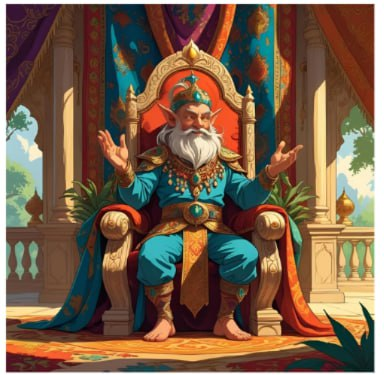
Sultan of IL-Heban