Description
The official central government of Kildar, made up out of a council of Guilds. Though powerful in the past, it's inability to act in even the direst of circumstances have resulted in much of its political power having shifted to the large cities and individual Guilds and their factions.
History
Though conferences between the guilds of Kildar have existed for as long as the guilds themselves, after the Thronebreaker Coup the victorious guilds officially formed an assembly of representatives on the 15th of March 414. Though the Monarch was still the official head of state, Astrid Medvedov had to hand most of her power over to the newly formed Landsraad.
As the new de-facto rulers of Kildar, the Guilds within the Landsraad helped Kildar prosper more than ever before. This period is often called the Guild Golden Age, both because of the absolute prime of the Guilds political power, and because of the wealth they spread throughout the cities of Kildar.
But even the most prudent of guilds became complacent during peace. The wealth and luxuries that those favoured by the Guilds collected led to them dismissing the needs of those less fortunate. Especially the Orcs, who had little to no representation in the Guilds' leadership or the Landsraad, were increasingly upset about the loss of wealth and respect in comparison to the species that had benefited well from the Golden Age.
The long and bloody conflict that followed, known as the War of Unyielding Shadows, laid bare the first cracks in the prestige and effectiveness of the Landsraad. Their squabbling for power in the first few months lead to the Orcs organizing far quicker than the Guilds and towns of Kildar, eventually leading to the massacre of multiple towns, the complete loss of the Dwarven Strongholds and the complete loss of control over the Orclands.
Whilst the intervention of the adventurer Destro Fortica allowed the Guilds to destroy the Orcish hordes and retake the Orclands, the squabbling and jockeying for power remained. Though peace was restored and the reinstituted Adventurers Guild joined the once-again dominant Landsraad, the next 50 years saw a steady decline of cohesion and relations between the Guilds, with the Landsraad only remaining effective thanks to the experienced representatives of the Guilds negotiating and compromising their way to new legislation.
But this broke down completely during the Hadarian Crisis. The abrupt and complete destruction of Torrica killed not only the representatives and present leaders of the Guilds, which had been discussing the royal succession crisis at the time, the entire Medvedov Dynasty was wiped from the face of Kildar. Even after Hadar had been defeated, and Stormhaven was made the new capital and new seat of the Landsraad, the Landsraad proved to have lost all influence it once had.
The 80 years between the Hadarian Crisis and the Grandmother's Rise resulted in no new legislation being passed. Though all the Guilds considered the Medvedov Dynasty extinct and there was not even a throne for the next Medvedov to sit on, the disagreements between the Guilds prevented the official disillusion of the Monarchy, and with it kept the old structure in place.
This complete incompetence lead to no action being taken by the Landsraad against the threat of the Grand Mother, whose dominance over Kildar was prevented solely by the adventurers of the Unbound. Neither has any action been taken by Kildar's central government regarding the Portal Network or the appearance of the Fey and Shadowfellians.
As such, the Landsraad currently holds little presence in the minds of everyday Kildarians, and the De-Facto rule over Kildar has completely moved towards the individual cities and the ability of Kildars' factions to influence those cities.
Structure
Though the country is formally still a kingdom, the Landsraad sits at the heart of Kildar's central government. The Landsraad sets nation-wide policy. Among other things, this means that they hold the power to propose and vote on legislation as well as set and amend the the budget.
Members of the Landsraad
The Landsraad is made up of 22 represresentatives, each from one of the major guilds of Kildar. They are, roughly speaking, aligned with one of three factions the Military Guilds, Commerce Factions, and the Knowledge Factions.
The Landsraad in modern Kildar
Formally, the Landsraad is the highest authority in Kildar. In practice, they have felt their influence wane over the last years due to the gridlock caused by the absent King.
While the Landsraad's laws supersede the local regulations and ordinances of the cities, cities are afforded a high degree of autonomy to govern their citizens. This is necessary, as the Landsraad has been ineffective at dealing with crises or adequately responding to events for the past ~90 years.
General procedure
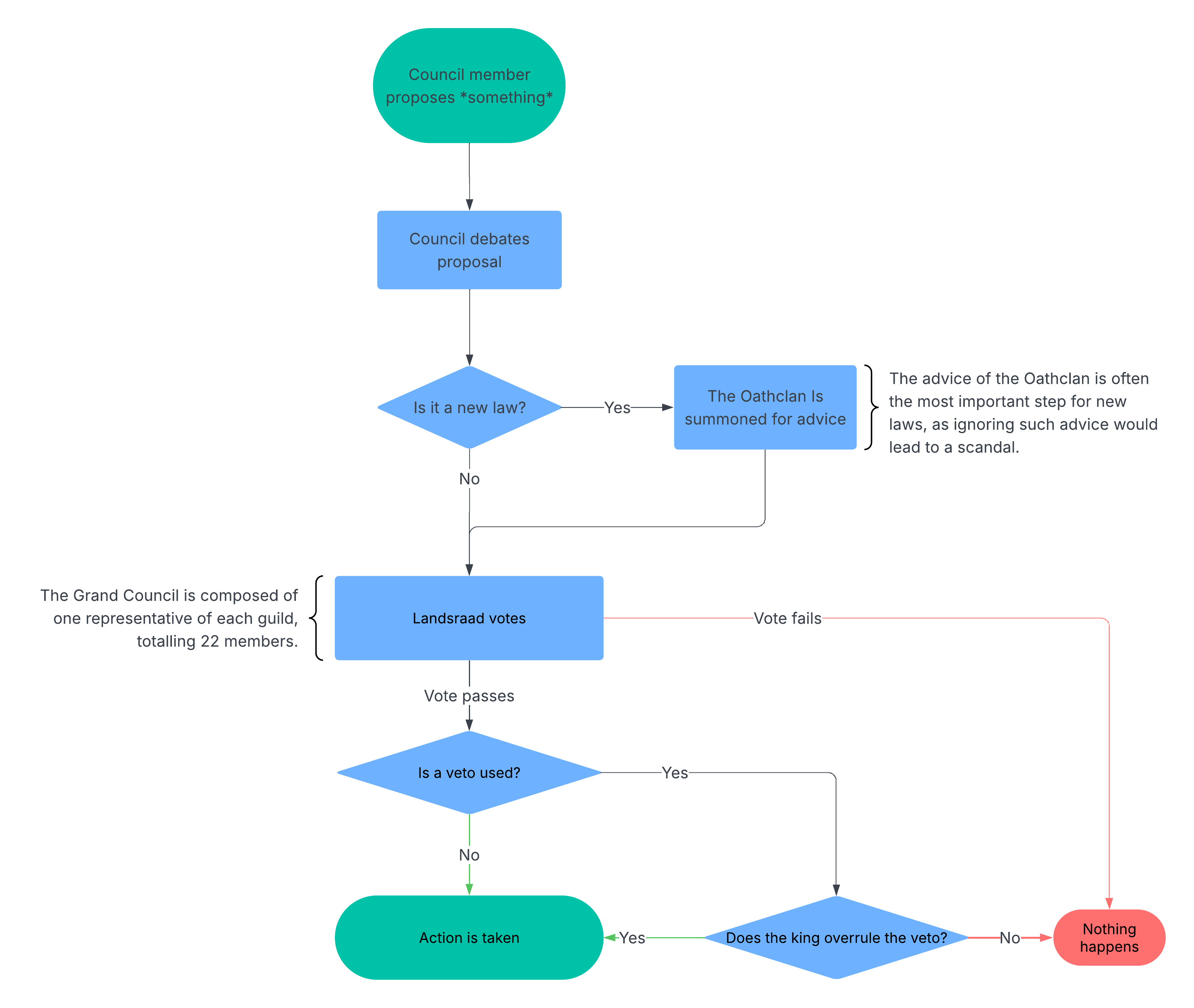
Whenever a council member has a proposal, they can schedule a vote in the Landsraad. The vote must either be unanimous, or achieve a simple majority and have the King vote in favour. Ever since the fall of the Medvedov Dynasty, the office of King has been empty, which means that in practice, the Landsraad can only take action when the vote is unanimous.
Passing laws
When introducing a new law, the Oathclan must be consulted on the practicality of the newly proposed law. If their advice is negative, that is often enough to sway the Landsraad and scrap the current draft.