Author: rem (instagram: @ripgiftedkid and @rem_the_winds_sister)
Editor: Aztec
Notes on the biology and social organization of the Nickers by Professor Iaver Syrma
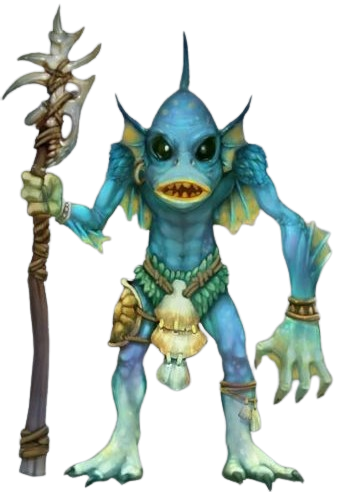
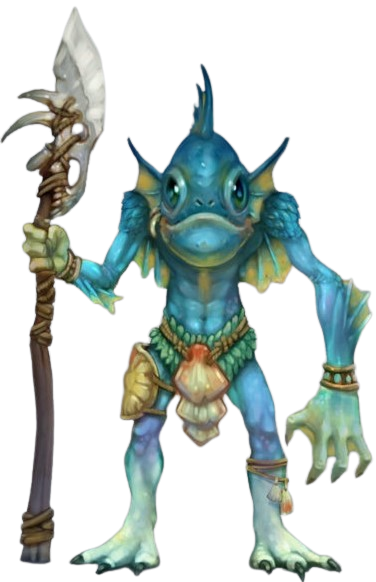
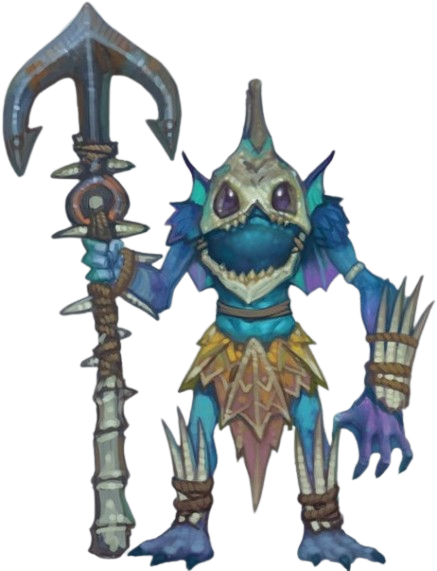
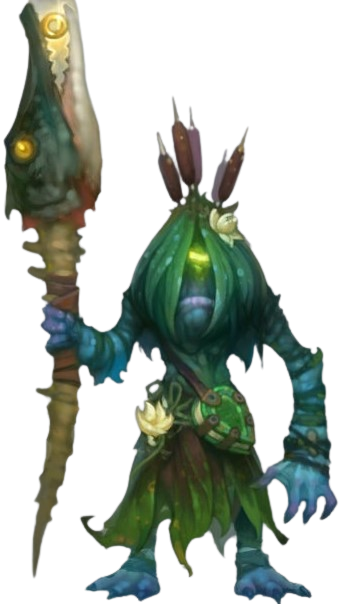
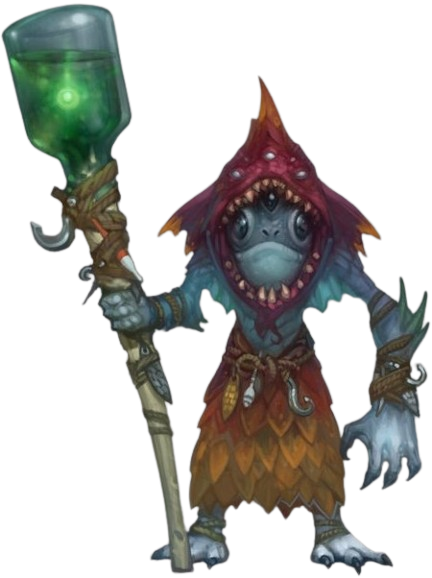
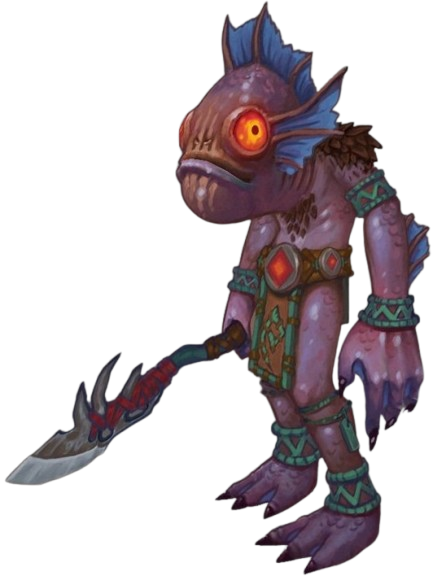
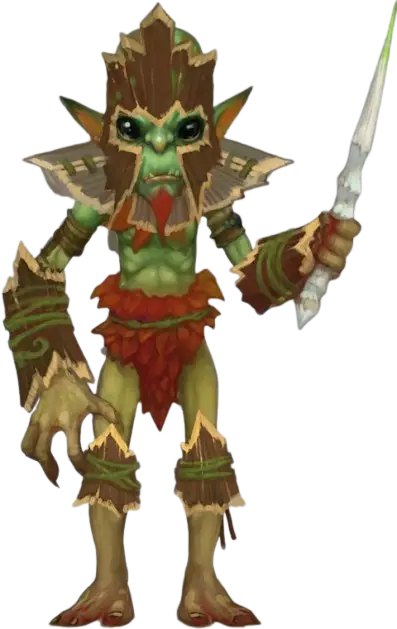
Nickers, also called vodyaniki or fish folk by the commoners, are small amphibious humanoids.
The Nickers first were a lake species and developed double-breathing as a result of oxygen lack in stale water. Most species have gills and a lung-like sack for air breathing; typically there is one, but some species have two or more. This same sack is used to regulate buoyancy in bottom dwellers. Carnivorous species have taste receptors in their fins and whiskers or barbels. The sense of taste of these species is exceptional, far beyond other races. They possess a 300 angle view and do not have eyelids, having to episodically lick their eyes to keep them moist on land. They do not have very good hearing, but they have a lateral line that helps them feel water vibrations. They have a good vibration sense in general which slightly compensates for their primitive hearing apparatus; they can ignore nearby whispering, but will feel earth vibrations if you try to walk up on them. They talk both on exhale and inhale, using the loud vibration of a quickly expanding and contracting air sack. They do not have vocal cords.
Nickers pass several stages while growing: egg, tadpole, metamorphoser, and adult. Each age group has a different lifestyle and micro-society. The older a Nicker is, the less it is dependent on water, starting with eggs and tadpoles who form underwater microtribes, only occasionally visited by their ancestors, who occupy the shore and shallows territories and have some decently developed culture. It is entirely the tadpole microtribe's responsibility to guarantee the eggs' safety. That is how, completely in the wild and on their own, they first learn to cooperate and fight for their tribe together. Only those tadpole tribes that have succeeded to guard the eggs until new tadpoles are born out of them are considered worthy to join the adult tribe. By that time they enter the metamorphosis stage, so they don't entirely join the tribe, but form another micro-society with its own rules and internal self-government. However, they are allowed to occupy the same territories as the adult tribe. Those microtribes that did not succeed to guard the young have very slim chances of surviving on their own, even when trying to form their own adult clan, as they still desperately need the knowledge and primitive technology of their ancestors.
The air sack is the most multifunctional organ in their body. Apart from performing the respiratory function, it acts as a resonator to help them speak and even hear, capturing low-frequency vibrations and, being connected to the inner ear, transferring the sound information there. As a result, it is their cultural belief that the air sack holds the soul of an individual. Nickers typically keep the dried air sacks of their ancestors, occasionally speaking to them and bringing them to the tribe's shaman, so he can interpret their will. Meanwhile, it is the shaman's duty to keep the air sacks of all previous leaders and shamans of the tribe and stay in communication with them, in order to bring the message to the current leader and the tribe. Many shamans find a way to wear them—usually it's not hard because depending on the way it was dried, an air sack can shrink to a ball that can fit in one Nicker's hand—so that they can never part with the ancestors. After extracting the air sack, Nickers don't typically care what happens to the body. Some tribes just toss the body into running water so that it can be carried away, while some gather to ceremonially eat the deceased together. If some individual doesn't have anybody to extract, dry and keep their air sack, it is considered the worst fate—the soul is bound to feel every stage of rotting away, after which disappearing completely. For a banished Nicker it is not the danger of surviving alone that is the worst punishment, but the fact that they were deprived of afterlife. This, among many others, is an important reason why Nickers are a highly collective society with low understanding of individualism as a concept.
Nickers, as many other primitive tribes, worship nature forces personified as three gods and a huge number of demigods and spirits. The three gods are a personification of water (the Mother), earth (the Mentor) and sky (the Judge). Their roles are obvious: Nickers are born and brought up in water, and during their whole life cycle water stays the nurturing, soothing place where they come to moisten their tired dry skin, rest and restore their strength—hence the Mother status. After finishing their first trial of guarding the young and gaining some consciousness, they slowly enter Earth and therefore society, new challenges and discoveries. First time in their life they are being taught their culture, taught to act not only by instinct of fear and hunger, but logical thinking and their quite peculiar, yet still, morality. Contrary to Water, Earth is not a source of comfort, but of progress, which is why they call it the Mentor. Finally, the sky is the Judge, which seems to have a correlation with a lot of other cultures. However, the reason for that is pretty unique. Nickers as a species are closely ecologically intertwined with another predatory species: the giant spotted eagle. The Nickers are a main food source of the nestlings of these huge birds. It is notable that they only target individuals in their metamorphosis stage because of the perfect balance between a size big enough to feed the nestling, high percentage of fat and fins, barbs, and bones underdeveloped and soft enough to make the eating comfortable and non-traumatizing. The episodicity and selectivity of the eagles' attack made the Nickers believe that upon becoming of mature age, their young enter a trial period, where the sky watches everyone and judges based on worthiness. The hunted are considered to be punished by the sky's executors—the eagles. As a result, the eagles became highly respected worshipped creatures. Some tribes build temples out of their bones and feathers, while some start "singing" when spotting an eagle above them. It is a lucky coincidence that the giant spotted eagle is an extremely small population, and also a very careful one. Otherwise the Nickers, who refuse to even try to defend themselves against the "judgement", would have quickly gone extinct.
All of the Nicker subspecies are carnivorous, although only few of them are perceived as such. The majority of them are either insectivorous, or feed on whatever tiny water organisms they manage to strain through a straw drain, which they later shape into salty protein patties and serve with some seaweed as a decoration. Different humanoid outsiders have found them quite tasty and nutritious despite their disgusting texture. There are, however, hunter species that mostly target fish, and just one tribe that eats any species they are able to kill, including their own. Interestingly enough, from their perspective this custom is not barbaric at all, as they view the process of eating as a symbolic ritual which can serve both as an act of domination and of respect. This tribe doesn't believe in unification through singing, dancing or touching each other. Only rituals that perceptively involve physiology bear significance to them: eating, killing, and mating. Getting too old is a disgrace to them—so if you manage to survive until old age, being killed and eaten by your family or tribe is usually an earned sign of deep respect and love. However, they are also quite aggressive and easily provoked on a conflict both between tribes and inside their own one. In this case, eating your rival is a way of humiliating them. Eating an outsider is an exceptionally honorable thing to do, as you not only gain their powers, but also channel this power into the some sort of imaginary "energetical bank" of the tribe. Being extremely collectivistic as all Nickers are, they perceive the tribe as a unified organism which gets stronger every time each member does something right, according to customs. In this case, by eating an outsider, you channel the power of their tribe into yours.
Nickers don't live in families, however, it matters to them who is your closest kin. Because during the mating season females lay eggs in the same place and males fertilize them randomly, kinship within the tribe is heavily intertwined, so everyone is randomly related to each other. Through some mechanism (supposedly, pheromonal) they always instantly recognize who are their parents and children. Because everyone has siblings from a lot of different fathers and mothers, there's no reason to form any particular closed families, so the tribe just lives together, everyone equally responsible for educating and protecting the tribe's youngest ones. However, as was mentioned above, when it comes to afterlife, it is your kin who is supposed to gather and keep your air sack, and therefore, your soul. The tribe always has a chief (in rare cases, several chiefs) and a shaman. The methods of electing both of them significantly differ from tribe to tribe: it can be congenital, through battle with your predecessor, through being chosen by your predecessor, or voting.