In the year 967, following his inauguration as Great Mage of Igsh, Yasker prioritised the modernisation of the state’s military-industrial complex. Observing the Free Merchants’ success with promissory notes, he worked with economic advisors to create a currency that removed the Empire’s dependence on silver. This transition allowed the state to reserve all precious metals for military production and mana-tech engineering.
The Imperial Mark became the mandatory legal tender. This fiat system relies on the industrial output of the Empire and the extraction and refinement of mana. The currency is backed by the labour of the Imperial citizen and the state’s energy reserves.
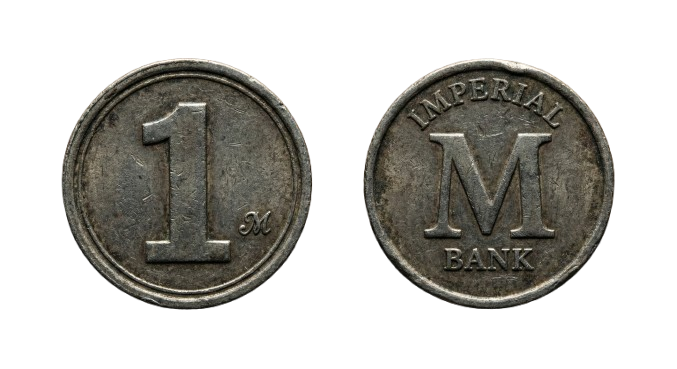
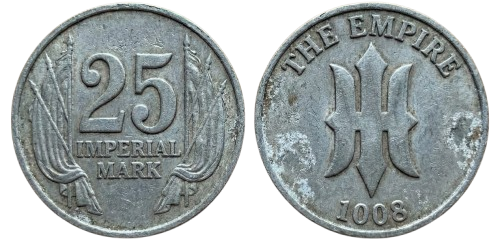
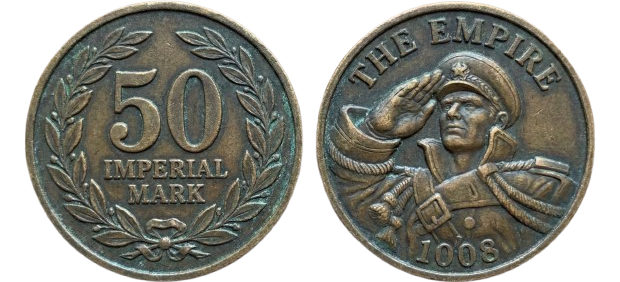
Daily trade functions through base-metal coins. Tin marks serve for small purchases of one, five, and ten marks. Zinc and bronze coins represent denominations of twenty-five and fifty marks. The Empire prints banknotes on high-quality linen and cotton fibres for a larger scale commerce.
Exchange rates established and controlled by the Imperial Bank
Imperial mark | Silver pieces | Processed mana |
1 | 0.1 | 1 mg |
5 | 0.5 | 5 mg |
10 | 1 | 1 g |
25 | 2.5 | 2.5 g |
50 | 5 | 5 g |
100 | 10 | 10 g |
200 | 20 | 20 g |
500 | 50 | 50 g |
1000 | 100 | 100 g |
2500 | 250 | 250 g |
5000 | 500 | 500 g |
10000 | 1000 | 1000 g |
History of Imperial Mark
The transition began in 970 AGC. Yasker’s administration utilised a "soft-entry" strategy to prevent market collapse. The Imperial Bank issued the first notes alongside the "Strength of the People" campaign, which framed silver as a relic of weak feudalism. The state incentivised adoption through a 10% "Patriot Bonus" on mana purchases and lower prices in government-run shops for those using the Mark.
The Imperial market was already heavily regulated under Nezeb, but Yasker tightened this control through the Price Stabilisation Act, issued in the year 975. This law fixed the cost of essential goods -- bread, basic clothing, and domestic mana -- strictly in Marks. Merchants could legally accept silver, but they faced quite unpleasant taxes on these transactions, making trading in solid coin unprofitable for the average shopkeeper.
The shift towards total enforcement arrived in 978 with the Industrial Loyalty Decree. This decree mandated that all state employees, soldiers, and factory workers receive their full wages in Marks. The state simultaneously classified silver, gold and platinum as strategic military resources. Possession of more than three pounds of coins made of any of these metals on the Imperial territory without a special permit became a crime of "economic sabotage." Random searches of money safes and bank accounts were sanctioned by the Committee. The state nationalised businesses that continued to hoard silver illegaly.
When it all first started, the Imperial Bank immediately opened exchange windows across the Empire territories. Hadaganians formed long queues to surrender their silver. They trusted their Motherland wholeheartedly and viewed the transition as a necessary sacrifice for the war against the League. The Arisen calculated the economic benefits within days and complied easily. The orcs were the one who took it with a large grain of salt. When the Industrial Loyalty Decree was issued, massive protests and riots broke out. Orcs burned banknotes in the streets and demanded real spoils. The Committee responded with force. Throughout the year, until the conflict was somewhat regulated, there were deaths, arrests and deportations.
Today, in 1010, silver remains a desired commodity among traditionalists, dissidents and speculators who might hoard it as insurance against state collapse. Using silver in a domestic transaction is a high crime and is viewed as economic sabotage. The state encourages citizens to report "hoarders" in exchange for various material boons and reference letters.
The "Holy Inflation"
The economy functioned with relatively low denominations until the war for the Holy Land ignited in 1008. Industrial capacity was diverted to military production, leaving less mana for the global export market. This weakened the currency's primary physical backing.
Market uncertainty and political pressure from the League forced the Great Goblin Bank to implement "stability sanctions," arguing the Mark was no longer a reliable asset. Very Respectable Goblin the "risk premium" on Imperial transactions, causing import costs to escalate on an extreme level. To cover these expenses, the Imperial Bank printed more money, flooding the market and eroding purchasing power. The 5,000 and 10,000 Mark notes were a desperate solution to facilitate massive military contracts that had become unmanageable in smaller denominations.
Imperial Mark outside the Empire
The Mark functions poorly on neutral allods, where it is often devalued by heavy local taxes. Only the Great Goblin Bank branches and select Free Merchant outposts trade it at standard rates.
Anti-counterfeiting
Arisen scientists developed a spell to embed a magical watermark into the banknote. This mark emits a specific arcane frequency recognised by magical detection. The spell's mechanics are a state secret. Forging these signatures requires immense arcane mastery. The penalty for forging is a lifetime in a labour camp.
Imperial Marks