Table of Contents
The Conclave of Great Mages and Elven Houses
It was among the elves that the first Great Mages emerged – those who managed to combine all three known types of sorcery: necromancy, mysticism and elemental magic.
In the year 2298, the Conclave of Great Mages was founded, with elves as its original creators. Only later did humans join, the first being Skrakan, who brought with him Tenses and Nezeb – the future leaders of Kania and Hadagan. At that time, elves willingly shared their knowledge with humans. Among their students were also Zem necromancers, although the elves' contact with those people was minimal.
Ironically, the Zem civilization perished just a few years before the Great Mages uncovered the secret of long, nearly eternal life. However, that likely wouldn’t have saved them: the secret of longevity is one of the most closely guarded truths of the Conclave, and only the Great Mages possess this gift. It is known that receiving this gift is inseparable from the ritual of ascension into the ranks of the Great Mages, and so “near immortality” remains the domain of the chosen few.
Not all elves have the perseverance or desire to devote part of their lives to study and become Great Mages. Yet all of them wield one or more types of sorcery, and magic is an inseparable part of elven life. Scattered across the world, elves began to form Houses – family-based groups, each living according to its own rules and customs.
The Great Cataclysm, which shattered the world into floating isles called allods, also fractured elven society. The elven Houses were cut off from one another and remained isolated for some time. Yet it was thanks to the elves (notably Nayan, who not only authored the Chronicles but was also a co-creator of the magical ritual that stabilized the Astral and began the salvation of the world), that the Astral tide was halted and the world spared from annihilation.
The Conclave
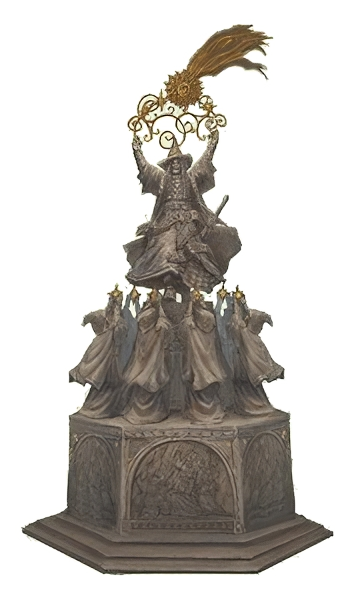
Originally, the Conclave included about forty mages. Of these, seven formed the Council, the Conclave’s permanent governing body. The Council consisted of the oldest and wisest mages.
Any mage could attempt to pass the Test and join the Conclave. The Test was a deadly trial, requiring mastery of magical arts. Once in the Conclave, a mage gained the support of others in matters approved by the Council. This included access to knowledge sharing, access to certain "unpublished" secrets, and the privilege of being part of the magical elite. However, this also came with the duty to abide by the Conclave’s Charter.
In the third millennium of the Old Era, the Great Mage Skrakan rose to lead the Council. Under his leadership, Tenses and Nezeb – his best students – were admitted. However, their growing disagreements led to the southern part of Kania breaking away, giving rise to the new state of Hadagan, ruled by Nezeb. The Council, too, became divided.
Yet, five centuries after the first Kania-Hadagan war, Skrakan managed to reunite the Conclave. Tenses and Nezeb both returned to the Council and were forced to tolerate one another.
After the Cataclysm, the Conclave of Mages had to work harder and more harmoniously than ever – saving the world was imperative. For about a century, the Council continued to function, carrying out this mission, but tensions (mainly between Tensess and Nezeb) once again came to the surface. The Council split into two factions – Kanian, led by Tensess, and one Hadaganian, led by Nezeb. Skarkan attempted to restore unity to the Council, but his efforts were in vain. By the year 356, the Conclave had practically ceased to exist. The Great Mages of Hadagan and Kania communicated only with their own supporters, under the oversight of their respective national leaders – Nezeb and Tenses.
There were still a few Great Mages who did not belong to either national faction, but they either showed little interest in worldly affairs (like Tka-Rik on Hipat) or saw no realistic path to reunify the Conclave (like Skarkan).
The Conclave of the Great Mages, which had existed for two thousand years, eventually fell apart.
One of the most authoritative sources describing the nature of the Conclave and the Great Mages themselves is The Memoirs of Prospero – a monograph written by one of the founders of the Conclave, who perished during the Cataclysm. Here is a curious quote from that book:
“One of the most fascinating topics for young mages just beginning their journey into the arcane has always been – and remains – the ‘Test’. The trial for the title of Great Mage. That’s perfectly normal, and I would never take on an apprentice who showed no interest in that sacred rite.
What’s far worse is when that fascination persists after their training ends – and the adept still cannot grasp the true essence of the Test. Such a mage will never become Great. And if his unbridled curiosity still drives him to challenge the Conclave – I summon the burial detail in advance.
Though in most cases, there’s nothing left to bury – just ashes to scatter into the wind, remnants of yet another fool and failure...”
Eight Houses and the Grand Bal
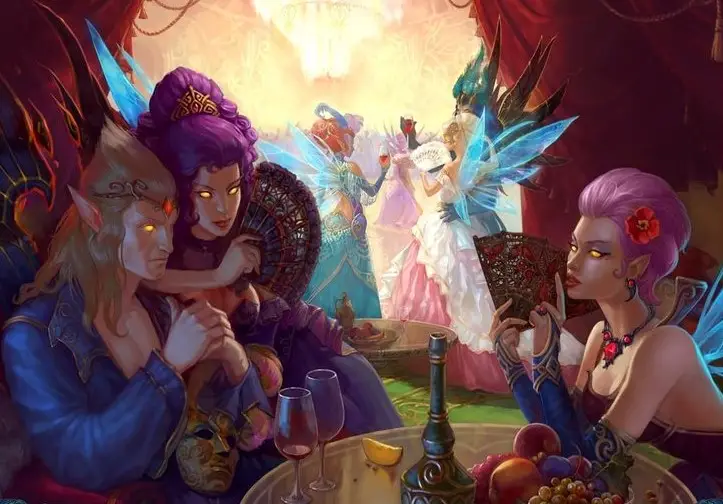
The foundations of elven statehood were laid even before the Cataclysm, during the Grand Bals – gatherings of elves from various Houses. These were magnificent celebrations, capable of astonishing even the most unbridled imagination. Magic in all its manifestations reigned at these Bals, while behind the scenes important political decisions were made. It was during these events that the groundwork was laid for the Great Game, which would later become the central pursuit of elven society. At first, the intrigues revolved mainly around Conclave membership, but gradually the Great Game expanded to encompass nearly every aspect of elven life.
After the Cataclysm, the elves lost many of their kin. The Grand Bal could no longer truly be called “Grand,” and after several centuries it was renamed the le Bal des Huit Maisons (The Ball of the Eight Houses). These were the families that adapted most quickly to the changed world, and through intrigue, alliances, and magical duels, earned the right to rule over the Bal.
In practice, power lies with the heads of the 8 Major Houses – the more influential the House, the greater its vote carries weight. All significant matters are decided at formal receptions and balls hosted by the Families of the Great Eight, including those of foreign policy. And there are many such matters.
The Eight Houses are:
di Ardeur
di Duser
di Grandeur
di Vevre
di Daziré
di Delis
di Blizar
di Pluie