Hunt. Fury. Strength.
Life is a competition.
Death is losing.
Happiness is victory.
The Empire is Stepmother.
The League is food.
The Astral is fuck knows what.
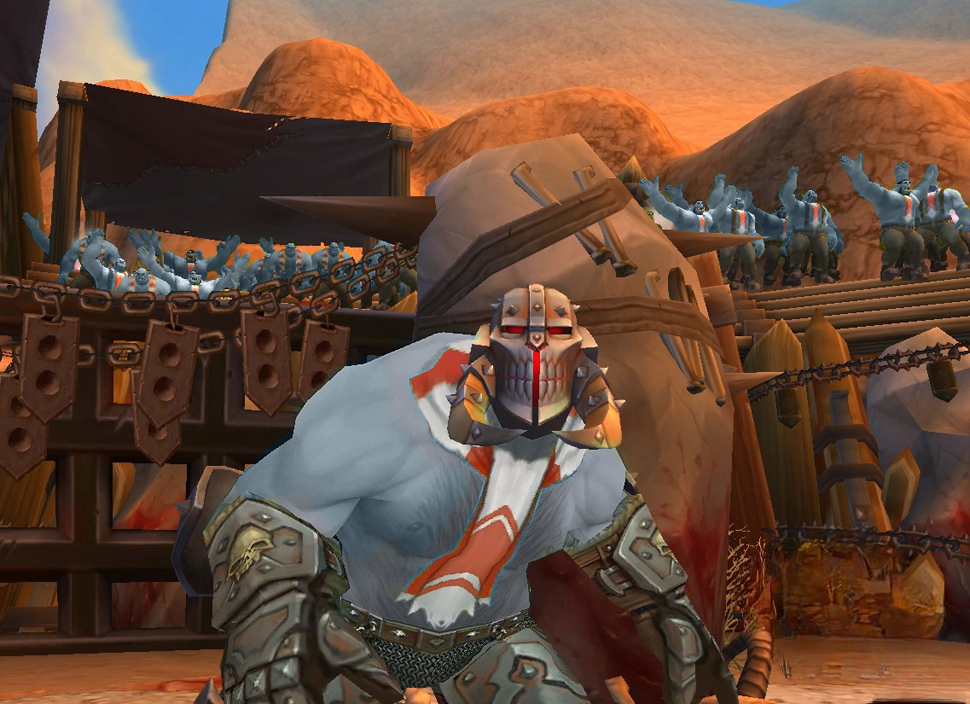
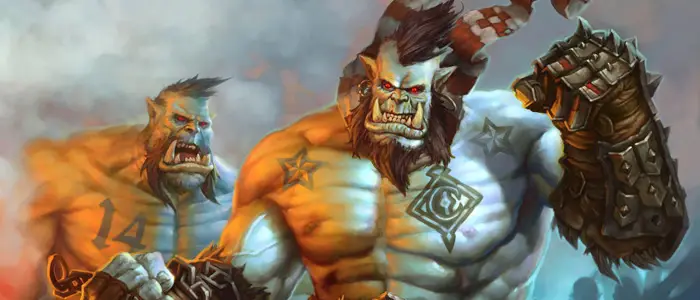
The Orc race has a long history on Sarnout, which has mainly been concentrated in the Eastern part of the continent of Yul. These mighty creatures possess great strength and endurance, but are poor at crafting and magic. Unsurprisingly, their main activity is either preparing for war, or fighting in wars.
Although the Orcs will unite into hordes before going on raids against their enemies, they are primarily a nomadic nation. When they do settle, they build communities that are planned to be temporary and easy to abandon. These communities are usually located in the steppes, where their hardy physique allows them to survive.
An average Orc is a full head taller than the tallest Hadaganian male. Used to open areas, they are uncomfortable living in areas such as dense forests, and their hard skin can easily stand the heat of a relentless sun. There are also many Shamans among the Orcs, allowing other Orcs to increase their physical strength and endurance by conducting mystical rituals.
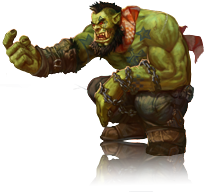
Orcs are probably the most anarchic and freedom-loving creatures on Sarnout. Deep in their nature, each Orc strives to be his own boss, and is only interested in looking after himself. This is partly the reason why they are so scattered, divided into families and clans, often fighting among themselves.
Orcs rule the goblins as an inferior caste, usually forcing them to do all the labor – because orcs themselves do not want to spend time on chores, they just want to have time to fight. Because of such a lifestyle, orcs mostly die young - the average life expectancy of an orc is about 25 years (the leader of the Horde, Skull, once said: “an orc that lived to 25 is a shit, not an orc!”).
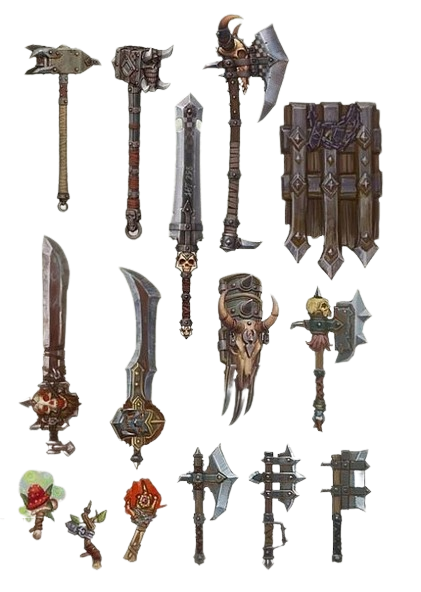
In ancient times, the Orcs did not have a state or kingdom of their own, Orc tribes lived throughout the Eastern lands. After the Great Cataclysm, their situation became precarious as they did not have a Great Mage to hold their land together, and many Orcs died in vain trying to save it. The allods controlled by the Great Mages did not suffer the same fate as the Orcs lands, but people from other allods did not welcome Orcs on their territories.
The once Great nation became weak and vulnerable, and to ensure their survival and to hold onto what was left of their lands, the Orcs joined the Empire, forming an alliance with the Hadaganians and coming under the protection of their Great Mages.
As the second millennium approaches, most orcs remain a wild and anarchic people, driven by simple and unrefined needs. The Cult of Strength reigns supreme among them, with each tribe following its own primitive laws, leading to a lack of unity among their kind.
Yet orcs are a force of nature, capable of sweeping away everything in their path. If they were ever to unite, if a new leader were to emerge — one as mighty as the great heroes of old — if their chaotic nature were to become organized, then the orcs could claim dominion over the entire world.
And now, it seems, this unification has already begun. The orcs stand at a crossroads, choosing a new path for their people. Will they follow the way of strength and the spirits of their ancestors? Will they unlock the secrets of higher magic? Or will the wild tribes be assimilated into Hadagan civilization?
Only time and the course of history will reveal the answer.