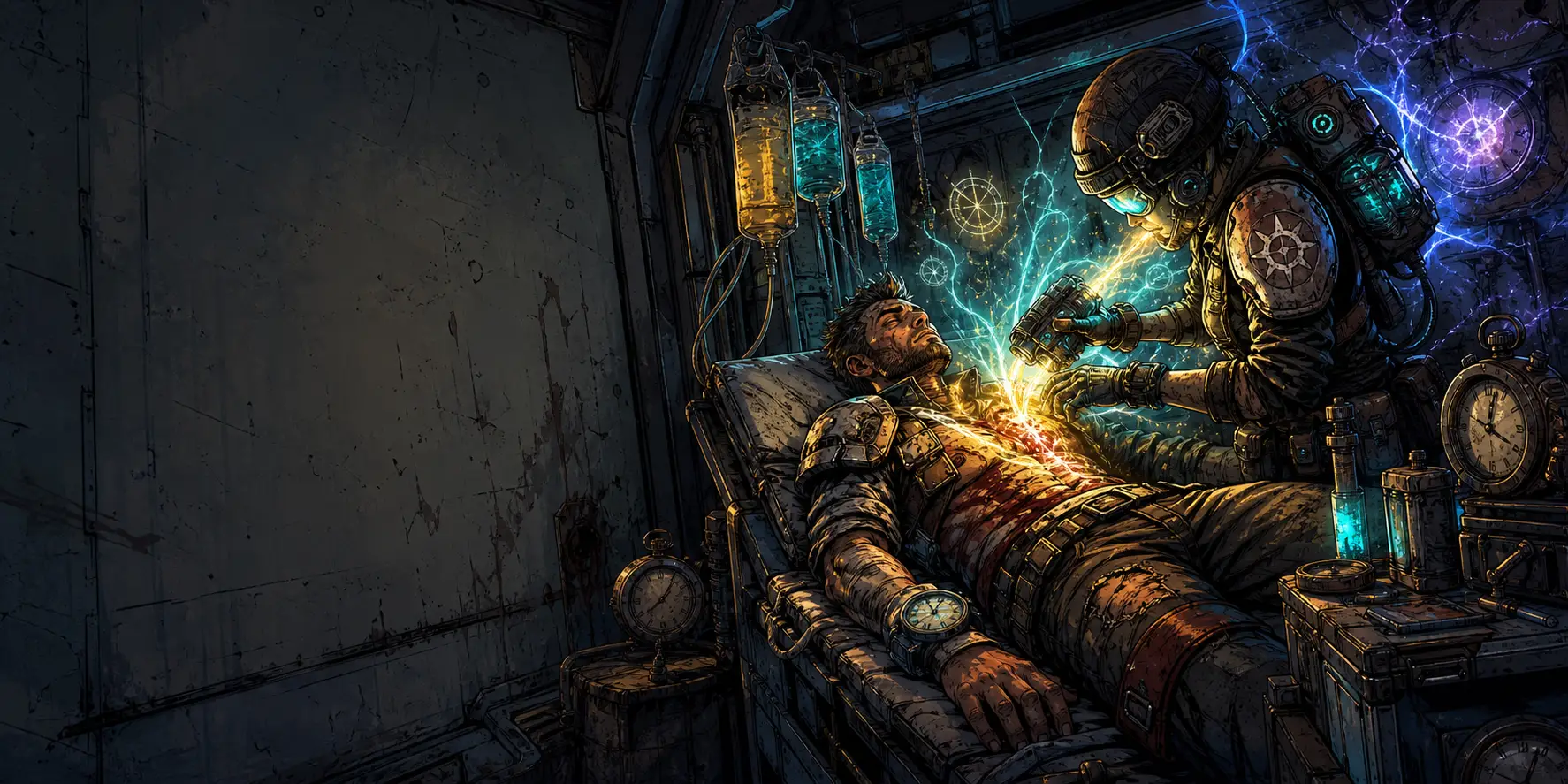
Borrowed Time and Stolen Pain
Healing is less “back to full” and more “bought yourself a few more Yoms.” Medkits, improvised clinics, Chronologist triage stations, and jury‑rigged nanogel injectors all serve the same purpose: keep people moving one more day against Riftstorms, starvation, bad air, and bullets.
Most spacers have scars a healer couldn’t smooth out or chose not to—proof they lived through something that should have ended them. Healing in Starfall is transactional: maybe a medic spends a spell slot, a guild doctor takes your last Yoms, a Rift‑touched mystic pushes your pain into the Maelstrom, or a void cultist re-stitches your flesh with something that doesn’t belong in reality at all. The healing trait tags all of those as effects that give some part of you back, even if the “you” that comes back isn’t quite the same.
Implications
Downtime recovery and endurance
Healing effects determine how quickly crews bounce back between jobs: whether a short Drift rest restores everyone, whether you need a guild clinic, or whether an injured ally becomes a long-running liability.
Social leverage and obligation
Healers—medics, mystics, Chronologist surgeons, Viridian bio‑adepts—often trade healing for favors, reputation, or devotion. Mechanically simple healing can become a major story driver when it is scarce, expensive, or morally complicated.
Hazard survival and exploration
In biohazard‑heavy or Rift‑warped zones, ongoing chip damage is expected; reliable healing lets groups press deeper rather than retreat, while limited healing forces hard choices about when to advance, rest, or cut losses.
Societal Impact
In a survival‑driven economy where time/Yoms are currency, healing is literally a way to buy more time. Factions that control robust healing—Chronologists with temporal stabilizers, Viridian enclaves with regenerative biotech, corporate med‑chains with nanoforges—gain enormous leverage over populations.
This also shapes culture. Some groups see heavy magical healing as a dangerous crutch, inviting Rift‑taint or debt to strange patrons. Others treat scars as social currency: a sign that you survived without “wasting” too much expensive healing on yourself. Meanwhile, undead or void‑aligned beings live in a parallel medical reality, seeking void healing sources no ordinary clinic offers, and building their own economies around the few who can patch them up.