Source Player Core pg. 413
Small: Compact Frames, Standard Footing
A creature with the Small trait occupies a 5-foot space and typically has a 5-foot reach, the same battlefield footprint as a Medium creature. In most core combat interactions, Small and Medium creatures function similarly: both usually take up one square on the grid, both normally threaten adjacent spaces, and neither can usually share spaces the way Tiny creatures can.
The practical differences show up more in fiction, equipment fit, carrying expectations, and any ability or effect that specifically references size. Small creatures use properly sized gear where relevant, and like other non-Tiny creatures, they can move through another creature’s space only if that creature is at least three sizes larger than they are; for a Small creature, that usually means Huge or Gargantuan creatures.
Because Small is a size trait, it combines with creature-type traits rather than replacing them. A creature might be Small humanoid, Small construct, Small robot, or Small undead, and its size tells you how much space it occupies while its other traits tell you what kind of being it is.
Built for Tight Places
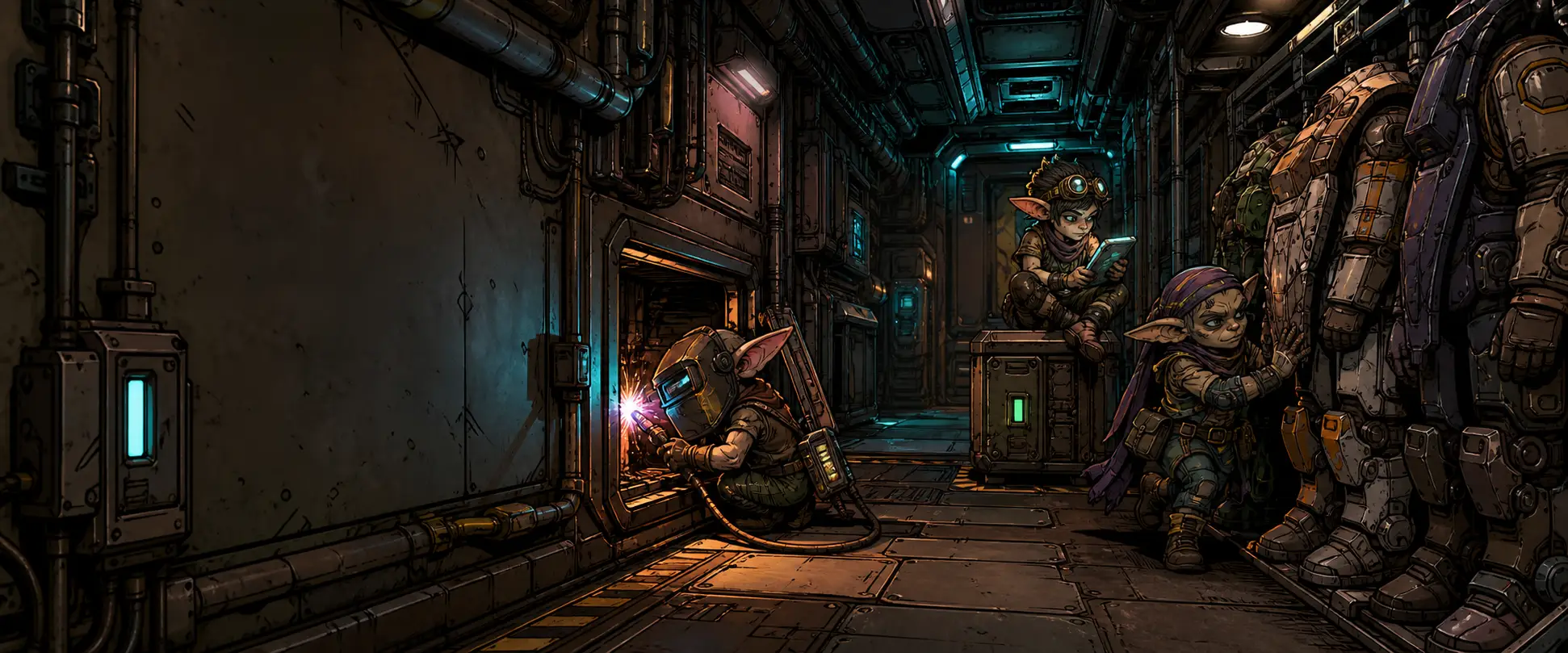
In Starfall, “small” rarely means weak. It means compact, efficient, and often better suited to the galaxy’s real living conditions than the broad-shouldered heroics of station propaganda. Most ships, maintenance corridors, lower-tier housing blocks, crawlspace tunnels, and overpacked market lanes reward bodies that can slip through crowds, work in close quarters, and live where every cubic meter matters.
Small folk in Starfall are often underestimated by people who confuse mass with leverage. Salvage runners, tunnel colonists, burrow-adapted species, compact cybernetic warforms, and gutter-brilliant techs all prove otherwise on a daily basis. A Small frame is often a mark of adaptation: to scarcity, to shipboard life, to hostile terrain, or to a culture that learned long ago that surviving the galaxy matters more than looming over it.
What the Small trait does
The Small trait communicates a few immediate assumptions:demiplane+1
The creature occupies one 5-foot square.
The creature usually has 5-foot reach.
The creature does not get Tiny-style space-sharing movement rules.
The creature is still small enough to fit the standard assumptions of most humanoid-scale infrastructure better than Large or larger bodies do.
Mechanically, this makes Small one of the most table-friendly sizes in the game. It avoids the special crowding rules of Tiny creatures and the footprint complications of Large creatures while still carrying strong setting flavor and occasional equipment or movement implications.
Small in Starfall society
Small bodies fit the lived geometry of Starfall well. Crowded stations, jury-rigged freighters, maintenance shafts, scavenger warrens, and frontier bunkers are often easier for Small people to navigate than for bulkier species or labor frames. In many regions, that makes Small populations especially common in technical trades, tunnel settlements, lower-deck communities, and mobile cultures built around constrained space.
At the same time, architecture is often built around a broad Small-to-Medium norm, which means Small beings are usually accommodated but not always prioritized. Consoles sit a little high, recoil systems assume longer arms, and armor markets tend to treat properly sized gear as a variation rather than a default. That tension gives the Small trait social weight without requiring separate rules overhead.
Non-Combat Applications
Shipboard utility — Small characters are ideal for maintenance work, vent access, tight salvage sites, and cluttered industrial environments.
Urban survival — dense lower-district life, hidden routes, and improvised housing — often favors compact bodies that use less space and resources.
Equipment culture — Small weapons, tools, and armor often reflect practical design choices: folding stocks, compact harnesses, shorter grips, and less wasted material.
Societal Impact
The Small trait reinforces one of Starfall’s core themes: civilization survives not because everything is grand, but because people adapt to cramped, damaged, and overused spaces. Small species and body plans fit naturally into a galaxy of aging infrastructure, salvage economies, and lived-in technology, where utility often matters more than spectacle.
That also makes Small a useful storytelling trait. It can signal populations shaped by burrowing, shipboard migration, resource scarcity, stealth trades, or generations spent living inside the machinery of bigger powers.
The Small trait marks creatures that share standard combat footing with Medium bodies but carry a distinct advantage in the tight, crowded, resource-strained environments that define much of Starfall Galaxy.