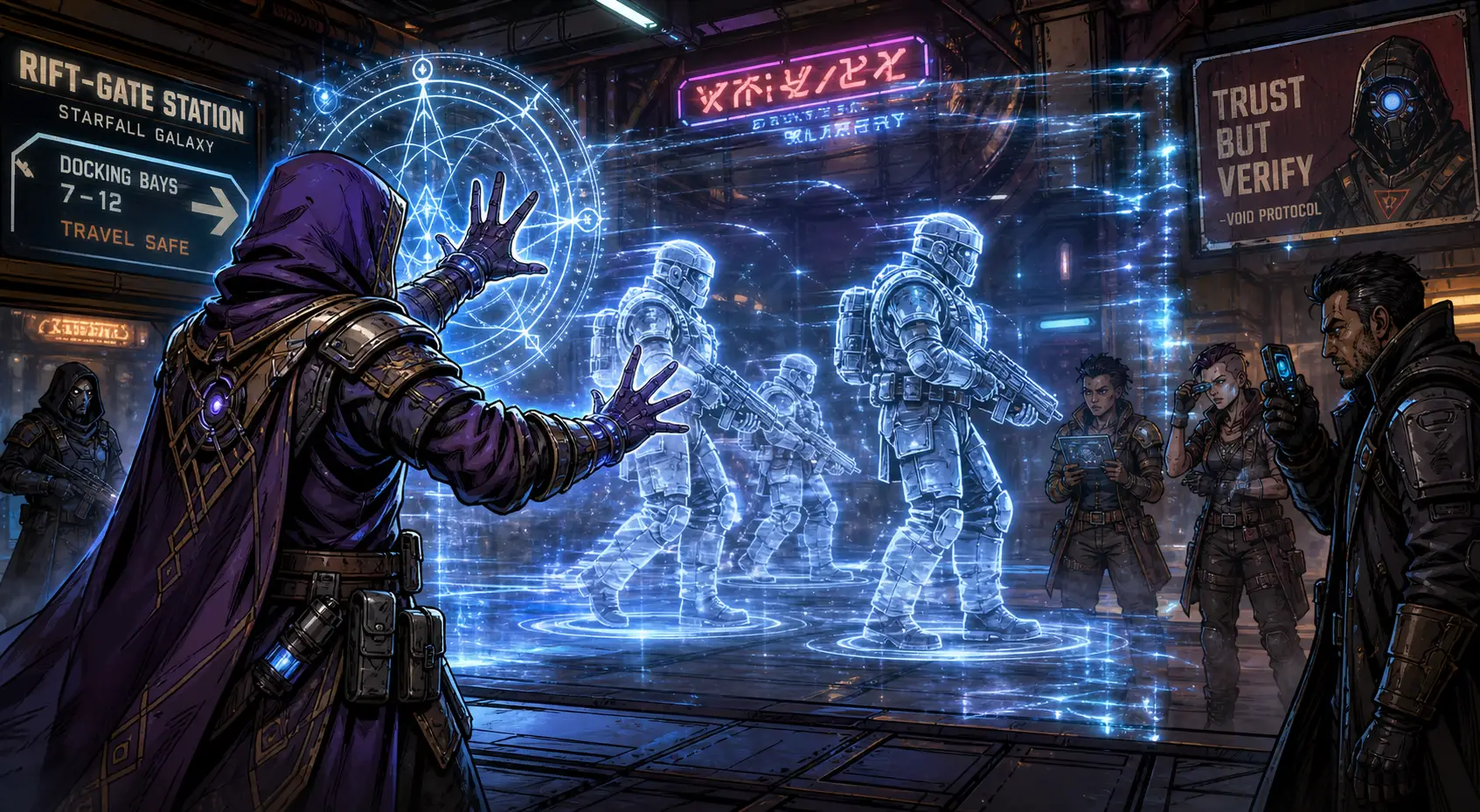
Illusory Scene: Scripted Rift Phantoms
Illusory Scene is the darling of arcane tacticians, con artists, and propagandists who understand that most beings believe what they see—until the Rift proves them wrong. On Inner Sphere ecumenopolises, commissioned spellwrights project whole riot scenes or fake security cordons over real streets, using programmed loops to herd crowds where corporate or Commission planners want them to go. In wilder sectors, Riftsworn cults conjure phantom battlefields and ghostly crusades across Rift‑scarred horizons, using Illusory Scene to blur the line between genuine planar bleed and weaponized spectacle.
Chronologist field teams and Accord security outfits lean on Illusory Scene to mask their real operations: a fake dockyard fire to clear civilians from a Rift‑contaminated berth, or a looping image of a sealed Metronome core to hide the fact that the chamber is wide open and crawling with technicians. In neon‑lit cantinas and black‑market bazaars, crime syndicates spin illusory crowds, extra guards, or fake cargo stacks to confuse rivals and ambush would‑be raiders.
On the metaphysical level, Illusory Scene is a tightly leashed fragment of the Rifts psychoreactive chaos, constrained by arcane logic into a predictable loop rather than an evolving nightmare. Casters who specialize in large‑scale illusions are prized in urban security, psychological ops, and high‑stakes infiltration work, but they walk a fine line—overuse in Rift‑unstable zones risks attracting entities that appreciate the artistry a little too much.
Implications
Crowd Control and Evacuation
Emergency coordinators in Commission hubs deploy Illusory Scene to create convincing but bloodless crises—spreading phantom smoke, fire, or structural damage—to clear districts before a real Rift incident cascades out of control. The spell’s long duration and wide radius let authorities stage orderly evacuations without firing a shot, at least when public trust hasn’t already been eroded by prior manipulations.
Training and Simulation
Military academies and corporate security schools use Illusory Scene to simulate complex urban engagements, starport assaults, or riot responses without the cost of full holodeck infrastructure. Trainees learn to distinguish looping patterns, read tells in artificial motion, and practice Seek‑like observation drills to spot illusions—a vital skill in a galaxy where the Rift warps reality and enemy casters weaponize perception.
Cover for Covert Work
Chronologists and Azure Archivists often cloak sensitive repairs or excavations behind a looping illusion of a quiet, sealed chamber or a mundane maintenance scene. As long as onlookers are far away and not interacting with the scene, the spell’s reliability keeps curious eyes and peripheral cam drones from noticing that half a wall is missing or that a Metronome core is in pieces.
Psychological Operations and Propaganda
The Crimson Concord and Ebon Syndicate alike broadcast Illusory Scenes as spectral “live” events—a burning symbol over a Commission plaza, a repeating tableau of heroic revolution, or a staged atrocity pinned on a rival faction. These displays, especially when chained across multiple sites, can spark fear, unrest, or fervor long before investigators prove that no shots were ever fired.
Art, Theater, and Religion
On Rift‑rich worlds, artists and mystics craft looping ritual illusions—a star falling into a sea of masks, or a god perpetually sacrificing itself over a crowd of pilgrims—to explore devotion, memory, and the meaning of repetition in a universe defined by cycles and Metronome beats. Some performances hide real messages or contact drops inside the scene, rewarding anyone who spots the loop and interacts with the “wrong” part of the illusion.
Societal Impact
As Illusory Scene became more widespread, Inner Sphere cultures developed a quiet paranoia around anything that looks too perfectly staged. Security doctrines now assume that any large public spectacle—a protest, a retreating squad, an exposed magitech shipment—might be a scripted illusion masking a very different reality. This has driven an arms race between illusionists refining their loops and counter‑illusion specialists training to spot repetition, lighting errors, or physics glitches.
Economically, the spell has undercut parts of the entertainment and training market; small syndicates and frontier militias can run “good enough” simulations or shows with one competent caster instead of investing in full holo‑infrastructure. Conversely, high‑end venues hire arcane designers to blend Illusory Scene with practical sets and magitech projectors, creating layered experiences where not even the staff are sure which parts are real.
Politically, repeated use of Illusory Scene for propaganda and PSYOPs has fueled conspiracy thinking in marginalized regions. Entire communities in the Outer Sphere insist that famous historical events were nothing but looping illusions—Commission crackdowns, alleged Rift incursions, even whole battles—making truth‑reconstruction and transitional justice nearly impossible. Chronologists attempting to reconcile timelines must now prove not only what happened, but whether witnesses ever saw reality at all.