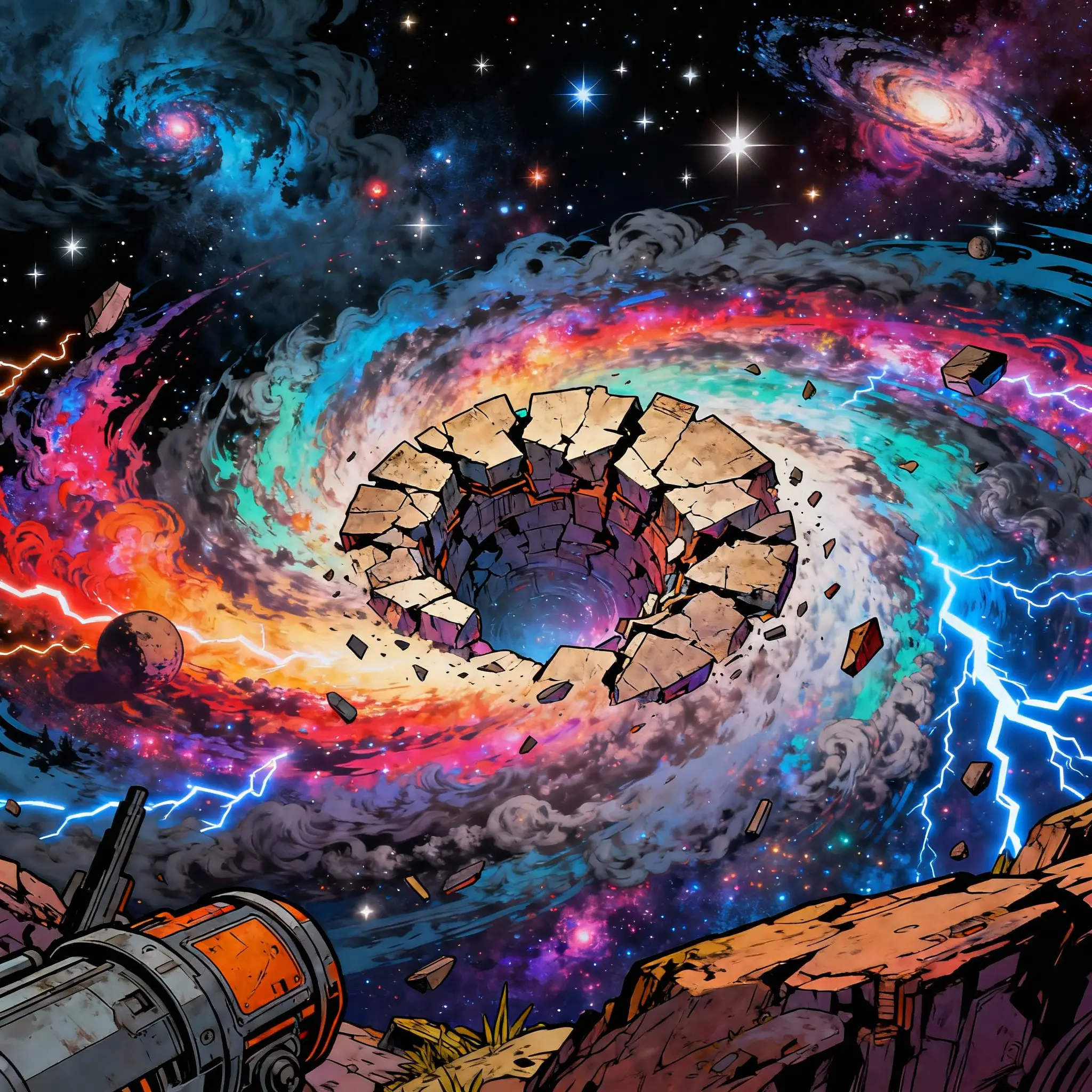
“The galaxy doesn’t care if you were born under Inner Sphere neon, Outer Sphere artillery fire, or the dead silence of the Frontier. Out here, nobody gets paid in credits or promises—we get paid in days. Every Yom you claw from the void is one more sunrise the Rift hasn’t stolen yet. Factions rise, Metronomes falter, Riftstorms eat worlds whole, and still the lanes stay busy because we’re too desperate or too hopeful to stop. Remember this when you spin up a Rift-drive or haggle over a Dei pack: you’re not buying comfort, you’re buying time—and time, in the Starfall Galaxy, is the only thing that ever runs out.”
— Navarch Ilyas “Grave-Luck” Renn, Free Rift-Runner of the Kaynsean Bowl
The Starfall Galaxy setting fuses the heart of grimdark science fantasy with survival-driven mechanics. Inspired by Grimdark Future, Starfinder 2e, and Magic: The Gathering’s Color Pie, this galaxy is not a land of utopias, but of colossal struggles, neon decay, and fleeting hope. Every resource and risk revolves around survival—time itself is the coin of existence. Navigating the galaxy means weighing every faction’s devotion and every journey’s hazards, as interstellar travel runs through the perilous Rift, and the persistent possibility of cosmic disaster shapes the fate of worlds.
Starfall Galaxy’s Boundless Skies
The Starfall Galaxy is vast and ancient, rebuilt and reimagined in the aftermath of empires long fallen. From the shining decay of the Inner Sphere, to the lawless Outer Sphere, and the perilous Frontier, every region harbors ancient mysteries, powerful factions, and unpredictable dangers. The galaxy’s main currency is the Yom—a day of survival—used to gauge trade, fuel, and equipment. The economy’s instability makes timekeepers and the Chronologist Guild essential for prosperity.
Primary Features
The Rift
A Psychoreactive Dimension that exist along side Real-Space.
The Yom Value System
Representative Currencies do not retain their value across the vast distances of Space; Instead spacers trade on the value of the resources required to survive a day in the Void
Pulse Reckoning
Reliable navigation between burning balls of gas hurtling among clusters of other burning balls of gas is supported by Transmission beacons place throughout the galaxy
The Passage of Time
Time’s unreliability is a constant anxiety: Rift journeys can send travelers decades or centuries into their future, fracturing families and societies. Metronomes—ancient temporal engines—anchor the galaxy’s Standard Cycle and are fiercely defended by the Chronologist Guild against those seeking to disrupt reality itself.
In the Inner Sphere, they say "Time is money," but out here in the Frontier, Time is life. The instability of the Rift means a simple trade run could cost you a decade of relative time if a Navigator slips. Because of this, the Yom (a standard day of survival) has become the universal currency. You don't pay in credits; you pay in the hours of life support, fuel, and labor required to keep breathing.
Components
The Devoted Factions
Six wide-spanning factions were in a time gone by formidable political entities in the Galaxy bitter warfare among them resulted in calamities that set them in steep decline. No longer strong enough to defy the great powers of the galaxy or even sustain open conflict among themselves. The Core Devotion Factions now bring about their objectives through subtle political influence and intrigue
Celestial Accord: Militarized, enforcing order and predictability. Guardians of the Rift-Gate network.
Crimson Concord: Anarchists valuing emotion, freedom, and constant change. Performance warfare and neon chaos.
Ebon Syndicate: Black market overlords—hyper-capitalist and ruthless, shaping galactic commerce from the shadows.
Azure Archivists: Seekers of lost knowledge, cybernetic and emotionless, braving cosmic mysteries with machine precision.
Riftsworn: Rift-mages and zealots fighting to dissolve reality’s laws and merge the galaxy with chaotic Rift energy.
Viridian Ascent: Biopunk ecosystemists cultivating psychic unity and rejecting mechanical life, growing flesh citadels and living starships.
Each faction employs agents, alliances, and subterfuge—rarely does open warfare dominate politics, as memories of galactic devastation remain fresh.
Notable Areas
Galactic Structure
The Starfall Galaxy spans an immense, largely uncharted realm, shaped by millennia of cosmic upheaval and by civilizations both ancient and new. Species, factions, and technologies have woven a tangled web of alliances and rivalries, creating a living history of settlement, migration, rebellion, and rediscovery. A vast network of trade, travel, and communication divides the galaxy into three principal regions: the Inner Sphere, Outer Sphere, and the Frontier.
The Rift Transitive Conceptual plane that exists alongside Real-Space
The Inner Sphere Central Core of the Starfall Galaxy, the most developed and densely populated galactic Sphere
The Outer Sphere Galactic Sphere of loosely associate clusters with many rival factions
The Frontier Sparsely populated outermost sphere of the Galaxy