Source Player Core pg. 295
Spellcasting in Starfall Galaxy: Channeling the Rift's Power
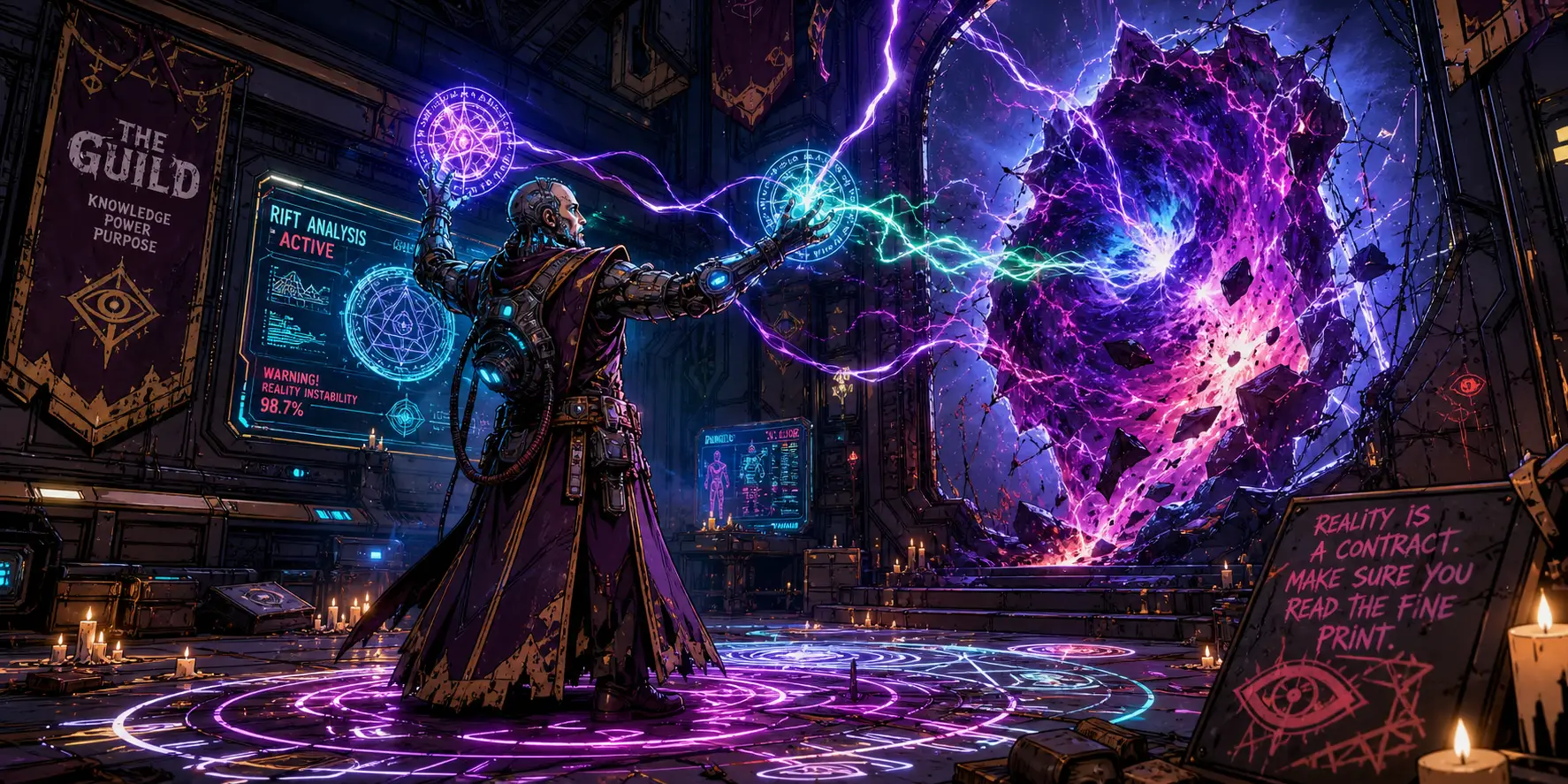
Spellcasting in the Starfall Galaxy is a dangerous bargain with reality itself. Every spell draws power from the Rift, the psychoreactive dimension beneath real space that birthed all life in the galaxy. Mages don't simply memorize incantations—they anchor their will against the roiling chaos of a cosmos that hungers to warp, mutate, and consume.
The Four Magical Traditions
Starfall Galaxy uses four distinct magical traditions, each representing a different approach to channeling the Rift's volatile energies.
Arcane: Logic Against Chaos
Arcane spellcasters use logic and rationality to categorize and control the Rift's inherent magic. Wizards pore over grimoires in Guild laboratories, technomancers integrate algorithms with spell-code, and researchers at the Chronologists Academy trace temporal equations across holographic slates. The arcane tradition offers the broadest spell selection but struggles with matters of spirit and soul. In Starfall, arcane casters are the galaxy's reality engineers—calculating, precise, and always one miscalculation away from Rift-Taint.
Divine: Faith as Shield
Divine magic flows from devotion—not always to gods, but to ideals, philosophies, and the convictions that anchor consciousness against the Rift. Clerics channel their Color Devotion (White, Blue, Black, Red, or Green) as spiritual armor, while animists draw power from the spirits they believe inhabit stars, ships, and stations. Divine casters excel at healing, protection, and manipulating planar forces—critical skills when Rift-Space bleeds into reality.
Occult: The Unexplained Systematized
Occult practitioners seek to understand the Rift's bizarre, ephemeral nature through systematic study of the mind, emotion, and cosmic mystery. Bards collect strange esoterica across the Inner Sphere, psychics navigate mental landscapes, and investigators catalog anomalies that defy conventional arcane models. The occult tradition thrives on mental magic, illusions, and effects that warp perception—reflecting the Rift's psychoreactive nature.
Primal: Raw Elemental Power
Primal magic taps the elemental forces of the Inner Planes—nature, the elements, and the fundamental energies predating civilization. Druids bond with biopunk ecosystems on Viridian Ascent worlds, while elemental kineticists channel plasma storms and gravity wells. On low-tech frontier worlds and living ships, primal casters are essential—their magic doesn't rely on failing infrastructure or complex rituals.
Prepared vs. Spontaneous Spellcasting
Starfall spellcasters fall into two categories based on how they access their power.
Prepared Spellcasters
Prepared casters—wizards, clerics, druids—must choose their spells during daily preparations, typically an hour-long ritual after rest. They select specific spells to "anchor" from the Rift, loading them like programs into mental architecture. This grants incredible day-to-day flexibility but locks choices once made. A wizard who prepared Fireball three times can't swap one for Lightning Bolt mid-mission—though in emergencies, they can use higher-rank slots to cast lower-rank prepared spells.
Spontaneous Spellcasters
Spontaneous casters—sorcerers, bards, psychics—draw from a fixed spell repertoire but can cast any known spell using available slots. They offer superior tactical flexibility within a single day but can't change their repertoire until they gain levels or retrain. Their magic is intuitive, instinctive, and often tied to bloodline, emotion, or innate Rift-attunement.
Spell Slots and Heightening
Both prepared and spontaneous casters use spell slots—daily reserves of magical energy organized by rank (1st through 10th). Higher-rank slots can heighten lower-rank spells, amplifying their effects. A Heal spell cast in a 4th-rank slot restores far more HP than the same spell in a 1st-rank slot.
Spell Signatures and Manifestations
Casting a spell creates obvious sensory manifestations: crackling energy, glowing runes, sharp scents, and visible spell signatures—colorful magical glyphs that appear mid-air, usually around the caster's hands. In Starfall, these signatures reflect the caster's tradition, Color Devotion, and personal style
Academic wizards: Neat, ordered geometric patterns
Druids: Organic, living spirals
Clerics: Glyphs inspired by their deity or devotion
Witchwarpers: Reality-fracture distortions, prismatic tears
Magic and the Rift: Risk and Reward
All spellcasting in Starfall taps the Rift, making every spell a gamble. The Rift is psychoreactive—it responds to emotion, devotion, and desperation. Navigators, chronomancers, and field mages all risk Rift-Taint when channeling its power. Some effects:
Rift-Burgs: Stable pockets in the Maelstrom where spells behave unpredictably.
Planar Bleed: Regions where reality thins, amplifying or warping magic.
Mana Storms: Surges of Color-aligned energy that empower matching Devotions.
Implications
Chronomancers stabilize temporal anomalies and repair Metronome networks
Technomancers integrate spells into starship systems and magitech devices
Animists commune with ship spirits for navigation guidance
Druids cultivate biopunk ecosystems on living vessels
Societal Impact
Magic has reshaped Starfall's economy, culture, and power structures:
Rift-Gates require chronomantic stabilization to remain operational
Black markets trade in illicit spell formulas and Rift-touched components
Guild politics revolve around magical expertise and temporal clearances
Tech duels pit technomancers against each other in ritual combat
The most skilled casters aren't just adventurers—they're power brokers, negotiators, and the thin line between civilization and Rift-chaos.