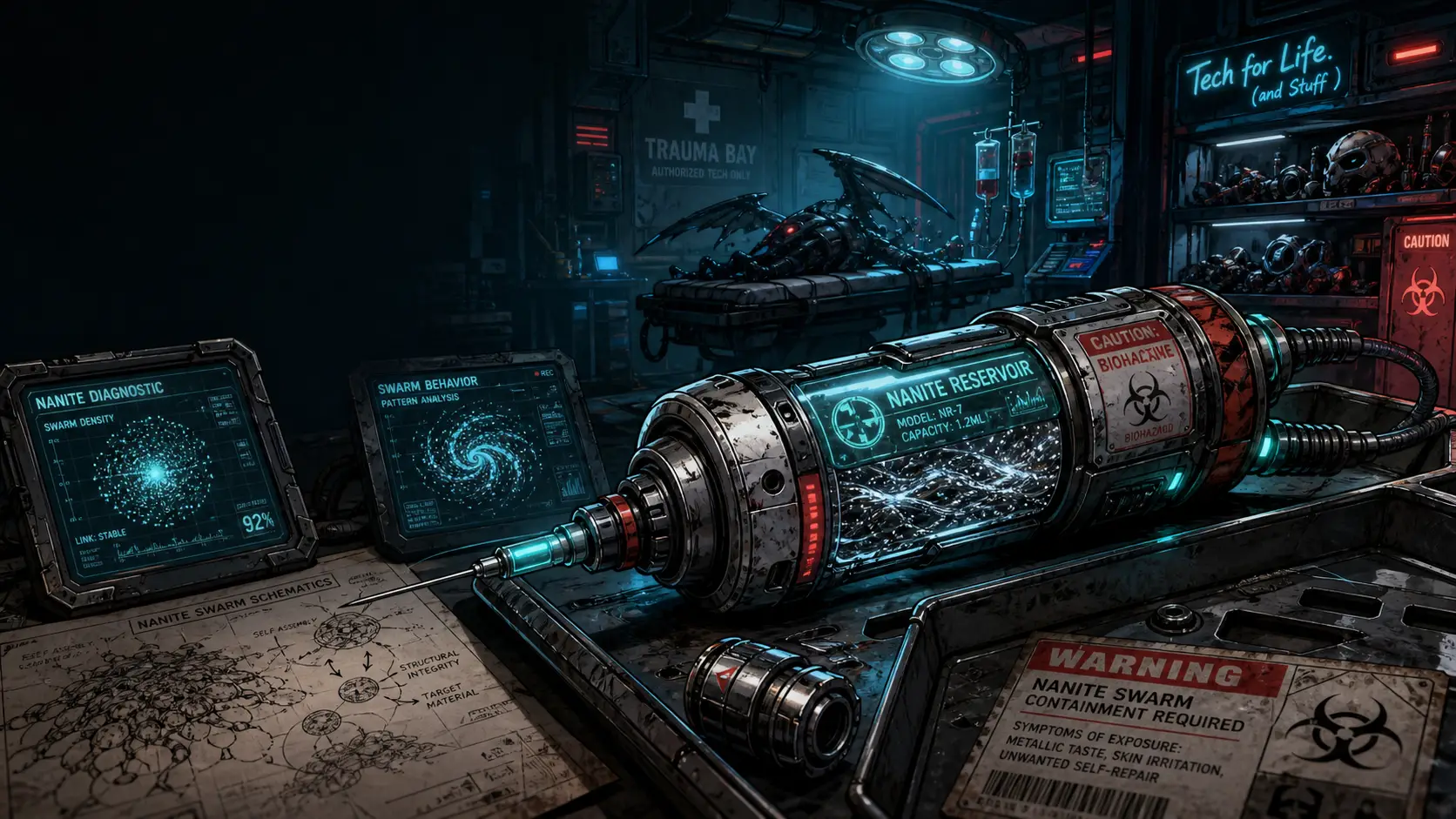
In the guts of a Wingbot, the Nanite Reservoir & Injector looks innocuous—just a thumb‑sized capsule wired into the sting assembly with a bundle of micro‑lines. Inside, though, is a dense slurry of maintenance and disruption swarms, each factory‑coded with repair routines, interface protocols, and hostile “exception handlers” that happen to work just as well on rogue Tech and uncooperative flesh as on turbine bearings.
Once salvaged, that capsule becomes a coveted bit of kit. Dockside docs see it as an off‑the‑shelf injector system; gang chemists see programmable venom they don’t have to grow; Viridian bio‑engineers see a rival “machine immune system” to dissect. In Starfall’s grim economy, anything that can be reprogrammed, refit, or re‑weaponized is money—and nanites are the purest expression of that ethos.
Implications
Field Repair Swarms – Reflashed to their original maintenance routines, reservoirs can be loaded into industrial injectors or spray heads to perform micro‑repairs on hull plating, exosuits, and micro‑circuitry, especially in places where full workshops won’t fit.
Targeted Medical Flushes – Risky medtechs experiment with using tamed nanites as selective chelation or clot‑breaking agents—injecting them to strip heavy metals, dissolve clots, or scrub out other nanites. The line between “therapy” and “experimental war crime” is thin.
Forensic Data Tracers – Investigators and corporate black‑ops teams code nanites as trace markers, so anyone stung or injected starts shedding a detectable signature in their bioelectric field or on surfaces they touch, turning the reservoir into a tracking and tagging tool rather than a weapon.
Bio‑Mech Interface Research – Viridian Ascent labs and archivist think‑tanks dissect different reservoir lines (Wingbot‑pattern, Turret‑grade, Starship‑sentry) to map how machine swarms adapt to organic environments, looking for ways either to immunize life against them or to hybridize them with living tissues.
Controlled Deconstruction – Salvage crews sometimes mount reservoirs into “smart solvents” that eat specific alloys or polymers on command—perfect for stripping valuable components from wrecks without damaging them.
Societal Impact
Because Nanite Reservoirs & Injectors are small, durable, and easily repurposed, they’ve become a quiet backbone of the black‑market biotech and Tech‑poison trade. Commission regulators classify factory‑fresh reservoirs as controlled items, but once they’re deployed inside Wingbots, crowd‑control drones, or experimental weapons, they inevitably start turning up in salvage yards and back‑alley clinics.
On core worlds, nanite incidents have become a grimly familiar hazard. Street medics carry “nano‑flush” kits next to burn dressings; union organizers warn crews about bosses who “juice” security drones with nastier firmware; ghost stories circulate about people who survived multiple stings only to develop mysterious tremors, sensory glitches, or an irrational itch whenever Wingbots fly overhead.
For factions, reservoirs are a strategic asset. The Celestial Accord prefers tightly controlled “non‑lethal” loadouts that mostly Glitch Tech targets, preserving infrastructure. Ebon Syndicate labs remix salvaged swarms into bespoke poisons keyed to corporate implant firmware. Riftsworn cult cells whisper about using Rift‑tainted reservoirs as vectors for metaphysical infection, letting the Rift seep into machines and minds drop by drop.
All of this reinforces Starfall’s core tension: survival and control depend on microscopic machines few citizens truly understand, and the same capsule that might patch a cracked pressure hull can just as easily shut down a heart—or a city’s entire security grid.