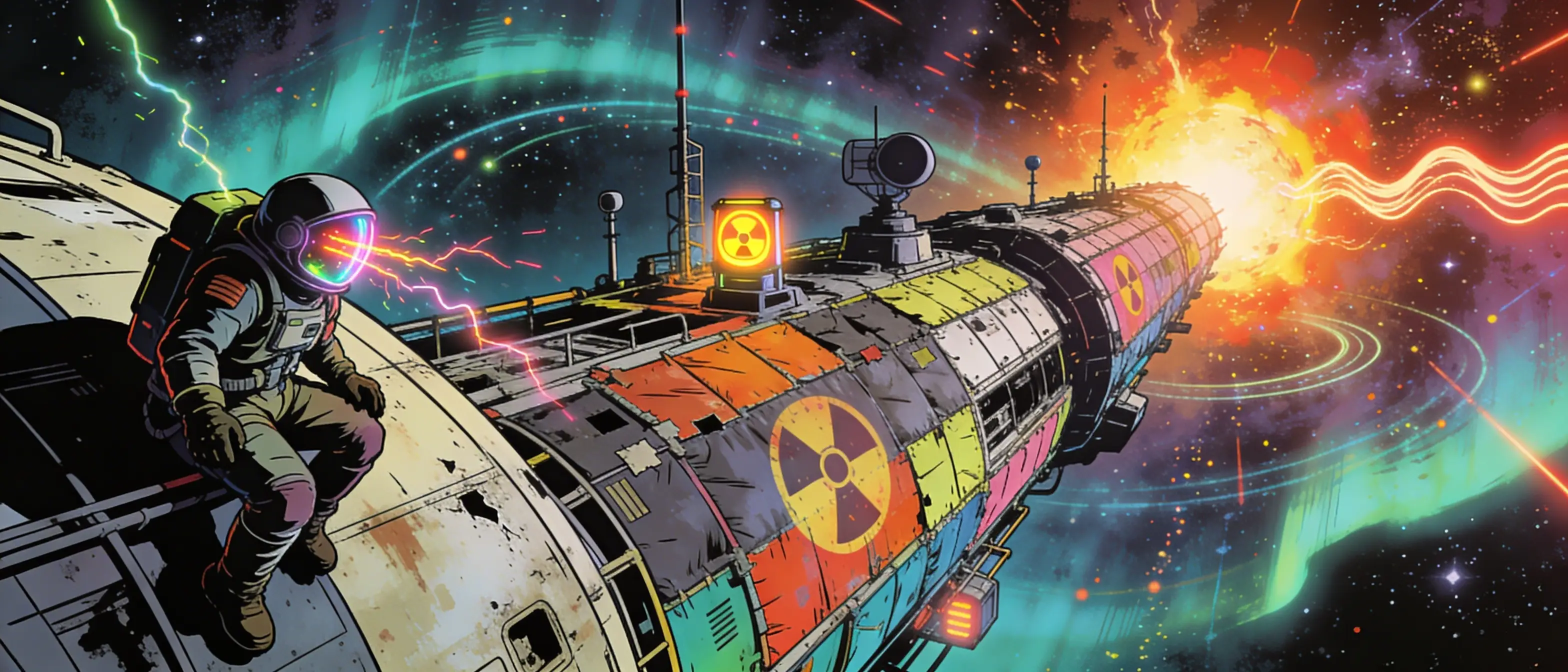
Starlight That Bites
To most spacers, cosmic radiation is “the bite in starlight”—the unseen teeth riding on every beam and particle that crosses the void. Stars don’t just shine; they hurl a constant storm of high‑energy photons, protons, and heavier ions outward, and the galaxy adds its own crossfire of distant supernovae, black‑hole jets, and relics of the Big Bang.
On worlds with thick atmospheres and strong magnetic fields, people forget this. The planet’s magnetosphere bends most incoming charged particles away, and the air above their heads soaks up the rest, turning lethal ionizing radiation into something background and almost harmless. But step out onto an airless moon, a derelict in deep orbit, or a bare station hull, and you feel it in the hiss of Geiger counters and the slow, quiet breakdown of anything not built to endure the stars.
In Starfall, elder navies used to say, “Vacuum is patient, but radiation is hungry”—vacuum waits forever, but cosmic rays are always gnawing at hulls, cells, and circuits.
Mechanics
Cosmic radiation is an environmental feature of outer space and Atmosphere less worlds, inflicting degrees of Radiation Sickness (Mild → Severe → Extreme → Incredible) on unprotected creatures.
In Starfall Galaxy, you can treat “Cosmic Radiation” as the default background hazard whenever PCs are outside an atmosphere or hull without functioning environmental protections—spacesuits, armor seals, hardened starship sections, or specially shielded habitats. It also justifies radiation‑linked hazards, diseases, and glitches in technology, especially in long‑term exposure zones like dead stations, asteroid belts, and abandoned research arrays.
Cosmic Radiation in Starfall Galaxy
Spacers talk about the “unmitigated energy of the Big Bang”—their poetic way of describing long‑term exposure to deep‑space cosmic rays that can inflict Incredible radiation sickness on unshielded beings.
Rift Interaction: Near unstable Rift eddies, cosmic radiation becomes knotty and erratic—flux levels spike along invisible “psychic lines,” and some radiation storms seem to follow Navigators or Metronome pulses instead of simple orbital mechanics.
Metronome Belts: Ancient temporal engines often sit inside artificial “quiet zones” of filtered space, but their maintenance shells can form secondary radiation belts from trapped particles around their mass and field geometries, making approach lanes dangerously patchy.
Yom Calculus: Long voyages through high‑radiation regions don’t just cost fuel and life support; they cost health time—extra Yoms for medical monitoring, rad‑hard drugs, and replacement tissue, all priced into contracts.
Cosmic radiation is part of what makes Starfall’s void hostile and expensive even when “nothing is happening”: it erodes hulls, corrupts data, and slowly poisons anyone cutting corners on shielding.
Manifestation
Cosmic radiation is manifested in two broad forms:
Electromagnetic radiation – high‑energy ultraviolet, X‑rays, and gamma rays pouring out of stars, flares, and exotic objects. These photons can penetrate armor, damage DNA, and fog sensors.
Particle radiation – streams of fast protons, electrons, and heavy ions thrown off by stellar winds, supernova shock fronts, and active galactic phenomena. These are what sailors call “star hail,” the charged bullets that punch into hulls and tissues alike.
Natural Shielding and Exposure
On habitable worlds, two overlapping shields keep life possible:
A magnetic field deflects many charged particles, funneling them toward the poles and away from most of the surface.
A thick atmosphere absorbs most remaining high‑energy rays before they reach the ground.
As a result, surface dwellers live under relatively low, fluctuating doses, while high‑altitude pilots, station crews, and frontier colonists on thin‑air or magnetically weak worlds live closer to the raw flux. In game terms, GM Core captures this by stating that planets without atmospheres expose creatures to mild to severe radiation constantly unless they are shielded.
Space stations and starships have no natural protection other than their own hulls and fields; in the real universe, space stations in low orbit already see radiation doses hundreds to thousands of times higher than on the ground, and Starfall’s harsher stellar neighborhoods can be worse. This is why every vacuum‑rated structure in Starfall is a compromise between massive shielding, which is expensive and heavy, and acceptable risk, which gets cheaper the more desperate your passengers are.
Impact
Beyond “it kills you,” cosmic radiation shapes technology, science, and daily life in several ways:
Power and Propulsion: Some Outer Sphere corporations and guilds harvest radiation belts and stellar output through vast panel arrays and magitech siphons, turning lethal flux into energy for stations and Rift‑drives.
Sensing and Mapping: Differences in local radiation—shadows behind asteroids, bright belts, and odd gaps—help Navigators map out safe “shadow lanes” for ships or identify hidden structures by the way they disturb the flux.
Medicine and Mutation: Controlled radiation exposure is used in cutting‑edge medical treatments, gene‑editing, and regenerative vat‑work, while uncontrolled exposure explains certain frontier mutants, Rift‑stained fauna, and the occasional “rad‑saint” cult figure.
Forensics: Investigators can read radiation signatures in wrecks and crime scenes—burst‑patterned burns on hull plating or unusual isotope ratios—to reconstruct when and how a ship passed through a flare or sabotage event.
Civilizations in Starfall organize themselves around where radiation is tolerable, profitable, or weaponizable:
Habitat Design: Coreworld habitats bury themselves under regolith, water jackets, or spell‑reinforced armor, while poorer belts and Frontier clades make do with flimsy hulls and short service lives, accepting higher cancer rates and mutations as the cost of existence.
Rad‑Hard Tech: Electronics in ship cores, Metronome nodes, and military networks rely on radiation‑hardened components—bulkier, slower, but resistant to bitflips and glitches from cosmic hits. Smugglers and warlords prize surplus mil‑grade rad‑hard gear.
Occupational Castes: “Rad‑monks,” shield techs, and flux surveyors form specialized guild tracks; their work deciding which orbits, hull sections, or mining shafts are survivable shapes local economies and politics.
Faith and Fear: Some Devotional sects interpret cosmic radiation as literal divine fire—punishment, purifying trial, or the whisper of the Colorless Void—fueling pilgrimages to rad‑blasted moons or worship of survivors as touched by the stars.
In short, where radiation is high, society clusters in caves of alloy and spellglass; where radiation is low, people spread across surfaces and orbits, trading safety for sky.
Cosmic radiation in Starfall is more than a line on a hazard table: it’s the ever‑present background threat and resource of the void, one that shapes where people can live, how ships are built, and what it costs—in Yoms and lives—to cross the galaxy at all.