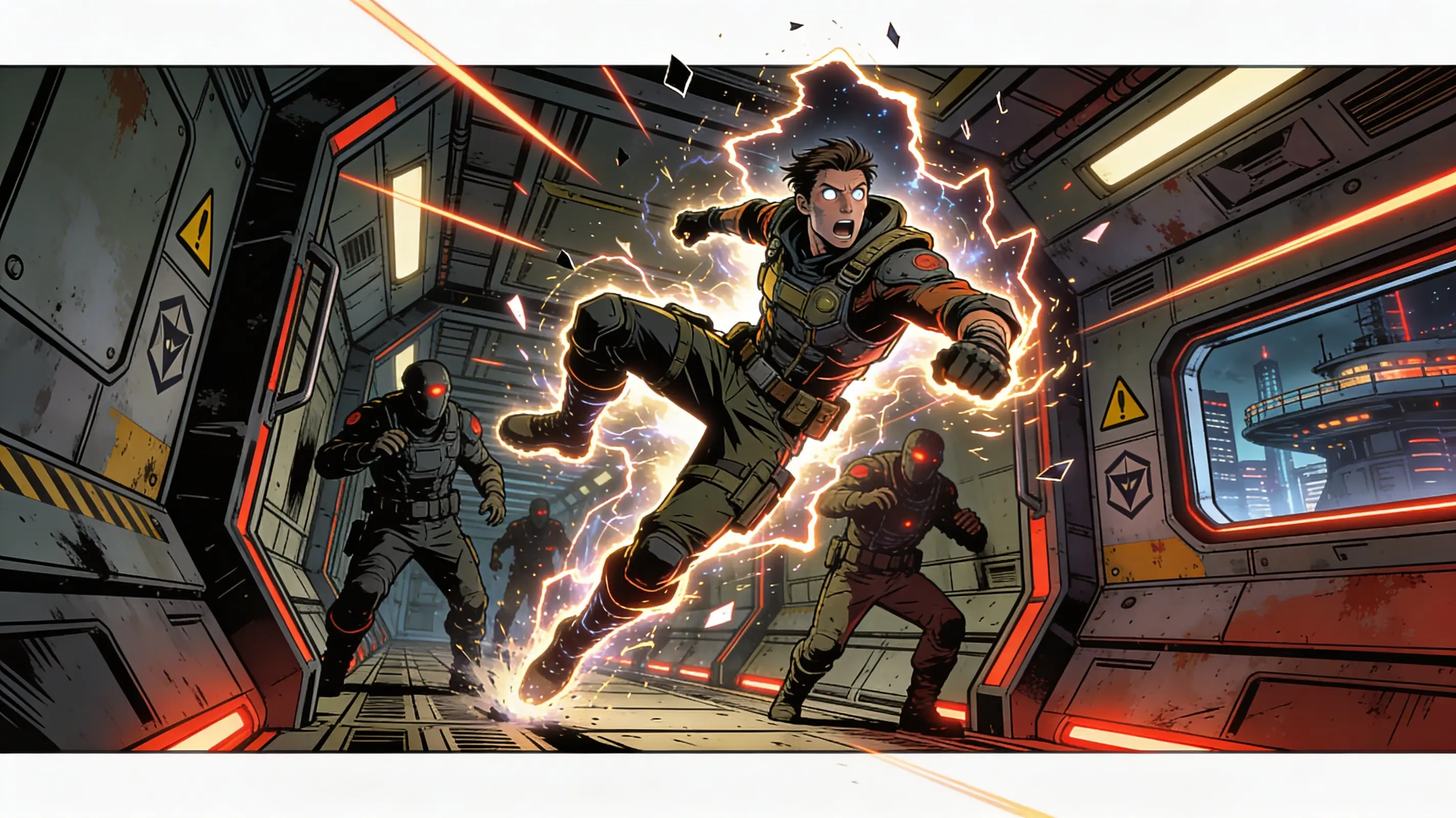
The Void Exchange does not bristle with visible batteries or dreadnought gun decks; its most feared weapon is the simple act of moving you somewhere else. When the Administrator declares the Exchange under threat, the station’s Rift linked teleportation lattice snaps from quiet logistics tool to executioner.
Captains who have tested the Exchange’s patience—firing on its hull, breaching dock security, or attempting to ram—report the same thing, when they survive to tell it. One moment their weapons are hot and solutions locked; the next, the stars are in the wrong place and their sensors scream. Some find themselves at the cold edge of the system, drive coils fried by transition stress. Others flicker into existence too close to the local star, hull plating curling like paper before an emergency Rift jump can be triggered. Many are simply never heard from again.
Inside the hull, the effect is subtler but no less absolute. A mercenary commander throws a punch in the wrong chamber, or a saboteur arms a device near a Vuswis maintenance route—and suddenly they are elsewhere, mid-sentence, in a brightly lit brig cell or a stripped isolation deck with all weapons disassembled on a separate table. No alarms. No flash. Just a lurch in the stomach and a very clear sense that something watching the corridors decided their location was unacceptable.
The Exchange’s residents have learned the lesson: there are lines you do not cross. You do not fire on the ship. You do not threaten the Crossroads. And you do not lay a hand on the Vuswis.
Enforcing the Administrator's Law
The Vector net is the administrator's tool of law enforcement. there are 3 laws that The administrator enforces;
Do not Threaten this ship
Do not risk essential ship systems
Do not interfere with the Vuswis Crew
The conduct of citizens in the Habdecks are generally left to the resident council to govern. As long as nothing interferes with the operation of the ship the city inside is permited to govern itself. The most common offenses that results in bodily displacement are escalation of force infractions. Brandishing a weapon in the council chamber or as a threat to the crew results in being teleported to the Brig where the subject is held for 72 hours and subjected to their Vuswis warden's disappointment. Multiple offences will get the subject expelled back to the ship they came in on if they are lucky or marooned on a nearby planet if they are not.
Ships that fire weapons in the general direction of the Void Exchange are displaced out of threat range; Ernest attempts at damaging the Void Exchange cause ships to be displaced into Asteroids, Stars, or small Planetoids.
On three occasions a Vuswis has been wounded on the void exchange and once a Partisan aimed a laspistol at the administrator; on all four occasions the offenders had the skin teleported off of thier bodies and they were left to die writhing in pain.
Implications
Despite its reputation as a weapon, most of the EVN’s activity is quiet, routine, and deeply practical. The Administrator uses the same lattice that can relocate a battleship to run the station like a living organism.
Emergency Evacuation:
Teleporting civilians and staff out of breached sections during hull ruptures, fires, or Rift anomalies.
“Swapping” endangered personnel with empty compartments near safe med bays.
Quarantine & Containment:
Isolating contaminated or tainted decks by rerouting teleport permissions, making it impossible to access them without explicit high-level authorization.
Shunting infected individuals directly into sealed quarantine wards.
Logistics & Routing:
Quietly moving high-value cargo or critical components directly between deep storage and key facilities when physical transit would be too slow or too visible.
Repositioning Vuswis work teams to distant maintenance nodes without exposing them to public corridors.
De-Escalation:
Relocating heated negotiation parties to separate secure rooms before a dispute turns violent.
Extracting an at-risk witness from a compromised meeting, leaving their would‑be attackers punching air.
Used this way, the EVN is less a cannon and more a nervous system: constant micro‑adjustments that keep the worldship alive.
Societal Impact
The existence of the Exchange Vector Net shapes culture and behavior throughout the station.
Deterrence Culture: Everyone knows the Exchange can simply move them if they step too far out of line. Open armed uprisings are rare; most conflict plays out through legal maneuvers, trade pressure, and covert operations that try not to trigger the Administrator’s threshold.
Paranoia & Discipline: Politicians and crime lords alike adopt rigid “safe corridor” protocols—never meeting in the same room twice, checking for hidden teleporter beacons, and building rituals around “grounding” themselves with tech that supposedly resists displacement, whether or not it actually works.
Myth of the “Clean Kill” Because the EVN can delete a ship from effective play without leaving wreckage, stories circulate of enemies who “vanished into the Rift” for displeasing the Administrator. Some are true. Others are propaganda tools used to keep junior officers and gang lieutenants in line.
Sanctity of the Vuswis: Everyone understands—if only at the level of rumor—that harming a Vuswis invites the harshest application of the grid. As a result, even hardened crews treat the “ghost crew” with wary respect and give them wide berth.
The net effect is a station where violence is always possible, but overt, messy violence is strongly disfavored. Power expresses itself in who controls access, who vanishes quietly, and who can walk through contested corridors without being moved.