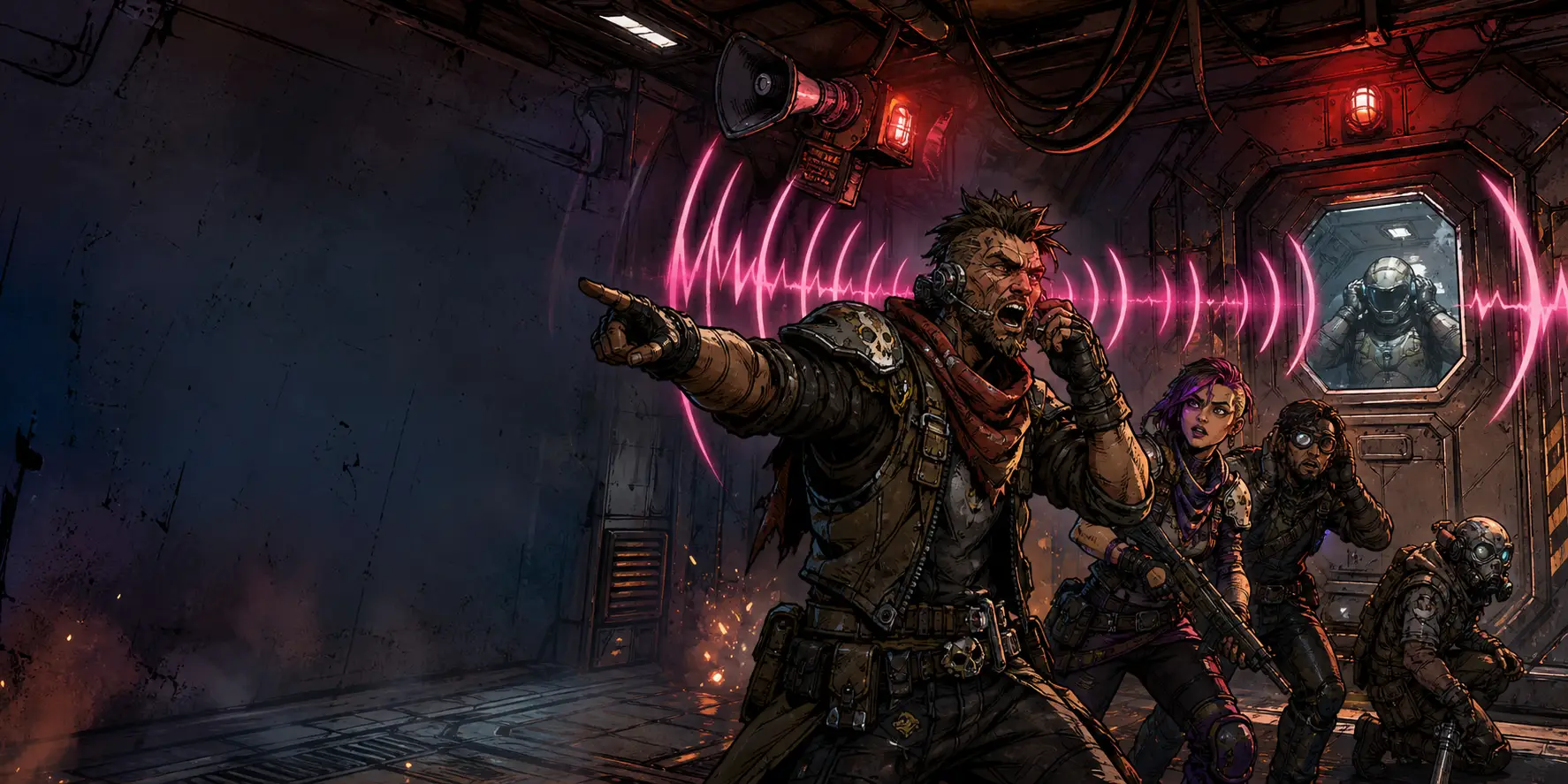
Sound is cheap and everywhere: engine hum, station alarms, guild jingle-ads, pirate broadcasts, and the constant background rattle of ships never meant to last this long. But none of that matters if the right ears never catch the signal. An auditory effect—whether it is a shouted warning, a coded whistle, a shrieking Rift siren, or a command phrase keyed into a drone’s behavior—is only as real as the minds that hear it.
Spacefarers learn fast that sound is fickle. Vacuum kills it, bulkheads muffle it, jammers drown it, and some creatures simply do not listen with anything resembling ears. An order barked over failing intercoms, a panic-calming chant in a burning corridor, or a Concord anthem meant to break a riot can all fail—not because the will behind them falters, but because the sound never quite reaches the people it needs to reach.
Implications
Command and coordination
Many directives, rallying cries, and leadership techniques are explicitly auditory—if allies cannot hear you (due to helmets, jamming, or environment), those bonuses never land.
Alerts, passwords, and coded signals
Alarms, station klaxons, cargo-bay whistles, shipboard call-and-response phrases, and black-market birdcalls all rely on the auditory trait to matter; dampen hearing and these systems become fragile.
Illusions and performances
Holographic acts, illusory scenes, masquerade rigs, and projection systems often carry auditory and visual tags together; a target immune to auditory effects might still see the illusion but not be swayed by its soundscape.
Social Impact
Because so many social tools rely on sound—speeches, propaganda, coded guild hails, sirens, devotional chants—the distinction between “auditory” and other trait tags has real cultural weight in Starfall. Communities hardened by vacuum work, sonic warfare, or sensory hazards develop parallel systems: sign-based command codes, haptic alerts, light-panel warnings, and psychic pings to backstop moments when ears cannot be trusted.
At the same time, those who control auditory channels—broadcasters, guild dispatchers, station authorities, cult hymnmasters—wield disproportionate power over what the galaxy hears. This makes devices that block, distort, or hijack sound (deafening weapons, dampening fields, jammers, or sense-dulling gear that resists auditory effects) strategically valuable in both warfare and resistance.