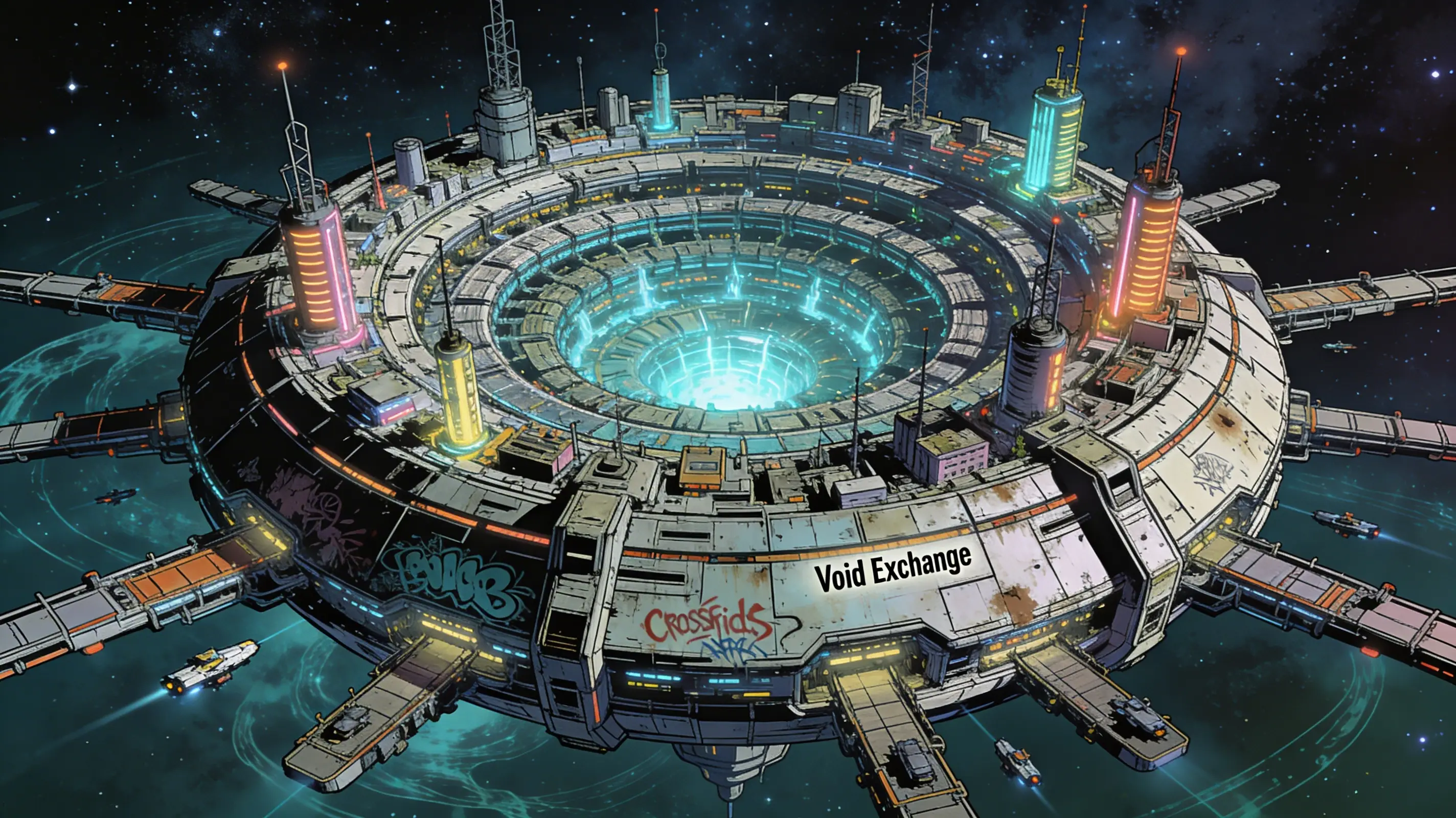
“From the outside, the Void Exchange looks like a city built around a miracle of travel. From the inside, you learn the truth: it’s a ledger wrapped in steel, where days of life, cargo routes, and whole governments are bartered away so quietly the galaxy mistakes it for law.”
Description
The Void Exchange is a Precursor Worldship, a colossal mobile megastructure that serves as the Inner Sphere’s roving capital and the primary diplomatic, commercial, and legal hub of the Inner Sphere. Designed by the precursors around an ancient nexus of Riftgates known as the Crossroads, it functions simultaneously as neutral ground, economic engine, and strategic chokepoint for interstellar politics. Its chambers host everything from famine relief negotiations to quiet declarations of economic war.
Origins in Fire and Ruin
Long before the Commission wrapped it in bureaucratic steel and neon, the Void Exchange was a different ship with a different name. The vessel first entered recorded history as the Star Weaver, a massive worldship discovered adrift by the Xoz-Roq, Scale Hegemony, complete with atmosphere-producing ecohab levels and a concealed Riftgate network embedded deep in its hull. Later, during the ascendancy of the Principalities, it was rechristened the Phoenix Wing and turned into a diplomatic refuge where princes and envoys bargained beneath ancestral banners.
The RiftStorm Cataclysm shattered that order. As worlds were dragged into the Rift and the Vaelen Principalities bled themselves dry, a sparsely crewed Phoenix Wing limped into the Terra system. A human officer stepped from its command suite, declared herself administrator of the craft, and invited the rising Terran Republic to occupy the vacant council chambers. The ship took a new name—Void Exchange—and became home to the Star Congress, the first serious attempt to rebuild a coherent interstellar forum after the Cataclysm.
As the Terran Republic waned under the weight of its own rift-born disasters, the Star Congress gave way to a pan-species Commission of corporate blocs, guild coalitions, and dynastic enclaves. The Administrator refused to cede the Exchange itself, instead asserting its independence while allowing the Commission to use it as their meeting ground and traveling capital. The names on the doors changed; the ship remained.
Primary Features
The Crossroads
At the heart of the Void Exchange is the Crossroads, an ancient cluster of interlinked Riftgates that predates recorded Inner Sphere history. Control of these gates allows the Exchange to project influence across light‑years, turning routine session schedules into literal life‑and‑death timing for distant worlds.
The Galaxy's City
Centuries of expansion have wrapped the original Precursor hull in docks, habitation rings, embassy spires, legal towers, and worker slums, transforming the Void Exchange into a drifting city‑world. Millions live and die without ever leaving its corridors, forming layered cultures that range from polished Commission salons to rust‑stained maintenance warrens.
Weaponized Neutrality
The Administrator enforces “neutral ground” with Rift‑linked teleportation arrays and precision denial of access to the Crossroads. Ships that threaten the Exchange vanish to the system’s edge—or into a star’s corona—while disruptive individuals inside may find themselves mid‑sentence in a brig cell.
The Hidden Board
Behind the formal Commission chambers, a cabal known simply as the Board quietly sets agendas, coordinates “good business” between major parties, and decides which crises merit real help. Most citizens will never hear the Board’s name, only feel the slow pressure of rulings and sanctions that always seem to favor the same families and syndicates.
Function
Engines, Itinerary, and Presence
A web of colossal engines and anchor thrusters lets the Void Exchange move along a slow, deliberate circuit through the Inner Sphere. Officially, the itinerary is a symbol of inclusion; the Commission brings the capital to every major region in turn, reminding each system that their voices—and their obligations—matter.
In practice, the Exchange’s arrival in a system is a strategic event. During crises like the Barthaba Singularity—when a rogue AI seized a nanoforge world—the Void Exchange repositioned itself nearby so that orders, relief missions, and military contracts could be coordinated in real time as reports flowed in. When the Exchange’s silhouette eclipses a world’s star, everyone understands: decisions that affect entire sectors will be made close enough for the fallout to arrive in days, not months.
Law, Arbitration, and Slow Violence
Day to day, the Void Exchange functions as the supreme court and arbitration hall of the Inner Sphere. Thousands of cases are heard in its chambers at any given time: territorial disputes squeezed between dying Riftgates, accusations of market manipulation, contested elections in ecumenopolis sectors, or complaints of Commission overreach.
Magistrates raised in the Exchange’s legal schools and data vaults preside over these sessions with a cultural bias toward negotiated settlements, even if those compromises cement exploitative structures. For worlds on the periphery, a decision stamped in the Exchange’s archives can mean the difference between famine and relief, autonomy and forced dependency. The violence, here, is often slow: a denied petition that quietly ensures a planet’s viable future will be measured in riots and refugees instead of ship kills.
Natural Resources & Geography
Sanctions, Lifelines, and Leverage
Because the Commission’s committees meet aboard the Exchange, the station is where sanctions are drafted, lifelines approved, and sector-wide economic experiments unleashed. A world that angers key stakeholders may find Dei shipments quietly rerouted, Riftgate priority revoked, or insurance premiums on shipping adjusted high enough to make trade unviable. Conversely, systems vital to stability can be granted emergency convoys escorted by contracted militaries, turning the Exchange’s bureaucratic will into rapid action.
To residents of desperate systems, the Void Exchange is both the executioner and the last hope. Petitioners travel across sectors for a chance to win a hearing, secure a subsidy, or convince a single commissioner to care before their home runs out of Yoms.
Strategic Chokepoint and Battlefield-in-Waiting
The Void Exchange is both symbol and engine of inner-sphere hegemony. Its arrival in a system can deter aggression simply by promising consequences; few factions are eager to test what happens when the Commission and the Administrator decide a war is bad for business. At the same time, its nature as a crossroads makes it a perpetual target for plots.
Sabotage of life-support segments, covert tampering with engine clusters, or infiltration of administrative data systems could throw routes into chaos or sever access to key Riftgates. A single successful assassination inside its halls can destabilize whole sectors. Every faction with reach in the Inner Sphere maintains some assets aboard the Exchange—spies, lobbyists, sleeper cells—because decisions made here radiate outward like shockwaves.
Black Markets in the Shadow of Law
No structure this large stays clean. Beneath polished hearing halls and marble-plated corridors lie maintenance decks, cargo caverns, and forgotten utility shafts where the Commission’s writ is thinner. Here, the Ebon Syndicate and a thousand smaller outfits trade in counterfeit Dei packs, stolen cargo, illicit genemods, and data pried from Commission archives.
Some of this black trade undercuts the official economy, flooding fragile markets with dangerous substitutes. Some of it, paradoxically, keeps regions alive that the Commission has deemed expendable, smuggling survival where the budget does not reach. The Administrator tolerates a certain level of corruption as a pressure valve; when it threatens the station’s stability or the Crossroads’ security, her response is clinical and cruel.
Life Aboard: Neon, Rust, and Ritual
To live on the Void Exchange is to live in permanent transit, even when the engines are quiet. The Commission corridors are a microcosm of the Inner Sphere: Gringuc diplomats arguing with green-skinned Skittermander trade reps under the amused gaze of hulking Grolok security contractors, all lit by flickering holo-ads for faction banks and Rift insurance.
Down in the lower decks, workers and refugees pack into compartmentalized housing carved into old structural trusses, their lives governed by shift sirens, oxygen quotas, and the endless hunt for another day’s Dei. Subcultures sprout from the cracks—dockside clans, archivist cults, scavenger crews who know which corridors the camera grids always seem to “forget.”
Timekeeping rituals bind this chaos together. Every new Yom is marked by chimes, lanterns, projected constellations on borrowed bulkheads, or communal meals in cramped plazas, synchronized to Metronome pulses relayed from distant nodes. In a place where no one is truly local, shared cycles are all that separates community from drift.
The Commission- A coalition of powerful interests that replaced the Terran Star Congress, convenes aboard the Void Exchange and uses it as their moving seat of power. Each member capable of influencing Inner Sphere politics assigns representatives to the Commission’s chambers, where they debate trade routes, resource allocation, intervention mandates, and legal frameworks that bind—or choke—entire regions.
The Vuswis are a sentient species only found on the Void Exchange. They were on board when the Xoz Roq discovered the worldship and they still perform the essential functions that keep the ship traveling the galaxy.Most residents never see them, and those who do rarely agree on the details. Dockside slang prefers names like “Whispers,” “Hullborn,” or “Truecrew.” They do not exist on any public census.
Commission Parties
The Board is a cabal of powerful individuals that secretly set the agenda of the commission
The Adaptation Institute is a consortium of Bio-Engineers and Xenobiologists that have developed a technique of guided evolution to develop various biotechnologies.
The Arbiters Collective maintains systemic justice through the structured optimization of contractual law. Their Mediators are trained in both compassionate service and technical mastery.
The Biomass Consortium- Handles biomass recycling for the Void Exchange and Several Hive network systems. They wear practical gear, handle waste and biological hazards, and perform genuinely essential services.
The Crimson Veil doesn't seek to govern or control through systems like the Board families. They simply take what they want and provide what others desire but cannot obtain legally.
The Iron Covenant is a stern security conglomerate. They wear uniforms, follow procedures, and enforce laws. They genuinely protect citizens from pirates, settle disputes between corporations, and maintain order in chaotic sectors.
The Ledger Syndicate are the galaxy's premier "consultants" on insurance, data security, and regulatory compliance, providing services so essential that nearly every major organization on the Void Exchange depends on them. Their actuaries model pirate attack probabilities. Their data brokers trade cargo manifests and travel records. Their compliance engineers write the procedures that keep operations technically legal.
The Lifeweavers Consortium are a coalition of agricultural specialists, traditional farmers, and bio-engineers with a radical proposition: grow communities, not just crops.
The Primal Exchange provides essential services no one else will: raw resource extraction in the most hostile environments, salvage operations that tear apart dead stations for valuable materials, and "wildcat" security that intimidates through raw ferocity rather than sophisticated weapons.
The Pyre Consortium doesn't control territory or accumulate wealth like other factions. They simply create. They build technologies that shouldn't work, cast spells that violate magical law, and create art that warps reality. Their presence on the Void Exchange is tolerated only because their successes are too valuable to ignore, even as their failures threaten the Exchange's stability.
The Righteous Holdings believe the Exchange has become corrupted by amoral profiteers, and only passionate moral action can purify it.
People of Interest
The Administrator- Few beings see the Administrator outside her command suite, and fewer still claim to understand what she truly is. Those who meet her speak of an unnervingly composed, almost impossibly precise figure—uncannily beautiful, distant, and completely at ease with the station’s lethal systems humming around her.
Notable Areas
Wrapped around the mid‑hull is the Bazaar Ring, where the Void Exchange’s reputation as “the place where anything can be bought” is most literal. Multi‑level promenades are crammed with stalls, micro‑arcologies, pop‑up shrines, and stacked cargo modules converted into shops that sell everything from Dei survival packs and Rift insurance policies to curse‑bound art and bioluminescent pets.
Commission Heights is the “official” face of the Void Exchange: a vertical sprawl of council chambers, arbitration courts, embassy towers, and luxury residences stacked around central concourses. Here, polished stone, holo‑banners, and manicured hanging gardens conceal how much rust and patch‑work steel lies just a few decks below. Delegations from Commission parties, Board families, and major factions keep suites staffed around the cycle, their corridors thick with aides, lobbyists, and couriers dragging carts full of sealed dockets.
Far below the gleaming courts and bright markets, the Keel Warrens sprawl along the ship’s lower structural trusses and engine housings. Here, life support is always “a little behind schedule”: flickering lights, irregular gravity, and recycled air that tastes faintly of metal and algae. Workers, refugees, and undocumented families live in compartmentalized burrows cut into old reinforcement ribs, their neighborhoods mapped more by rumor than by any official schematic.
Even in a city of contracts and cargo, belief needs a place to breathe. The Pilgrim Decks gather shrines, chapels, meditation gardens, and cultural enclaves maintained by dozens of creeds and factions. Some are modest alcoves—just a fresco and a lamp tucked into an old bulkhead rib. Others are sprawling temple complexes funded by wealthy guilds or zealous orders, complete with ritual staff, choirs, and augmented reality liturgies.
The Shadow Levels are less a mapped district and more a web of maintenance conduits, sealed cargo bypasses, half‑abandoned service tunnels, and “temporarily decommissioned” chambers that snake between other quarters. These are the routes the Ebon Syndicate, Crimson Veil, and aligned Board fixers use to move contraband, fugitives, and forbidden tech without tripping standard customs nets.
Points of Interest
The Crossroads Core wraps directly around the ancient Riftgate nexus at the center of the Void Exchange, where Precursor alloy, Vaelen ornament, and inscrutable Primordial structures fuse into cathedral-like tunnels. Here, gravity can twist subtly near sealed gate mouths, static charges hair, and whispered rumors that the walls sometimes “listen” never quite die. Access is tightly controlled by the Administrator and her inner security cadres; only authorized Navigators, Chronologists, Commission envoys, and select Board intermediaries walk the main thoroughfares under visible guard.