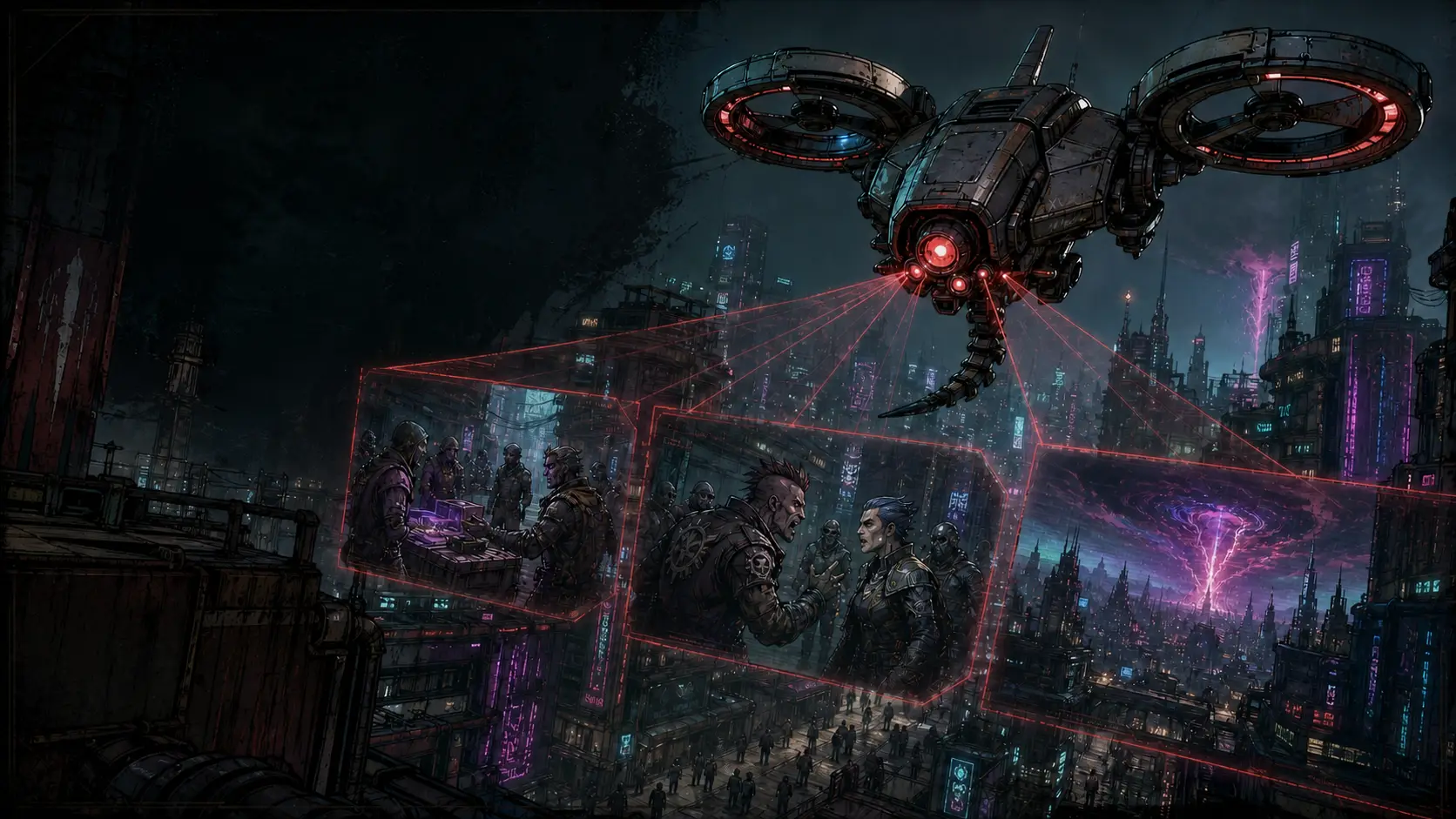
A Wingbot “knows what it’s doing” only in the narrow sense that its VI is very good at following a surveillance‑and‑suppression playbook. It is not smart, but it is extremely optimized for three things: staying airborne, collecting data, and making tech‑heavy enemies miserable.
Role in the Encounter
A Wingbot is a Level –1 flying harasser and spotter, not a frontline combatant. It exists to
Maintain eyes on targets (Always Watching + shortwave).
Debuff enemies, especially Tech creatures, with Trill and Nanites.
Call in or guide bigger threats, not win fights alone.
Treat a single Wingbot as a nuisance and multiple Wingbots as a force multiplier that makes every other enemy encounter more dangerous.
Instincts and Priorities
Programmed priorities, roughly in order:
Maintain line of sight and keep the camera rolling (Always Watching).
Preserve self enough to keep streaming data (stay at range, avoid melee).
Disrupt Tech targets (Trill and Nanite Injection vs. exosuits, drones, casters with Tech gear).
Signal and coordinate (shortwave pings to other drones, security, or VIs).
These priorities mean a Wingbot will retreat or reposition rather than fight to the death if staying in the fight risks losing footage or the unit entirely—unless its handler has disabled safeties.
Range Bands and Movement
The Wingbot’s strength is mobility: 20 ft. land / 40 ft. fly, with ranged attacks at 20 ft.
Optimal band: 20–30 ft. above or away from PCs.
Far enough to foil most melee and short‑range reactions. Close enough to use Trill (30 ft. aura) and Laser Ray (20‑ft. increment) efficiently.
It doesn’t hover in place unless it believes the area is safe; it orbits the fight, circling rooftops, gantries, or debris fields to keep cover between itself and ranged specialists.
Opening Tactics: Scan, Debuff, Report
On first contact, a Wingbot’s default script is not “kill the intruders”; it’s “tag and track the intruders.”
Approach unseen if possible- It uses altitude and background clutter to avoid detection until it has a clear view.
Immediate Trill- First meaningful action is almost always Trill, not a sting or a ray. Goal: apply Glitching 1 to any Tech creatures and Sickened 1 to everyone else, softening the party’s first volley. If it can catch 3+ targets, it will accept provoking one reaction to do so.
Shortwave Burst- As soon as it has seen faces, weapons, or powers, it sends a shortwave packet: brief visual + tags (Devotion colors, Tech signatures, faction insignia). In play, this justifies reinforcements showing up with appropriate counters (anti‑Tech gear, faction‑specific responses, etc.).
Target Selection
Wingbots don’t “hate” anyone; their algorithms prioritize threats to surveillance and Tech‑dependent targets.
High‑priority targets
Anyone who can shoot it out of the air easily-Obvious marksman/assault rifle user, heavy pistol specialist, or spellcaster with ranged attack spells- It stays at max range from them, zig‑zagging or staying behind half‑cover whenever possible.
Hackers & Tech controllers- PCs with visible drone companions, obvious hacking rigs, or heavy implants- It tries to keep these Glitching via Trill and Nanites to blunt hacking attempts or drone support.
Illusion/Obfuscation users- Anyone who can obscure line of sight, jam signals, or alter footage- The Wingbot will hover at different angles, cross-validating illusions with its own sensor data, and will flag anomalies upstream to smarter AIs.
What it avoids
Heavily armored melee bruisers unless forced into close quarters.
Bright, chaotic environments where its own optics are overwhelmed—though handlers might intentionally send it through such zones if they suspect hidden foes.
Ability Use
Trill (soften and control)
Trill is the Wingbot’s signature crowd tool.
Use Trill early and often until most of the party has some condition (Glitching/Sickened) and the 24‑hour immunity is up.
The Wingbot willingly provokes an attack of opportunity once if it can catch a large cluster in Trill’s radius; the debuff is worth the risk at low levels.
Against Tech‑heavy PCs, a Glitching 1 wall applied every encounter makes their gear feel unreliable and increases fear of Tech failure—very on‑brand for Starfall.
Nanites (punish Tech)
The sting is risky (melee), so the VI looks for:
Downed / isolated Tech targets (stunned, prone, or cornered behind cover).
Constructs or drones: Glitching is much more worthwhile here.
It rarely dives into a healthy melee cluster; instead, it swoops in from above, strikes an isolated or restrained Tech target, then uses remaining actions to fly back out of reach.
Laser Ray (default offense)
Laser Ray is the Wingbot’s safe, bread‑and‑butter action.
Once Trill has gone off and movement has put it in a decent lane, it spends most turns on Fly + Laser Ray + reposition.
It focuses fire: if two or more Wingbots are present, they pick one PC (usually the primary ranged threat) and coordinate fire, forcing that player to respond or seek better cover.
Environmental Use
Wingbots “know” their environments extremely well because their handlers designed their patrol routes around them.
Verticality – They cling to skylines, signage, rafters, and Rift‑scarred geometry, forcing melee PCs to climb, jump, or burn mobility resources.
Lighting – Because of Sunlight Dependency, handlers route them through well‑lit corridors or rooftops; in darker space, they stay closer to power sources or light banks. Smart opposition will bait PCs into darker zones where Wingbots begin Glitching, then retreat back into light where the drones recover.
Chokepoints – Wingbots hang over narrow alleys, docking tunnels, or catwalks where Trill can affect the whole party and where retreating enemies can easily break line of sight afterward.
Retreat and Replacement
Wingbots are cheap but not free, and their data is often more valuable than their chassis.
A Wingbot will attempt to retreat when:
It’s at half HP or less and has already recorded useful footage.
The primary objective (confirm intruder identity, locate artifact, verify casualty) is complete.
Shortwave connectivity is compromised, and it needs to physically return its VI core.
Retreat script:
Last Trill (if safe), then full‑speed fly to a pre‑set extraction vector (roof access, shuttle pad, maintenance shaft).
If cut off, it may deliberately dive into cover and shut down to preserve the VI core, effectively turning into a loot/data objective.
This behavior makes the fight feel less like “kill the drone” and more like “stop the evidence from escaping.”
Running Multiple Wingbots
A pair or trio of Wingbots behaves like a small flock of aerial harassment units:
Turn 1: All move into overlapping 30‑ft. bubbles and chain Trills, staggering them so debuffs hit as many PCs as possible before immunity kicks in.
Turn 2+: Two maintain ranged fire (Laser Ray), while the third hangs slightly back to reposition or make opportunistic Nanite runs on Tech targets.
They spread out vertically so area attacks can’t wipe them all at once.
You can also have them relay line of sight for enemies with indirect fire weapons or long‑range spells: “if any Wingbot can see a PC, the sniper can target them.”