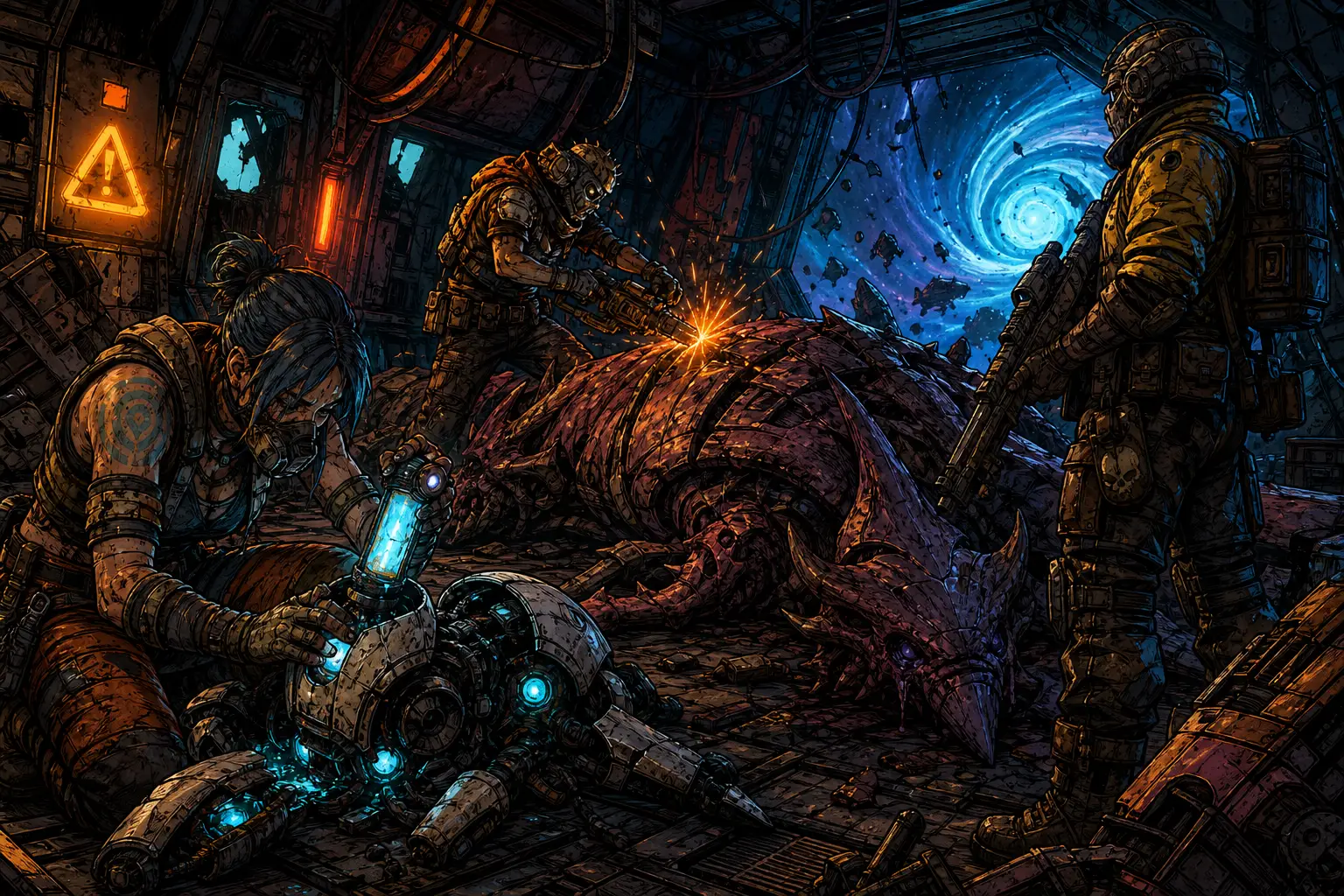
Nothing truly dies—it just waits for the right scavenger. Ships, cities, creatures, and even failed experiments collapse into resource fields that savvy crews can strip for parts, power, and secrets. On the Frontier and in the Outer Sphere, a good Salvager is worth more than a formal engineer; the former turns yesterday’s disaster into tomorrow’s life support.
Battlefields don’t stay sacred for long. Within hours, Rift-scorched constructs are reduced to coils and plates, fallen beasts become organ vats, and shattered turrets become a mesh of barrels and servos. Salvage crews mark their rights with spray-paint sigils and coded beacons; dispute over who has “first claim” on a wreck has started more than one station-wide brawl.
Implications
Forensic Salvage: Picking over impacts, scorch marks, and broken chassis can reveal who built a device, which faction fielded a drone, or what creature type was here, functioning as a narrative-friendly Recall Knowledge prompt bundled into Salvage scenes.
Environmental Recovery: Survivors on failing worlds strip derelict generators, crashed pods, and dead fauna to sustain air scrubbers, water reclamation, and ad-hoc farming rigs, making Salvage a key tool for community survival.
Evidence Gathering: Jurists, guild auditors, and bounty hunters use Salvage to pull data cores, ID tags, signal logs, and gene traces from wreckage and remains, turning every burned-out husk into a potential witness.
Societal Impact
Starfall’s economy already treats tangible goods and survival packs as more trustworthy than abstract currency, and Salvage is the bottom rung of that material ladder. Whole districts in the Outer Sphere are built atop “Salvage Rights”—informal laws and gang-enforced codes that say who is allowed to strip which wrecks, and how much must be tithed to local powers.
Guilds quietly sponsor certified Salvagers to patrol Rift-lanes and battlefield sites, ensuring that Metronome parts, Rift-reactive alloys, and unique biotech don’t vanish into black markets. Meanwhile, independent salvagers—“scrap priests” and “bone-pickers”—are either celebrated as community lifelines or reviled as grave-robbers, depending on whether you needed that generator or the body it was attached to.