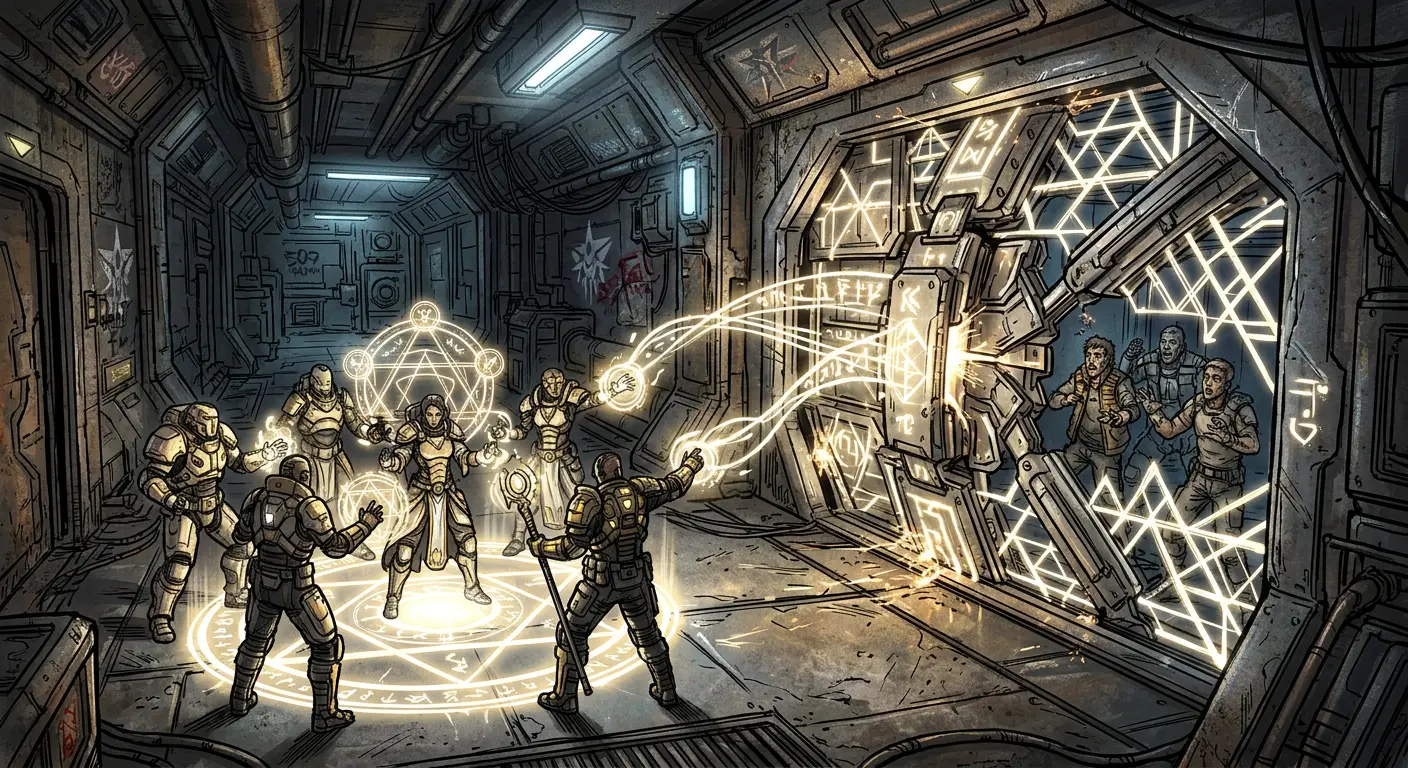
This White-variant of Animate Object creates semi-sentient Warden Walls—sections of bulkhead, barricade, or masonry that wake up just enough to defend corridors, seal breaches, and enforce authorized passage in the Starfall Galaxy. Where Blue Animate Object scripts tools and statues as obedient processes, the White Warden Wall variant scripts space itself—turning corridors and bulkheads into quiet, tireless co‑defenders of law, doctrine, and the fragile pockets of order clinging to the Starfall Galaxy.
Warden Walls of the Inner Sphere
Where Blue-devoted ritualists animate tools and statues as programmable labor, White circles in Starfall specialize in animating structures—dock walls, shrine facades, prison bulkheads, and fortress gates—so the building itself participates in security doctrine.
Chronologist bastions, guild tribunals, and cathedral-stations along stable Rift lanes commonly embed White-pattern Animate Object circles into their architecture, letting walls shift, brace, or close ranks in response to alarms without needing a living guard on every
To residents, these “warden walls” feel like a quiet, ever-present authority: bulkheads that straighten when a commander enters, doorframes that narrow around an unauthorized body, and corridor ribs that subtly steer foot traffic away from restricted zones.
In older installations, you can see centuries of doctrinal changes carved directly into the stone—layers of White sigils and geometric law-knots stacked over each other where the ritual has been reforged again and again to match new security regulations.
White Devotion Security
White‑devoted mages in Starfall justify Warden Walls as the purest expression of ordered space: instead of endless patrols and frightened guards, the building itself embodies law—granting or denying passage without anger, corruption, or fatigue.
Chronologist bastions on volatile Metronome worlds often give their main corridors layered warden segments that can contract into kill-boxes, open spill‑chutes for crowd evacuation, or seal off time‑fractured rooms with seconds’ notice.
Religious enclaves use gentler configurations: cloister walls that simply refuse to open for the uninvited, or shrine facades that physically step between supplicants and sacrilege rather than lashing out.
In both cases, the White variant is inherently supplemental—it’s meant to work with existing security staff and alarms, not replace them, enforcing chokepoints and defense-in-depth around high‑value spaces.
Blue‑aligned circles treat Animate Object like writing a physical daemon process:
The object’s form suggests its stat block family (loader crane as a slam‑focused brute, holo‑projector as a support unit, security door as a grappler or blocker).
The command is phrased like a concise script: “Patrol these coordinates and challenge anyone without this glyph.”
The cost is logged like a procurement line item, since animated guardians are capital assets, not disposable spell effects.
Chronologist field stations often maintain a “Blue stable” of animated chronometers, archive-shelves, and sensor rigs that can be shut down safely if a Metronome event goes bad, providing reliable labor that doesn’t panic when time runs sideways.
Ebon Syndicate dockmasters, by contrast, favor animated cargo pallets, chain-golems, and signage that can slam shut, tangle pursuers, or physically redirect crowds during a raid or police sweep.
Non-Combat Applications
Emergency bulkhead control: Warden Walls automatically seal fire, vacuum, or radiation zones, then open safe corridors for evacuees, acting as self-moving signage and shielding at once.
Crowd management: In starports and pilgrim hubs, they subtly reshape choke‑points, widening for outbound traffic or narrowing around contraband scanners during peak risk windows.
Living architecture: Prestige sites commission “processional walls” that bow, open, or rearrange ornamentation when ranking officials or guildmasters pass—ceremony and security in the same ritual budget.
Societal Impact
Stations and fortresses guarded by White-pattern Animate Object circles feel watched even in empty halls: people quickly learn which corridors never quite feel alone, and rumors spread of walls that “remember” troublemakers and squeeze them a little tighter at the next visit.
Civil libertarians, smuggling syndicates, and some Chronologist sub-factions hate warden deployments, arguing that judgment built into the architecture is just another kind of omnipresent surveillance, especially when doctrines can be quietly rewritten by those in
On the other hand, frontier colonies and small garrisons see them as force multipliers—one ritual team can give a whole block the ability to hold against boarding parties or rioters long enough for reinforcements to arrive.
Debates flare whenever an old installation’s Warden Walls begin to show emergent quirks: at what point does a centuries‑old, law‑driven structure count as a citizen rather than a piece of gear?