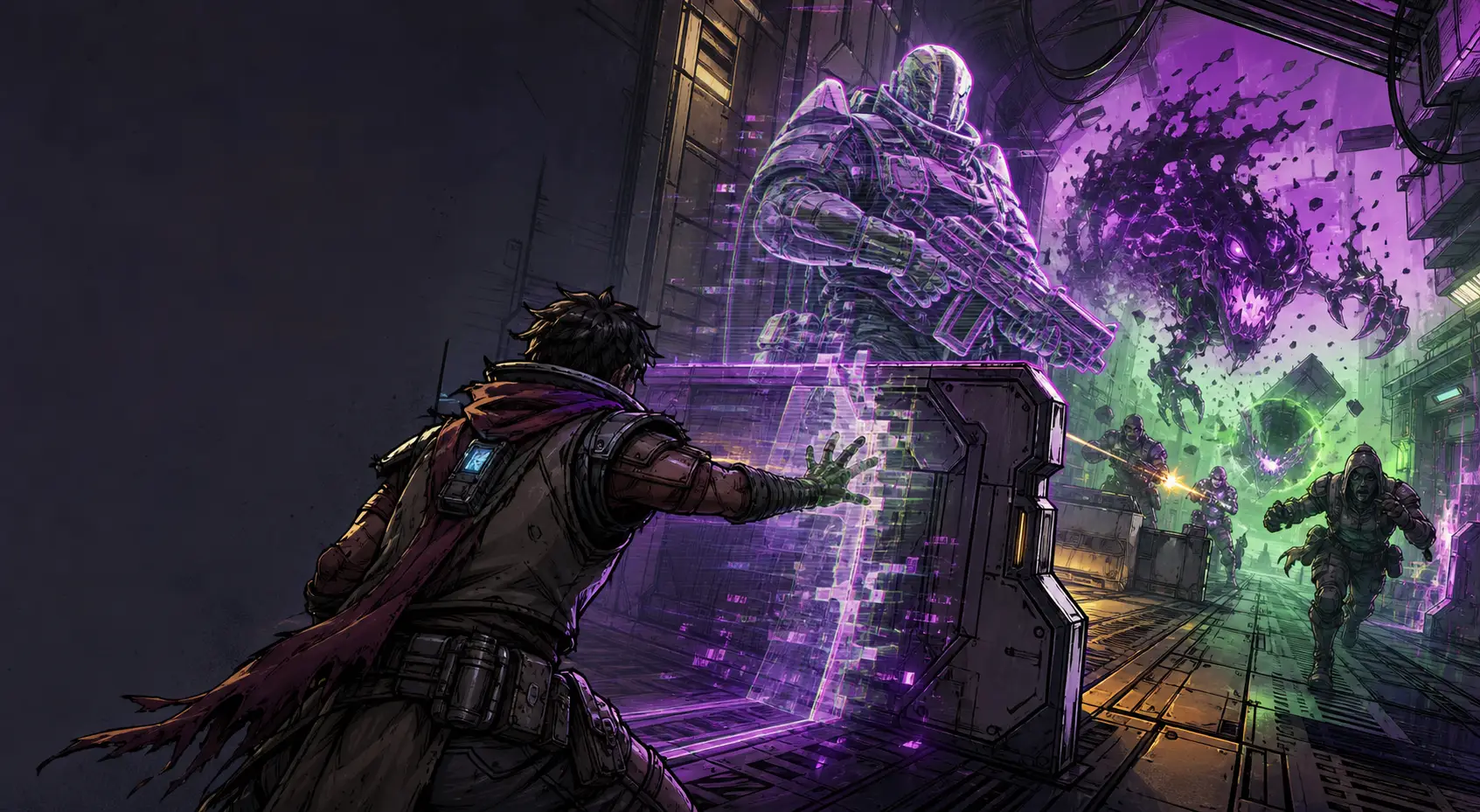
Lies the Rift Loves
The universe is already unstable enough that truth is a negotiable experience. Between Riftstorms, hacked sensor grids, cheap holo-projectors, psychic leaks, and devotion-maddened cultists, people learn quickly that what you perceive and what is actually there rarely match perfectly. Illusions are the sharp edge of that fact—deliberate, weaponized falsehoods aimed at the senses and mind.
To an ordinary spacer, an illusion might be a projected security decoy, a fake bulkhead sealing an escape route, or a guild hallucination used to keep a crowd calm while the real danger is elsewhere. To those who study the Rift or devotion magic, illusions are refined tools: spectral constructs that herd enemies, misdirect fire, or tug at the edges of perception until people make fatal decisions based on things that were never really there.
Implications
Deception and infiltration
Illusions are ideal for disguising routes, hiding doors, forging fake cargo stacks, or projecting decoy uniforms and insignia. In Starfall, a crew might hide a shuttle behind an illusory bulkhead, throw up a false gate in a Rift-Burg alley, or blur identification codes on docking scans using a blend of illusion and tech.
Morale and crowd control
Factions can use illusions to amplify rallies, simulate reinforcements, show “evidence” of events that never happened, or project comforting scenes over ruined districts. In a galaxy where survival is fragile, a convincing illusion of stability or threat can move populations without a single shot fired.
Exploration and misdirection
Explorers might use illusions to map line-of-sight risks, throw phantom predators at Rift beasts, or project false terrain to mislead pursuers. Illusory markers and signposts can guide allies who know the code while leaving everyone else confused.
Societal Impact
Illusion magic and technology thrive wherever information and perception are currency—which in Starfall is everywhere. The Celestial Accord uses illusion-tagged training sims and propaganda; the Ebon Syndicate deploys illusory manifests, counterfeit survival packs, and fake security feeds; the Crimson Concord turns illusions into performance warfare, staging revolutions with spectacle as much as with guns.
Because the Rift itself is psycho-reactive, cultures living closest to its storms are especially paranoid about illusions. They build practices around verification: physical contact checks, multi-sense confirmation, devotion-based wards that expose false images, and reliance on senses less easily fooled than sight alone. That paranoia is justified; in a world where entire cities have vanished into Rift mirages, the Illusion trait is not just a school of magic—it is an existential threat category.