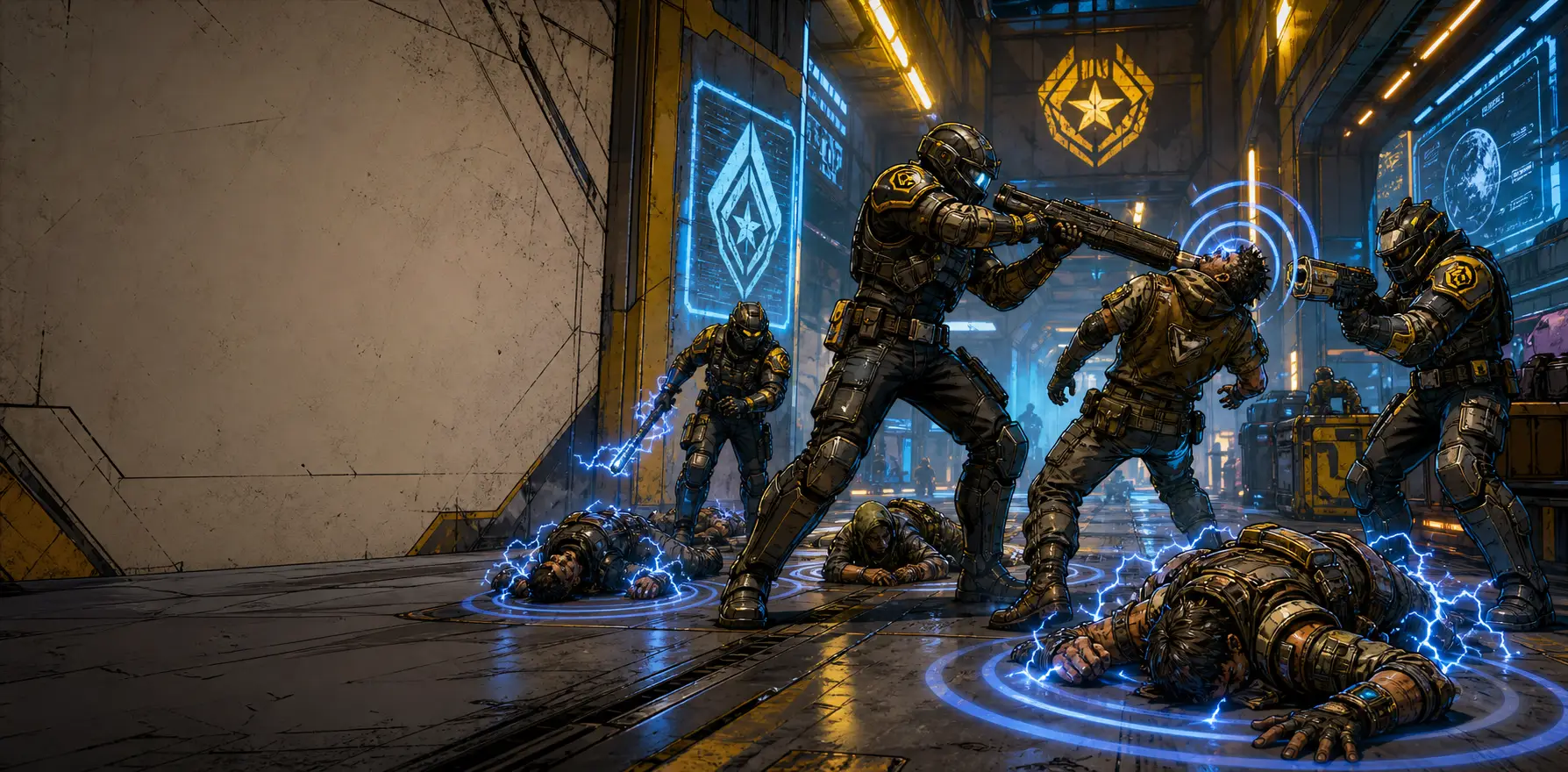
Nonlethal
Weapon Trait
The nonlethal trait marks weapons and effects that are inherently designed to incapacitate rather than kill. Attacks with a nonlethal weapon (including most fist strikes) deal normal damage, but when that damage reduces a creature to 0 Hit Points, the creature is knocked out instead of killed. They fall unconscious for a significant time (usually at least 10 minutes), do not gain the dying condition, and don’t interact with wounded or recovery checks the way lethal damage does.
You can always attempt a nonlethal attack with a weapon or unarmed Strike that doesn’t have the nonlethal trait, but you take a –2 circumstance penalty on the attack roll. Conversely, you can use a nonlethal weapon to make a lethal attack at a –2 circumstance penalty, if you truly intend to kill. Only the last hit that actually takes a target to 0 HP matters for whether they die or are merely knocked out—earlier lethal or nonlethal hits just subtract HP normally.
Spells and other effects can also have the nonlethal trait; any nonlethal effect that reduces a creature to 0 HP knocks it out instead of killing it, mirroring weapon behavior. Feats like Nonlethal Spell let you add the nonlethal trait to your next damaging spell (so long as it doesn’t have the death or void/negative trait), allowing casters to drop enemies without killing them.
A major exception is immunity to nonlethal: if a creature is immune to nonlethal attacks (common for constructs), it is immune to all damage from attacks and effects with the nonlethal trait, regardless of the damage type. This is why punching a typical construct with a nonlethal unarmed Strike can’t hurt it at all unless some ability explicitly removes the nonlethal trait from that Strike. Undead and many other creatures are not automatically immune to nonlethal damage; they still get destroyed at 0 HP if they aren’t using the “PC dying track” rules, even when the final blow is nonlethal.