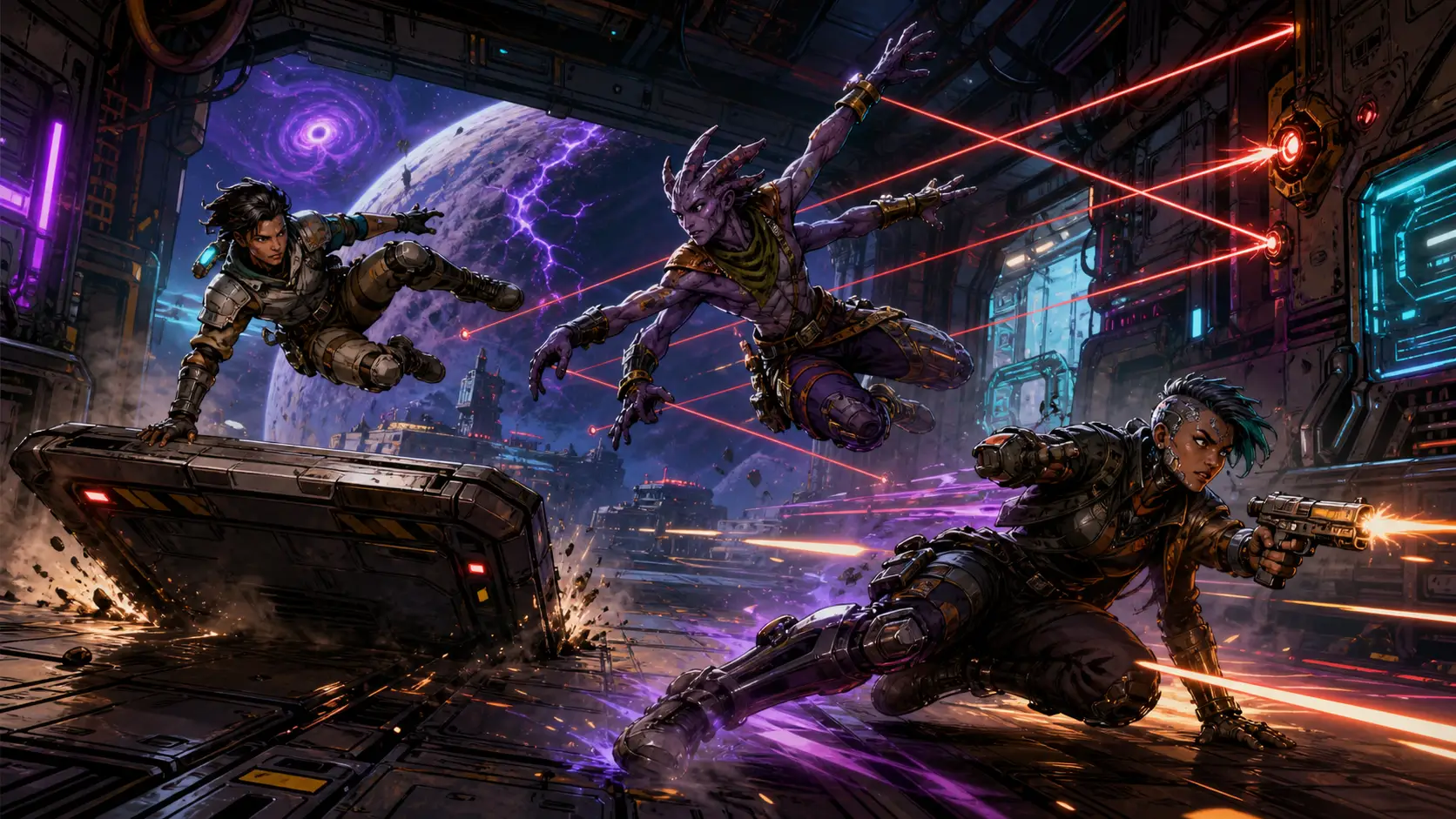
Reflex is the small miracle that happens between the warning siren and the blast—your body acting before your conscious mind catches up. Pirates call it “living half a second into the future,” the way experienced spacers lean away from shrapnel they haven’t technically seen yet.
Void‑dock workers develop Reflex by necessity. When a mag‑loader slips, you either dive under the rail or become part of the deck plating. On Rift‑scarred worlds, the ground sometimes liquefies or reorients underfoot; those who live long enough learn to jump at the first hair‑raising tingle of reality flexing. Starship crews practicing decompression drills don’t talk about Reflex as numbers—they talk about the “bolt‑and‑breathe drill,” snapping into cover and locking down in a heartbeat when the hull groans.
Across the Inner Sphere’s megacities, street kids run along moving traffic rails, timing their steps between autonomous cargo haulers, learning to pivot and drop at the slightest change in engine tone. In Outer Sphere warzones, soldiers and mercenaries read the telltale shimmer before a hardlight barrier fails or an enemy artillery barrage lands, ducking behind cover or throwing themselves through doors with reflexes honed by endless drills.
People with strong Reflex are easy to spot: they catch falling tools without looking, step around fights before fists swing, and somehow never stand under flickering lights that explode seconds later. In black‑market gun alleys, trigger‑duels are decided by Reflex as much as by aim—everyone fires, but only some move quickly enough to let the shots pass through where they were, not where they are.
Implications
Reflex isn’t only about grenades and fireballs; it shows up anytime instant physical response matters.
Starship and Vehicle Mishaps: When a ship lurches out of Drift‑like Rift‑space into an unexpected gravity well, crew with good Reflex grab rails and secure themselves before they’re flung into bulkheads. A GM might call for Reflex saves to avoid being knocked prone, taking damage, or being dragged toward decompression points during such emergencies.
Industrial and Void‑Dock Hazards: In orbital shipyards and refineries, pressure vents, swinging crane arms, and plasma cutters can all go sideways. Reflex saves can determine whether workers avoid getting hit by a misfired loader or a rupturing conduit during downtime scenes or exploration.
Rift Anomalies: Some anomalies “jump” or expand unpredictably, such as reality‑shear lines that suddenly sweep across a deck. Reflex saves allow characters to pull back limbs, dodge across seams, or throw themselves into cover before the anomaly fully manifests.
Performance and Acrobatics: High‑stakes performances—grav‑dance routines on floating platforms, zero‑G stunt shows, or competitive hoverboard runs—may use Reflex saves to handle sudden complications: failing spotlights, surprise pyrotechnics, or sabotage.
Social Scenes with Physical Stakes: In tense negotiations held on precarious gantries or rotating stations, a failed structural element might turn a diplomatic scene into a scramble for safety, with Reflex saves determining who keeps their footing and composure.
Used this way, Reflex contributes to scenes that blur the line between social/exploration and outright combat, emphasizing the dangerous, lived‑in nature of Starfall’s environments.
Social Impact
Reflex has shaped how many Starfall communities design training, architecture, and even rituals.
Training Regimens: Military and guild training often includes “Reflex corridors”—moving platforms, shifting gravity pockets, and timed hazards that teach recruits to react instantly. Surviving these courses is often a prerequisite for field deployment in Rift‑adjacent sectors.
Architecture and Infrastructure: On unstable worlds or older stations, people assume something will fail eventually. Handrails, grab rings, and emergency mag‑locks are everywhere, built for those quick enough to grab them in time. Communities with a reputation for poor infrastructure quietly prize high‑Reflex residents as natural survivors.
Sports and Entertainment: Popular sports emphasize reflexive action: drone‑ball matches where the arena itself reconfigures mid‑game, or “bolt runs” where contestants dash through semi‑randomized hazard courses. Champions of these circuits become folk heroes, embodying the idea that quick wits and quicker feet can beat any odds.
Economic Stratification: High‑risk, high‑pay jobs in salvage, Rift exploration, and extreme maintenance skew toward those with exceptional Reflex—natural or augmented. Those who lack this edge are more often pushed into slower, less hazardous, and less lucrative work.
Cultural Myths: Stories circulate about legendary figures who “never took a hit they didn’t choose”—envoys who stepped aside from sniper shots without breaking eye contact, mechanics who danced through minefields on intuition, or Riftborn who see reality stutter a moment in advance.
In many places, Reflex is part of how people judge whether someone “belongs” in dangerous work. A clumsy off‑world noble might impress locals with credits, but they only truly earn respect if they learn to move with the environment rather than against it.