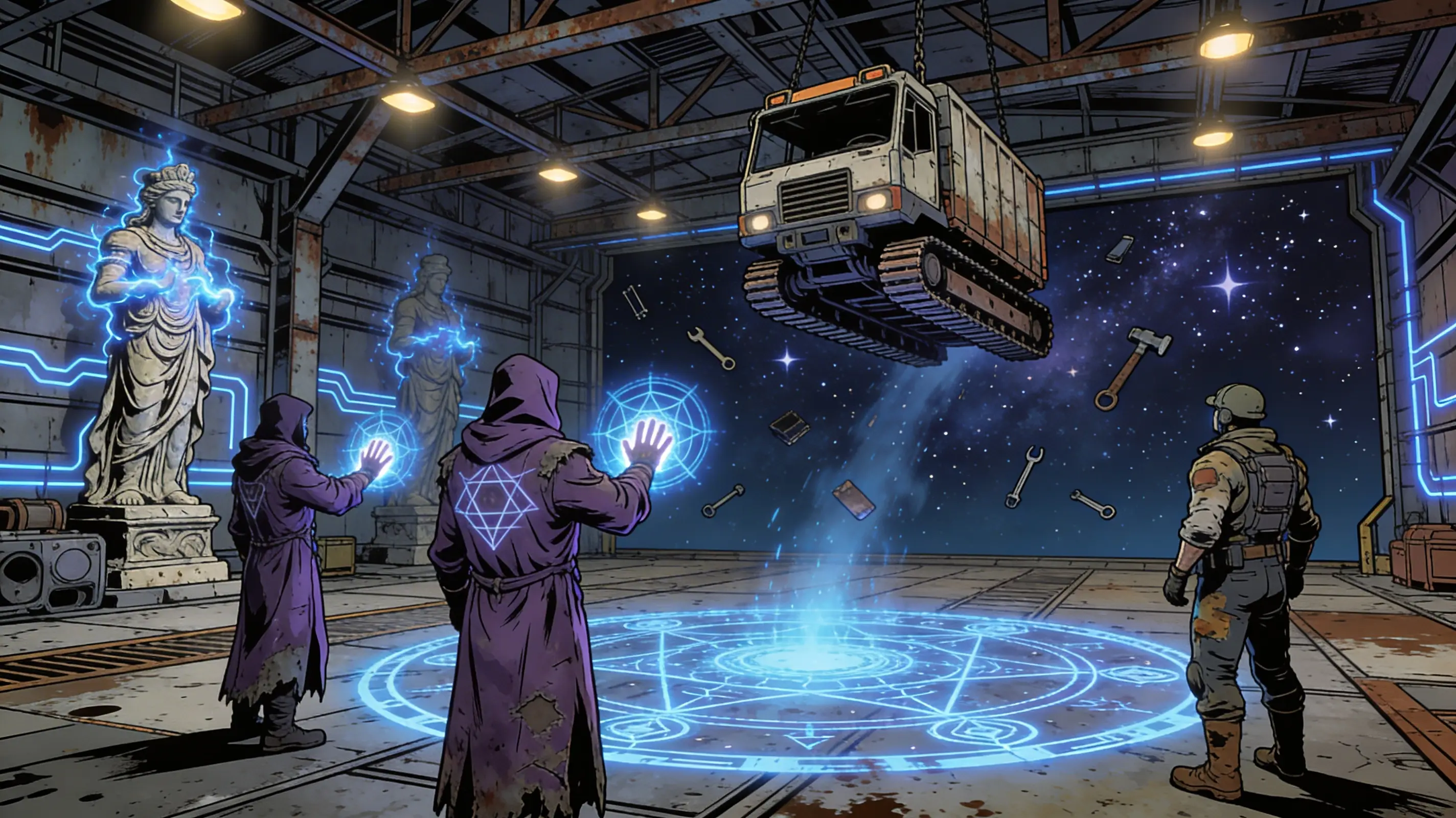
Animate Object in the Starfall Galaxy is the Blue-aligned ritual that turns engineering diagrams into walking machinery—granting “temporary personhood” to tools, statues, and hull-plated idols in the name of precision, security, or sheer logistical efficiency.
Pattern-Control Script
Across the Pact Lanes and Rift-frayed frontier, Animate Object is the quiet backbone of automated infrastructure: loading cranes that walk, archive-shelves that re-stack themselves, shrine statues that step down to bar intruders, and ceremonial banners that coil like serpents when alarm klaxons wail.
Chronologist enclaves, Azure Archivists stacks, and corporate shipyards all maintain Blue-devoted ritual teams who treat animated objects as carefully tuned subsystems—extensions of a site’s operating plan rather than mere “summoned monsters.”
In guild slang, animating an object is called “giving it a task-core”: the original tool or sculpture remains itself, but a bounded directive and fragment of animating force are wired in, sanding down free will into something closer to a very clever subroutine.
The most scrupulous factions reserve full, awakened minds for rare cases and rely on Animate Object for everything else, explicitly to avoid creating new people they’d then be morally—and legally—obligated to pay and protect.
Blue Devotion and Themes
Blue practitioners see it as an exercise in controlled systems design: you are not “playing god” so much as installing a precise behavior set into a chassis.
To Chronologists, animated objects are ideal temporal “buffers”—predictable, minimally conscious agents whose behavior can be modeled across slightly divergent timelines when planning an intervention around a Metronome site.
Azure Archivists rely on Blue-aligned Animate Object circles to run self-sorting stacks, roaming index-golems, and floating book-carts whose paths through the library double as a kind of visible search algorithm.
Blue‑aligned circles treat Animate Object like writing a physical daemon process:
The object’s form suggests its stat block family (loader crane as a slam‑focused brute, holo‑projector as a support unit, security door as a grappler or blocker).
The command is phrased like a concise script: “Patrol these coordinates and challenge anyone without this glyph.”
The cost is logged like a procurement line item, since animated guardians are capital assets, not disposable spell effects.
Chronologist field stations often maintain a “Blue stable” of animated chronometers, archive-shelves, and sensor rigs that can be shut down safely if a Metronome event goes bad, providing reliable labor that doesn’t panic when time runs sideways.
Ebon Syndicate dockmasters, by contrast, favor animated cargo pallets, chain-golems, and signage that can slam shut, tangle pursuers, or physically redirect crowds during a raid or police sweep.
Non-Combat Applications
Autonomous Logistics: Animated loaders, winches, and trolleys keep small stations and frontier colonies running with minimal crew, hauling ore, munitions, or supplies along pre‑charted paths.
Living Architecture: Archive stacks that rearrange themselves overnight, shrine statues that reposition to track the sun or the Rift, and modular bulkheads that walk into new configurations during refits.
Safety Systems: Fire‑shutter doors that actively herd civilians away from blaze paths, animated hazard signs that physically block entry into radiation zones, or medical gurneys that self‑navigate to triage zones.
Societal Impact
Because Animate Object is relatively low‑rank but high‑impact, it has reshaped labor across the Inner Sphere: docks, archives, and refineries that once relied on cheap sapient or semi‑sapient labor now lean heavily on animated infrastructure.
Unions, synth-rights advocates, and Chronologist ethicists argue constantly about the line between “tool with script” and “construct with personhood”—especially when long‑running animated objects begin to exhibit quirks, preferences, or proto‑personalities from centuries of Blue‑pattern operation.
Some jurisdictions treat long‑lived animated objects like ensouled sites or minor spirits, mandating periodic inspection rituals to ensure they haven’t drifted into full awareness without rights, while others classify them strictly as property, no different from an industrial robot arm.
This tension makes Animate Object circles politically sensitive: every new guardian statue or loader‑golem is also a small vote in the ongoing argument over who counts as “people” in the Starfall Galaxy.
In Starfall, Animate Object is Blue mana’s answer to the problem of work: a ritual that encodes obedience, repetition, and clever physicality into inert matter so civilization can keep moving—at the cost of blurring the line between tool and life one animated chassis at a time.