House Deneith
"I protect those who would be taken from those who would do them harm. For my siblings, this is a job; for me, it's a calling." — Harrie d'Deneith, Sentinel Marshal
Mark: Sentinel | Race: Human | Symbol: The Chimera Leader: Baron Breven d'Deneith | Headquarters: Sentinel Tower, Karrlakton, Karrnath | Guilds: Blademarks Guild, Defender's Guild, Sentinel Marshals
When you enter a room, you check the exits. When you meet a stranger, you search for concealed weapons, evaluate their stance, estimate how fast they could close the distance between you. You do this before you introduce yourself. You do this before you think about doing it. The Mark of Sentinel has been keeping you alert since it first appeared on your skin, and House Deneith has been training you since before that — because every heir of the house, marked or not, serves a tour in the Blademarks or the Defender's Guild before they do anything else with their lives. Whatever path you follow now, you were raised in a culture of martial discipline and service, and the mark on your skin never lets you fully relax.
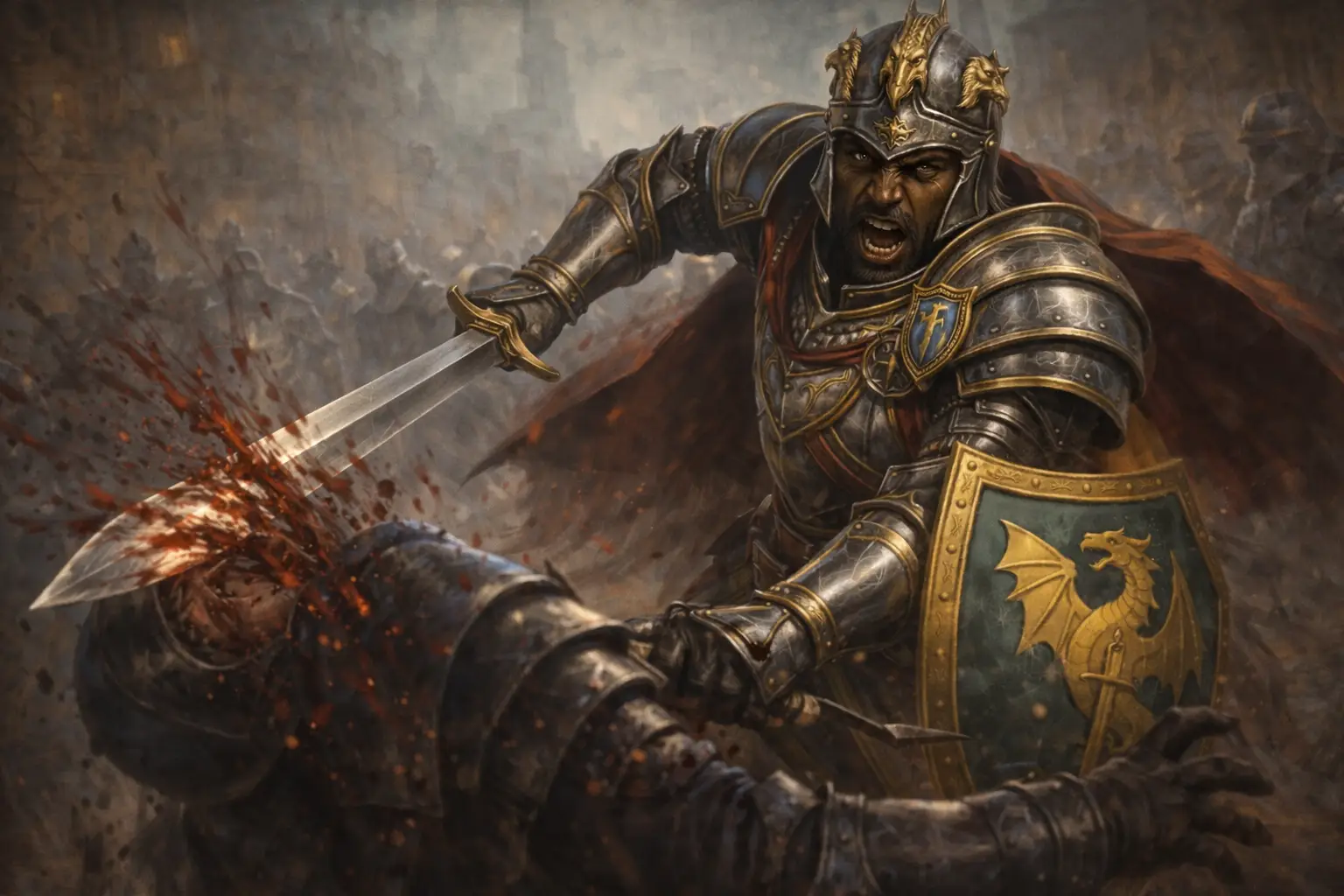
House Deneith was born in Karrnath, and war flows in its veins. For centuries, the Blademarks Guild has governed the mercenary trade across Khorvaire. While warriors bearing the Mark of Sentinel serve as the house's most elite forces — officers, trainers, strategists, and the renowned Sentinel Marshals — the house brokers a far broader range of soldiers: licensed human mercenaries, Ghaal'dar hobgoblin warbands, Valenar elf cavalry, Cyran veterans who no longer have a nation to fight for. Beyond the battlefield, the Defender's Guild provides professional bodyguards for anyone with coin and a credible need. And the Sentinel Marshals, the house's most prestigious corps, hold the authority to pursue criminals and enforce the law across every border in Khorvaire — one of the last echoes of united Galifar in a shattered world.
The house is headquartered at Sentinel Tower in Karrlakton — a stern edifice of angular stone that dominates the city's skyline, regarded as one of the most heavily defended fortresses in Khorvaire. Leadership rests with Baron Breven d'Deneith, who maintains the house's formal policy of absolute neutrality in interstate affairs. Despite holding what may be the largest private military force on the continent, Breven shows no inclination to turn that power toward personal ends. The importance of neutrality has been drilled into the house for generations. The Mark of Sentinel is a shield, not a crown.
But the heirs of Deneith are only human. And not everyone in the house agrees that the shield should remain in its sheath.
Origins & Lineage
The Mark of Sentinel was the first dragonmark to manifest among humans, appearing in the western duchies of what is now Karrnath at a time when the region was still a patchwork of domains held by anyone with the strength to keep them.
When the mark first appeared on Jarla Deneith, she kept it hidden while she mastered its powers. When three of her children developed the mark as well, the family used it to challenge the tyrant Dynass. Though Jarla was slain in the battles that followed, her eldest son Karrlak emerged victorious and laid the foundations of Sentinel Tower in the city that still bears his name. The Deneith family established itself as a powerful martial dynasty — but they were better soldiers than rulers. They struggled with peasant management and famine, and were eventually forced to abandon Karrlakton following rebellion. The core of the family survived intact as a mercenary company, their skills enhanced by the mark, and they chose the path of the mercenary over that of the landed warlord long before the Korth Edicts formalized the distinction.
Over the following century, the mark appeared among two other Karrnathi families: the Wyrns of Korth, loyal servants of the lords of the capital, and the Ravans of Vedykar — then called Ravanloft — who ruled through fear and force. Escalating raids and duels between Deneith and Ravan weakened both lines. When Karrn the Conqueror rose from Karrlakton, he appealed to these fractured Sentinel families to stand at his side. In allying with Karrn, Deneith was not seeking land — they sought dominance over the rival Sentinel families that served Karrn's enemies. Orrin Deneith accepted, and as Karrn united the warlords under his rule, the rival Sentinel families were forced to submit and serve within the Deneith Blademark — forming the foundation of the house as it exists today. Orrin ultimately challenged the Ravan matriarch Syele to a duel that settled the allegiance of all three lines, forging the unified House Deneith from three rivals.
The Sentinel families fought alongside Karrn as he crossed the Cyre River and claimed the lands to the south. When Karrn went too far — when his army was broken and his forces scattered — it was his Sentinel Guard who saw him safely back to his fortress. Orrin Deneith died in the battle of Daskaran, flinging himself in the path of a ballista bolt meant for Karrn. His death was a blow, but the story of Deneith's commitment and courage spread wide. When the war was over, Queen Lycia of Daskaran sent messengers to Karrnath, seeking a force of Sentinel Guards of her own. It was at this moment that Deneith embraced its destiny: not bound to a single king, but promising loyal service to any who would pay their price.
The house's symbol is the chimera — a fitting emblem for a house forged from three rival families. The traditional placement of the chimera's three heads maps to their geographic origins within Karrnath: the lion of Deneith at center, the wyvern of Wyrn to the left (as Korth sits west of Karrlakton), and the goat of Ravan to the right — even though the Ravans were long ago driven from their ancestral seat, now called Vedykar. Each founding line maintains distinct heraldry to this day.
When the young prince Galifar Wynarn — himself born in Karrlakton — became a conquering king, the offer he made to the Twelve was modeled on the role House Deneith had played throughout the history of Karrnath: loyal service in exchange for prosperity. Deneith's endorsement was essential to pressuring the other houses to accept the Korth Edicts, and it is no coincidence that Deneith alone was granted the right to maintain significant military forces. Nonetheless, the golden age of Galifar proved challenging for the house. With the nations united, the lords of Athandra and Danthaven resolved their disputes through courts rather than on the battlefield, and the people of Sigilstar no longer feared Aruldusk raiders. There was still need for Blademarks — defending merchants, battling brigands, suppressing unrest — but it was clear the house needed new paths. This led to the foundation of the Defender's Guild and the Sentinel Marshals.
When King Jarot began building toward the war his successors would finally fight, Patriarch Halden Harn d'Deneith sensed blood on the air and spent Jarot's final years rebuilding the Blademark and drawing together the scattered mercenary bands licensed by the house. The Sentinel Marshals largely opposed the coming war — Lord Commander Brashin Halar d'Deneith met with each of the rival Wynarn heirs, urging them to honor tradition and preserve the united kingdom. Some say that Brashin's assassination, six months after the death of King Jarot, was the true death knell of Galifar.
Once the war broke out in earnest, demand exploded. In most nations, nobles were expected to provide military forces to their ruler; a lord could avoid conscription by paying for a unit of Blademarks to take the place of their subjects. Karrnath and Thrane were culturally well-prepared for war and had less need of such forces, but Cyre leaned heavily on House Deneith, and Breland relied on Deneith in the early years before its own military matured. This meant that Deneith soldiers were often fighting their distant cousins in Karrnath — yet the Karrnathi rulers respected Deneith's neutrality, allowing the house to maintain its power in Karrlakton even as Blademark units laid siege to Karrnathi fortresses.
To meet unprecedented demand, the house turned south. When Deneith scouts discovered the military potential of the Ghaal'dar hobgoblin clans of southern Cyre and the Seawall Mountains, they recruited aggressively — concentrating those forces rather than dispersing them, a strategic failure that gave the warlord Haruuc the leverage to unify the clans and seize Darguun. The shadow of that catastrophic defection still follows the house, and it was this humiliation that opened the door for House Tharashk's own mercenary operations. Deneith's relationship with Valenar is similarly fraught: Queen Mishann negotiated directly with the var-shan Shaeras Vadallia over Deneith's objections, and it was only after Vadallia's betrayal that Deneith began brokering contracts with individual Valenar warbands under strict terms, with a representative of each warclan maintained at Sentinel Tower as surety.
With the war's end, Deneith finds itself with a surplus of soldiers and a house refocusing on the Defender's Guild. Many Blademark viceroys believe the peace will not hold and are working to keep their best units together.
SENTINEL TOWER — BLADEMARK RECRUITMENT NOTICE House Deneith is accepting applications for service in the Blademarks Guild. Applicants must present identification papers and background documentation issued by their nation of origin. All accepted recruits will undergo a rigorous training period. Room, board, basic equipment, and training are provided. Commission rates begin at 40% and increase with rank and distinction. Applicants unable to function within a chain of command will be dismissed. Apply at any Deneith enclave bearing the chimera seal.
The Mark of Sentinel
The Mark of Sentinel warns and protects. It sharpens senses and reflexes — not merely keen sight and sharp ears, but an intuitive evaluation of all possible threats, an instinctive awareness that reads a room the way a soldier reads a treeline, registering wrongness before the conscious mind has named it. Mechanically, this manifests as a +1d4 intuitive bonus to Perception and Insight checks. Whether on the battlefield or in a ballroom, a bearer of the Mark of Sentinel is prepared for danger.
It is nearly impossible for a Deneith heir to fully relax and let their guard down. It simply is not in their nature. Deneith heirs are driven by their desire to protect the people and things they care about — and this is one of the main reasons heirs end up leaving the house, whether voluntarily or as excoriates. As a Blademark or a Defender, you serve the client only as long as gold continues to change hands. You could be defending a noble one day and serving their mortal enemy the next. The house does its best to push heirs to see themselves as, ultimately, defending Deneith — protecting the family and ensuring its prosperity through hard work. But there are always Sentinels who develop an attachment to their clients or to ideals beyond pure profit.
The mark's spell list deepens instinct into capability. Shield deflects an attack with a wave of force; shield of faith provides slightly weaker protection over a longer period — no faith required, despite the name. At higher tiers, warding bond physically links the bearer to another creature, sharing damage and resistance, making the guard's body a literal extension of their charge's protection. Heirs with the lesser mark can disrupt other forms of energy through counterspell and protection from energy. Greater mark heirs can call on Bigby's hand — the same force as shield, amplified and wielded with greater finesse — and guardian of faith, which manifests a protective being formed from that same energy. A Deneith guardian of faith typically takes the form of the heir's family beast — a lion, wyvern, or ram — though exceptional bearers have produced other shapes; Matriarch Dalia d'Deneith was celebrated for manifesting a full chimera.
A subtler thread runs alongside these projections of force: compelled duel and warding bond tend to develop among heirs from the Ravan line, while those of the Wyrn families more commonly manifest shield of faith and barkskin. The core Deneith line is equally likely to develop either set — a reminder that while the three families merged long ago, their blood still runs in distinct channels.
The mark's most famous ability is Vigilant Guardian — the power to swap places with a creature within five feet as a reaction, intercepting an attack that would otherwise strike their charge. This is the Defender's signature, the moment that justifies every gold piece of their fee: the flash of blue-purple light, the sudden displacement, and the Defender standing exactly where the client was a heartbeat ago, shield raised, wound accepted.
Guild Operations
The Blademarks Guild
The Blademarks Guild is the house's mercenary arm — the largest licensed military force in Khorvaire. Heirs bearing the Mark of Sentinel serve as officers, trainers, and strategists; the rank and file draws from a broader pool. The bulk of Blademark soldiers are not blood heirs of the house — they are licensed mercenaries trained and managed by the house. Deneith heirs are elite mercenaries, but not every job requires an elite mercenary. Sometimes a black blade is all you need. And the fact that they carry the Blademark license tells you they are at least competent, disciplined, and backed by Deneith's reputation.
Soldiers of the Blademark are hired on two-year terms. Recruits must provide identification and background papers and pass a rigorous training period; those who cannot function within a chain of command are typically expelled. The house provides room, board, training, and basic equipment. In return, it takes a substantial cut of contract fees. A new recruit — a gray blade — receives only 40% commission; veterans who advance may eventually reach 70%. The internal hierarchy runs from black blades (entry-level) through gray, white, and gold blades, with officers drawn from the white and gold ranks.
The house also brokers the services of independent military organizations. When Deneith arranges work for Ghaal'dar warbands or Valenar cavalry, it handles transport, translators, and logistics in exchange for a commission of 10–30%, depending on the effort required.
It is common practice for a Blademark who serves a long and distinguished term to be granted honorary membership in House Deneith. While typically granted upon retirement, it can be bestowed on an active Blademark who performs remarkable deeds. Honorary membership grants access to Deneith enclaves and makes the honoree eligible to marry into the house. This is the origin of the lesser families within Deneith — the founding line they associate with reflects their common heritage and the values they choose to embrace.
One notable Blademark tradition is the first and felling blow: when blooded Deneith heirs faced one another on the field during the Last War, they would typically surrender after suffering any injury rather than fight to the death. Many carried a baton alongside their primary weapon when expecting to face other heirs, using the club rather than the blade against kin. No such restraint applied to licensed mercenaries without blood ties to the house.
The Defender's Guild
The Defender's Guild specializes in personal protection and is composed entirely of members of the Deneith bloodline — no outsiders may join. A would-be Defender must first complete at least one tour in the Blademarks, then pass a series of qualifying tests. Those who succeed are issued a writ of the Watchful Eye, a resilient document sealed with an arcane mark and virtually impossible to forge. Presenting this writ at any Deneith enclave entitles the heir to request work.
Defenders specialize in either speed or strength. Swift Defenders operate covertly in light or no armor, relying on speed and precision; Ravan heirs dominate this path. Strong Defenders wear heavy armor and deter attackers through obvious, imposing presence. The Peacekeepers are an elite subset trained to protect clients in environments where no weapons are allowed — formal courts, diplomatic functions, sacred spaces — relying on non-lethal unarmed techniques refined through study at the Order of the Broken Blade. Every marked Defender shares the core traits of the mark: the intuitive bonus to Perception and Insight, the ability to cast shield at least once per long rest, and Vigilant Guardian.
Mark Rank | Daily Rate |
|---|---|
Unmarked heir | 1 gp |
Least Mark | 3 gp |
Lesser Mark | 120 gp |
Greater or Siberys Mark | 650 gp |
The Sharn enclave maintains 33 unmarked Defenders, 75 with the Least Mark, and 7 with the Lesser Mark. No Greater or Siberys bearers are currently stationed in Sharn. The gap between the rates for least and lesser marks reflects the vast difference in capability — a lesser-marked Defender can cast counterspell, share damage with their charge through warding bond, and project protective energy at a level that an unmarked heir simply cannot approach.
The Sentinel Marshals
The Sentinel Marshals are the house's most prestigious corps and arguably its most important contribution to postwar Khorvaire. During the reign of King Galifar III, House Deneith was granted the right to enforce the laws of the kingdom — pursuing fugitives and enforcing punishments across the realm in exchange for gold. What began as a largely honorary role became indispensable when the Last War shattered Galifar's unified jurisdiction. The Sharn Watch, the Blackened Book, and the King's Citadel are agents of the Brelish crown and cannot pursue fugitives across national borders. The Sentinel Marshals can. Their cross-border authority was reaffirmed in the Treaty of Thronehold, and in many ways they represent the last functional remnant of Galifar — a legal authority that crosses every line the war drew.
Marshals are not obliged to intervene unless their services are engaged — they remain mercenaries, placing justice in the hands of anyone who can pay for it. They are never required to accept a case and may decline if they doubt either the justice of the cause or their ability to accomplish it. They enforce the law but are not authorized to break it in pursuit of justice. If a quarry has already been declared an outlaw, however, killing them is not a crime.
Only the most trusted and capable members of the house are appointed as Marshals, and candidates must have thorough knowledge of the laws and customs of all Five Nations. Many train with the Order of the Broken Blade, a martial arts monastery attached to the temple of Dol Dorn in Karrlakton — the largest temple dedicated solely to Dol Dorn on the continent, which is not a traditional temple but an enormous stadium where competitions are held on each of Dol Dorn's feast days. Graduates earn the title of Blademaster. The Sharn enclave maintains nine Marshals, all of whom also serve in the Defender's Guild. Five hold the Lesser Mark of Sentinel, three the Least Mark, and one is an unmarked heir.
"A Sentinel Marshal holds the honor of House Deneith in his hand. He carries the last law that all nations still respect. If he sells that for coin, there's nothing left." — Brashin Halar d'Deneith, Lord Commander of the Sentinel Marshals. Assassinated 896 YK.
Political Relations
House Deneith maintains absolute neutrality, selling its services to any party willing to pay. During the Last War it contracted forces to all sides simultaneously, never formally declaring for any nation. This policy remains the foundation of its postwar identity, allowing operations across national borders without legal challenge.
The Korth Edicts formally prevent dragonmarked houses from owning land, holding noble titles, or maintaining standing military forces — with House Deneith's armies being the single explicit exception. In the wake of the Last War, many within the houses argue the edicts have become obsolete. Within Deneith, this argument takes a sharper edge given the house's unique military position. The house's forces at Korth have grown beyond even the generous provisions of the edicts, and Karrnath has yet to challenge the expansion.
The house's principal external rivalry is with House Tharashk, which entered the mercenary market in the later stages of the war by supplying monster forces from Droaam. Deneith resents the encroachment bitterly, and the Twelve has refused Deneith's requests to censure the Dragonne's Roar. Bitter conflicts between individual Sentinel Marshals and Tharashk bounty hunters have simmered for years — overlapping jurisdictions, competing contracts, and the fundamental question of whether Deneith's monopoly on mercenary services still means anything when anyone with a troll and a contract can undercut them.
Notable Holdings & Infrastructure
Sentinel Tower, Karrlakton — The oldest and largest Deneith enclave, rebuilt and expanded many times over centuries. It is the ancestral home of the Deneith family and the Baron's formal seat. The enormous fortress contains everything from meeting rooms to training courtyards to smithies and taverns — the majority of Karrlakton's economic activity is tied to feeding, clothing, arming, and entertaining the mercenaries who train within its walls. Surrounding the Tower are Blademark barracks, three separate training academies, and Karrlak Field — a massive open arena used for drilling troops and sponsoring jousts and wargames. The Tower's smithies are supplemented by Cannith-trained craftsmen. Nearby, Olladra's Arch (known locally as "the Arch") is a major Jorasco house of healing supported by both Cannith and Deneith, and the site where the Jorcan Prosthetic Limb was developed to serve injured Blademarks. Karrlakton itself sits on the Cyre River directly across from the dead gray mists of the Mournland — close enough that the mile-high wall of dead-gray fog is visible from the city walls. Fear of the Mournland has driven an exodus over the last four years, and the city has attracted a plethora of doomsayers eager to witness the apocalypse.
Fort Cail and The Gathering Stone (Darguun) — Fort Cail in Rukhaan Draal is a heavily fortified stronghold and the center for ongoing negotiations with Lhesh Haruuc, as well as a base for salvage teams scouring old South Cyre. The Gathering Stone, built beside an ancient Dar monument, is the house's primary center for recruiting and training Darguul mercenaries — teaching them to operate within a larger army alongside Blademarks. It is almost always surrounded by the tents of aspiring recruits and the sounds of ongoing drills.
The Wyvern (Korth, Karrnath) — Carved into one of the mountain spires supporting the royal palace of Crownhome, its walls engraved with a wyvern wrapped around the stone. The ancestral home of the Wyrn line, its proximity to the palace reflecting the Wyrns' ancient role as royal bodyguards. Korth also hosts Graygate, a major Blademark outpost.
Thronehold — House Deneith has maintained this ancient citadel since the beginning of the Last War as a solemn duty separate from its commercial operations. The Throne Wardens posted there honor their obligation to protect the empty throne until it is occupied once more — a charge reaffirmed in the Treaty of Thronehold and funded as a shared cost by the surviving nations of Galifar.
Beyond these principal holdings, Deneith maintains significant enclaves in Sharn, Flamekeep, Trolanport, and Varna, with Blademark garrisons in nearly every major city in the Five Nations and noteworthy outposts in Newthrone, Taer Valaestas, Pylas Talaer, and Stormreach. In Sharn, the house maintains nearly two hundred members of the Deneith bloodline and a Blademark force of five hundred soldiers — forty-nine heirs and a host of Brelish recruits. Many fought in the Last War; today they serve as private security for the wealthiest citizens, with a particularly strong presence in Upper Tavick's Landing, where they hold equal authority with the Sharn Watch.
HOUSE DENEITH — KARRLAKTON FASHION NOTE Visitors to Karrlakton may be surprised by the duchy's colorful dress. While Karrns are typecast as grim figures in heavy cloaks, House Deneith has long flaunted sumptuary laws. The house's signature green, yellow, and purple colors date to a Galifaran monarch's ban on those colors — and the baron's decision to outfit the entire house in poofy, garish tunics in defiance. The fashion periodically returns and has become a permanent feature of the duchy.