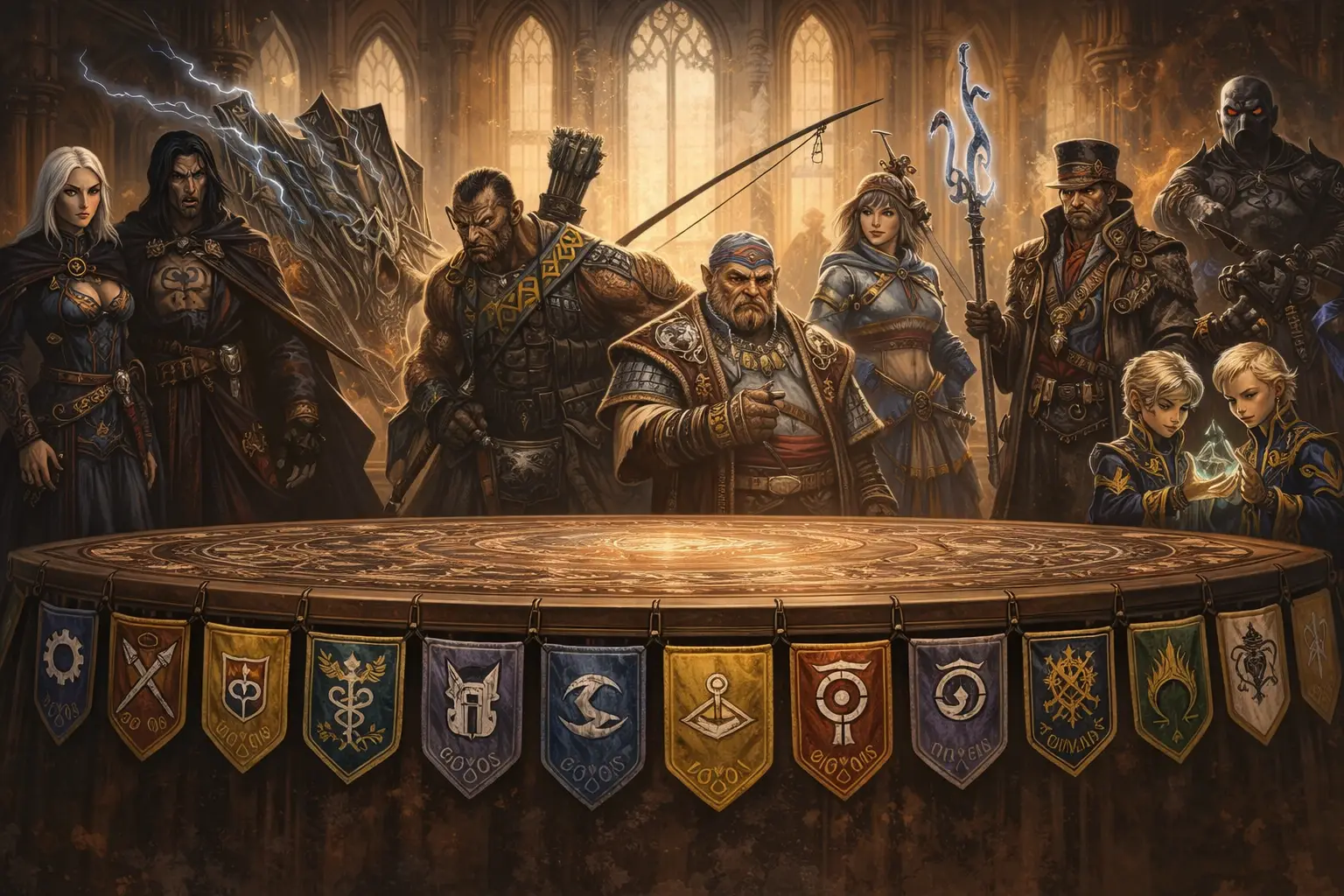
The Twelve
Inter-house consortium of the dragonmarked houses · Headquarters: Tower of the Twelve, Commerce Ward, Korth · Founded: circa −1,500 YK
"Rather than working for one single house, your group could work for an organization that serves them all: the Twelve."
The Elemental Galleon demonstrates the purpose of the Twelve better than any charter or speech. House Lyrandar heirs had been using conjured air elementals to fill their sails since the Mark of Storm first appeared — but doing it directly was grueling work for the heir and lacked precision. House Cannith had the artificers who could build a vessel capable of binding an elemental permanently, but lacked the talent to pilot it. House Zilargo's gnome binders could trap an elemental into a dragonshard, but the binding had to interface with Cannith engineering and Lyrandar dragonmarks to function. None of these houses could have built the Elemental Galleon alone. Together, through the institutional framework of the Twelve, they created a vessel that transformed maritime trade across Khorvaire.
That is the Twelve at its best: a space where the dragonmarked houses combine their proprietary expertise to create things that no single house could produce on its own. The lightning rail, the speaking stones, elemental airships, dragonshard focus items — all of these were designed with the cooperative assistance of Twelve researchers and produced through Twelve coordination. At its worst, the Twelve is a crucible of carefully managed tension, where houses fund research they can leverage, share results selectively, use the institution's shared infrastructure while protecting proprietary methods, and engage in the kind of maneuvering that produces headlines like the one above.
The Twelve does not command the houses, does not override house leadership, and is not answerable to any national government. What it does is provide the one enduring space where house interests overlap enough to allow collaboration — and where they compete in ways that are at least nominally controlled. In theory, the Twelve exists to advance magical innovation for the shared benefit of all houses. In practice, it is a forum for managed rivalry, selective knowledge-sharing, and the diplomatic containment of tensions that would otherwise become open feuds.
The Tower
The headquarters of the Twelve is the Tower of the Twelve: an enormous thirteen-spired building that floats above Korth's Commerce Ward, filled with arcane laboratories and libraries devoted to eldritch subjects, along with meeting chambers where house delegates resolve their differences and strike new terms of cooperation. Industrialized lifts carry personnel and cargo up to and down from the airborne structure.
The Tower was established in Korth for historical reasons — the Twelve was founded in the aftermath of the War of the Mark, and Baron Hadran d'Cannith proposed that the houses should unify their research in the Karrnathi capital. Prior to the Twelve's establishment, Karrnath was completely bereft of institutional magic education; the founding of the Twelve transformed Korth and gave the city its enduring relationship with arcane scholarship. Today, Korth is home to major enclaves of Houses Cannith, Deneith, Jorasco, Kundarak, Medani, Orien, and Thuranni, all clustering near the Tower's shadow. Adventurers seeking out the services of an Heir of Siberys from any of those houses have a good chance of finding them in Korth.
The Tower is not answerable to the Karrnathi crown — a distinction the crown is well aware of and the Twelve enforces carefully. Throughout the Last War, Karrnathi scholars provided the intellectual support that the Twelve was sometimes cut off from due to travel restrictions, strengthening the bond between the Twelve and its host nation. But the relationship remains one of mutual convenience, not subordination.
Not far from the Tower stands Korth's airship docking tower, completed in 993 YK — the first such facility in Karrnath, and a powerful symbol of the Twelve's influence on the city's economy and character.
History
The Twelve predates Galifar by five centuries. The story begins around −1,500 YK, when the dragonmarked families were still young and fragmented — not yet the houses they would become. Sivis envoys traveled across Khorvaire seeking out other marks, quickly forming an alliance with the Cannith and Deneith families. House Sivis recognized that the fate of the Line of Vol — an entire dragonmarked bloodline destroyed by the dragons and the Undying Court — could befall any of them if they stood alone, and the Lyrrimans of Sivis established the blueprint for the alliance, convincing the leaders of Deneith and Cannith to restructure themselves as houses.
What united the houses was a shared enemy. Aberrant marks were spread across the continent, and while some members of the newly unified houses genuinely saw aberrant marks as abominations, others recognized a convenient scapegoat that could bind the houses together and strengthen their collective position. Sivis and Phiarlan propagandists worked together to spread terrifying tales of aberrant dragonmarks, some based in truth and others entirely false. Deneith soldiers armed with Cannith weapons pursued aberrants across the land, while most people believed the dragonmarked forces were heroes defending them from a deadly threat. The result was the War of the Mark — a coordinated purge rather than a true war between equals. Toward the end, a few aberrant-marked champions rallied others and challenged the houses; the most infamous were Halas Tarkanan and the Lady of the Plague, who seized Sharn and declared it a haven for those with aberrant marks. When the houses laid siege to the city and victory was impossible, Tarkanan and the Lady unleashed the full power of their marks, destroying the city. But the outcome had never been in serious doubt.
The War of the Mark showed what the houses could accomplish when they worked together, and the leaders of the houses were not about to let that go. Hadran d'Cannith and Alysse Lyrriman d'Sivis forged the proposal for a permanent alliance. The architect and artificer Alder d'Cannith — though some sources name him Alder Juran — pushed to have that alliance named the Twelve, reasoning that while only ten dragonmarks were known at the time, twelve true marks would eventually flow through living blood. He was vindicated over a millennium later when House Tharashk was inducted in 498 YK, the last house to join. (House Kundarak was formally recognized in 106 YK.)
As part of the founding process, artisans from each house came together to work on collaborative projects, seeing what they could accomplish when they combined their skills. The most dramatic result was the Gorgon of Eston — the most sophisticated construct ever built by humans of Khorvaire. Previous human artificers had worked with homunculi, but such constructs required an ongoing bond to their creator. The Gorgon was self-sustaining and independent, even capable of making simple decisions in pursuit of directions given by its creators. To the houses, it was the first child of their union. The Gorgon led the parade in the festivals in Eston, and stood in the square outside Cannith Hall bellowing the hour. It was considered a wonder of the age, and the allied families took it as the sigil of their new institution.
The Twelve gained its formal charter when Galifar ir'Wynarn united the Five Nations and negotiated the Korth Edicts with the houses around −1,005 YK. In exchange for regulatory power and industrial preeminence across the kingdom, the houses agreed to remain a neutral force — forgoing land ownership, noble titles, and independent armies (with an exception for House Deneith). The Twelve was central to this compact, serving as the institutional face of house cooperation with the crown.
During the Last War, the houses were ostensibly neutral and sold their services to every nation involved. The Twelve weathered the century of war, but not cleanly. House Thuranni split from House Phiarlan during this period, partly because of the conflicts of interest that arose within an espionage organization serving multiple sides simultaneously — the Thuranni claim they quashed a Phiarlan plot to assassinate the heads of nations and dragonmarked houses, and within the Twelve, many believe them. House Cannith, whose foundries were destroyed and whose leadership was lost in the Mourning, emerged from the war fractured into three semi-independent branches still fighting for internal control. Cannith had long dominated the Twelve; many of the other houses were privately pleased to see Cannith taken down a peg. The institution that emerged from the Last War carries the scars of the houses' wartime choices.
What the Twelve Is For
The Twelve's utility is structural. Individual houses cannot — or will not — pursue certain research alone: the cost is too great, the political risk too high, the project requires expertise only a rival house possesses, or the implications are too sensitive for any single house to own. The Twelve provides the venue where that work can happen on agreed terms.
It monitors and helps regulate mutual interests: lightning rail expansion, elemental binding techniques, cross-mark synergies, the planar research that underpins the houses' most profitable services. When failure in any of these areas would damage all houses' reputations and markets equally, the Twelve is the institution that coordinates a response.
The Twelve also maintains the houses' collective claim to legitimacy as the custodians of practical arcana — in contrast to national bodies like the Arcane Congress, which serve state priorities, or unlicensed institutions like Morgrave University, which the Twelve views as undisciplined and epistemically leaky. The houses created the Twelve to advance their shared interests; they fund it to protect their shared position.
The Twelve also serves as the institution that mediates disputes between houses and within houses. House Sivis has always played a particularly active role in this diplomatic function, with Sivis mediators constantly working to resolve conflicts between houses and enclaves. Negotiations within the Twelve are backed by practical considerations beyond abstract law — Lyrandar needs Cannith to keep producing Wheels of Wind and Water, which limits how far Lyrandar can push the House of Making without threatening its own business. These mutual dependencies are the glue that holds the institution together.
Internal Politics
The Twelve presents itself as a body of cooperative research. It functions, in practice, as a crucible of carefully managed tension.
Houses fund research they can leverage. They share results selectively. They use the Twelve's shared infrastructure while protecting proprietary methods. Open sabotage is rare — at least publicly — but internal maneuvering never stops. When a house agent is caught sabotaging a rival's project within the Tower, the first authority to judge them is the legal authority of Karrnath (since the crime took place in Korth). But there is also a trial within the Twelve: the injured house can demand restitution, threaten to raise prices on critical goods, or use the forum to rally other houses against the offender. These negotiations are backed by the practical reality that every house depends on the others for something.
The Kundarak funding dispute reported in the Korranberg Chronicle is typical of the Twelve's texture. Whether it produces a lasting schism — and what that would mean for peaceful relations among the houses — remains an open question in the Tower's own meeting rooms.
House Cannith has long been seen as the most powerful dragonmarked house and the heart of the Twelve, in part because so many houses rely on Cannith for the tools integral to their success. The lightning rail, elemental airships, speaking stones — all were produced in Cannith factories. This has nurtured a cultural arrogance within the House of Making; Cannith heirs consider themselves the equals of any noble, seeing their house as the greatest power in Khorvaire. The fracturing of Cannith during the Last War has weakened this dominance, but the dynamics it created within the Twelve persist.
FROM THE KORRANBERG CHRONICLE
FEUD WITHIN THE TWELVE?
Reports emerged this week of bitter disputes within the Twelve, the arcane institution that supposedly embodies the spirit of cooperation among the houses. According to a source that wished to remain anonymous, a special meeting of the Committee of Twelve was called last week to address accusations that researchers connected to House Kundarak had been diverting funds from the institute's budget to fund their own private projects, then concealing the results of those projects from their colleagues. Kundarak's representative, according to our source, denied the accusations, saying that the researchers are operating within their allotted budget and keeping their results secret only temporarily, as a matter of house security. This matter is far from resolved, as the council meeting devolved into shouted arguments before disbanding. Representatives of House Medani and House Tharashk were particularly vocal in denouncing Kundarak, leaving this reporter to wonder whether a schism within the Council of Twelve might be imminent — and what that might mean for peaceful relations among the dragonmarked houses themselves.
Key Relationships
The Dragonmarked Houses. Founders, funders, and the only real constituency. The Twelve operates at the houses' pleasure and has no authority they do not grant it. Its value is preserved only as long as the cost of cooperation remains lower than the cost of its alternatives.
National Governments. Officially neutral; practically entangled. Nations view the Twelve as a private research engine with military implications and work to influence it through their house relationships. The Korth Edicts prevent the houses from holding land or titles, but they don't prevent the houses from becoming more powerful than the nations that regulate them — and in the wake of the Last War, many wonder whether any nation has the power to enforce its wishes on the houses.
The Arcane Congress (Aundair). The Congress was created as an explicit counterweight to the houses. The Twelve views the Congress as a state-controlled rival that sacrifices commercial relevance for public legitimacy; Congress members tend to view the Twelve as dangerously unaccountable to any public interest. Both institutions are watching the other's postwar development closely. The competition is real: the Congress's wand of magic missiles is an innovation Cannith cannot yet replicate.
Morgrave University. The Twelve views Morgrave as undisciplined and porous with sensitive material, and avoids association while monitoring its expeditions — especially those that recover unknown relics or touch on forbidden magic.
Working for the Twelve
The Twelve is a viable patron for an adventuring party — particularly one composed of characters from different dragonmarked houses who want to be involved in inter-house intrigue without being beholden to a single patron. The Twelve sends recruiters to Arcanix and maintains a known pipeline for talented artificers, wizards, and researchers. Characters who work for the Twelve might find themselves protecting shared research from sabotage, recovering stolen focus items, investigating anomalies in dragonmark manifestation, mediating disputes that could escalate into inter-house feuds, or pursuing expeditions into Xen'drik and elsewhere on behalf of the collective.
The work is rarely simple. Every mission for the Twelve involves navigating the competing interests of multiple houses, and a team that reports to the Twelve will eventually discover that their patron's unity is more fragile than it appears.