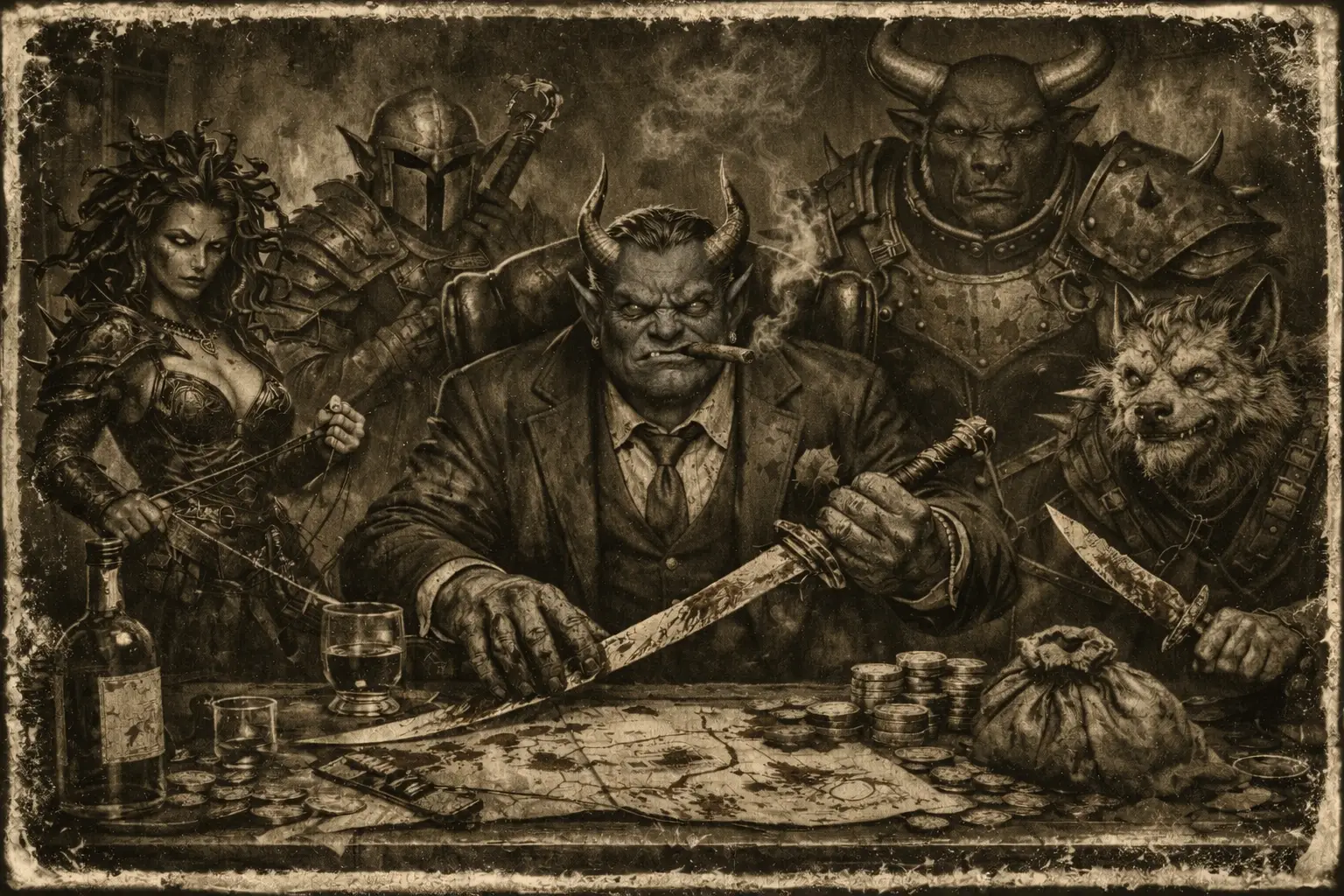
Daask
Droaamish criminal organization · Headquarters: Temple of the Six, Khyber's Gate · Membership: ~260 active · Cell Leader: Cavallah
"From the outside, Daask appears to be interested solely in fomenting violence and chaos. The monstrous nature of its members reinforces this impression; most people consider the members of Daask to be savage beasts. The truth is more complicated."
The gnoll that kicks in the door of a Boromar gambling hall in Callestan is not a bandit. The ogre standing behind her is not muscle for hire. The harpy perched three stories above, watching the street for Watch patrols, is not a lookout scrounged from the local slums. These are soldiers — disciplined, organized, and deployed with a purpose that extends well beyond the gold they take from the till.
Daask is the criminal organization built by monstrous immigrants from Droaam, operating out of Khyber's Gate and Malleon's Gate in Sharn's lower wards, and it has spent the last decade growing into the most significant challenger to Boromar Clan dominance the city has seen in generations. To most of Sharn's population, Daask is a violent mob of monsters: gnolls, ogres, minotaurs, harpies, medusas, and trolls who extort, rob, and destroy without strategic purpose. This impression is wrong, and deliberately maintained.
The Droaamites who form Daask's core are elite soldiers of Droaam, not bandits. They answer ultimately to Sora Katra, one of the three Daughters of Sora Kell who rule Droaam, who has been establishing Daask cells across Khorvaire's major cities for years. The Sharn operation is part of a coordinated expansion whose true objectives remain unknown — gold is among the least of Sora Katra's apparent concerns. Whether Daask is building toward political leverage, territorial acquisition, some agenda derived from Sora Teraza's oracular visions, or something else entirely, no investigative or criminal body in Sharn has been able to determine.
History and Establishment
Daask established its presence in Sharn in 988 YK, beginning in the goblinoid districts of Khyber's Gate and Malleon's Gate. For its first several years it kept a relatively low profile — building membership, consolidating control of the undercity, and establishing the Temple of the Six as a fortified headquarters. The current escalation against Boromar holdings began approximately two years ago and has been accelerating since. The Boromars were caught unprepared by the speed and discipline of Daask's attacks and have not found an effective counter-strategy.
The organization's base of operations is an ancient temple to the Dark Six, constructed beneath Sharn before the city's founding. In 484 YK, Flamekeeper Jalus Baine led the Silver Flame faithful in exterminating the temple's original congregation and ransacking it — but not destroying it. The temple lay forgotten for centuries until Cavallah claimed it as Daask's Sharn headquarters, restored the altars of the Mockery and the Shadow, and fortified the complex with beasts imported from Droaam: gricks, displacer beasts, basilisks, and an assortment of other deadly creatures. The wealth accumulated from Droaam's funding of the operation is vaulted in the temple — but seizing it would be a dangerous task.
Membership and Structure
Daask includes approximately 260 active members in Sharn, though this number fluctuates daily. Sora Katra can dispatch additional forces from Droaam as needed, and the organization also recruits from Sharn's destitute local population — primarily goblins, shifters, humans, and dwarves who feel that the current system has failed them.
The Droaamish core that constitutes Daask's military strength includes 100 gnolls, 25 ogres, 12 minotaurs, 8 harpies, 6 trolls, and 5 medusas, plus magical beasts including worgs, horrid wolves, displacer beasts, cockatrices, and basilisks. Daask has gone to considerable effort to conceal the true extent of its forces from the surface world. The magical beasts are almost never deployed outside Khyber's Gate and the Cogs, and it is very unusual for the organization to commit more than ten creatures to a single operation. What the surface sees — a dozen gnolls smashing up a Boromar warehouse — is the tip of something much larger.
Daask members shift residences frequently — most live in Khyber's Gate but change locations every few days. This mobility is a structural advantage: the Boromars cannot effectively deploy large numbers of mercenaries in the narrow passages of Khyber's Gate, and Daask's fluid presence is difficult to pin down for sustained counteraction. The organization uses Cog hubs — dark, defensible chambers with multiple chokepoint passages — as meeting places, stash locations, and prisoner holding. The dark, twisting halls of these underworld locations are familiar to Daask members and confusing to their enemies; the tight passages create one-on-one confrontations in which Daask's powerful monsters often have the advantage.
Joining Daask requires only willingness to serve when Cavallah calls. The organization receives its funding directly from Droaam, removing the typical syndicate pressure to maximize local revenue extraction.
Operations
Violence and Extortion. Violence and intimidation are Daask's primary tools. Unlike the Boromar Clan, Daask does not manage the Watch through bribery — it manages them through force and demonstrated reprisal against officers who resist. In the lower wards, many Watch officers have concluded that allowing a Daask raid to proceed is preferable to attracting the organization's attention. Daask prefers guerrilla tactics, using only as many combatants as necessary to get a job done, never staying in one place too long, and quickly retreating back to their turf. As Daask has seized Boromar territory, it has begun taking over traditional Boromar businesses within that territory — the Boromars still control much of the criminal activity in the middle and upper parts of Sharn, but Daask is gaining ground in the lower city and controls crime in the Cogs.
Drug Trade. Daask distributes both dreamlily and heartflow in the lower wards, entering markets the Boromars previously controlled. It is also the sole source and distributor of dragon's blood, a mysterious substance sold in drams or "veins" that is currently experiencing rapid demand growth across Sharn. Dragon's blood produces euphoria, a measurable impact on certain magical abilities (particularly sorcery and dragonmark powers), and severe addiction with significant overdose mortality. The drug is smuggled into the city in an inert, unrecognizable solid form; a Daask operative named Cask applies a special salve that restores it to usable consistency before distribution. Cask cannot produce the drug himself and does not know its ingredients — production occurs entirely in Droaam under conditions no outside investigator has been able to examine. What dragon's blood actually is, and whether its effects beyond the obvious are intentional, is unknown.
Mercenary Services. Daask sells the services of its monstrous agents as assassins, bodyguards, and laborers. This makes the organization's capabilities available to outside clients while generating revenue and expanding Daask's network of relationships above its core criminal operations.
Religious Infrastructure. Daask brought priests of the Dark Six to Sharn and restored the Temple of the Six in Khyber's Gate as a functional place of worship — the only openly operating Dark Six temple in the city. Followers of the Dark Six have almost no other opportunities to practice their faith in Sharn, and providing this facility has made many allies for Daask across the lower wards. This is not incidental — the temple functions as a community institution, generating goodwill, information, and cover in a population that has few other institutions serving its interests. Fifteen priests serve the temple, mostly goblin, human, and gnoll adepts.
FROM THE SHARN INQUISITIVE
BLOOD ADDICTS' DRAGON DRUG
Imagine it: a long-lasting state of euphoria, a feeling of power and energy, a measurable impact on certain magical powers, and the risk of addiction and deadly overdose with every use. That's the thrill of the drug called dragon's blood, which currently enjoys skyrocketing popularity in Sharn. Every day the death toll from this mysterious substance rises among "blood addicts." And no wonder, as it's produced in Droaam and sold in drams or "veins" by the monstrous thugs of Daask, who surely seek nothing less than to destroy the prosperity of Sharn by targeting its most precious resource: its sober, hardworking people. Remember friends, "Stay on the wagon."
Relationships
Boromar Clan. The primary target of Daask's current expansion. The two organizations are in active conflict in the lower wards and Cogs, with Daask conducting escalating guerrilla raids against Boromar holdings while the Boromar Clan struggles to mount an effective response to a mobile opponent it cannot pin down. Daask agents go out of their way to harm up-and-coming Boromar operatives.
Sharn City Watch. Daask manipulates the Watch through demonstrated force and reprisal rather than bribery. Officers in the lower wards have largely concluded that non-interference with Daask operations is the safer policy. This arrangement is unstable and generates ongoing friction, but Daask's willingness to make examples of resistant officers has been effective.
House Tarkanan and the Tyrants. Daask does not target the Tyrants or House Tarkanan, and those organizations take no side in the Daask-Boromar conflict. The Tyrants maintain their long-standing truce with the Boromars while avoiding Daask entanglement.
Dark Six Worshippers. The restoration of the Temple of the Six has created a network of informal allies among Dark Six faithful across the lower city — a constituency that has few other institutions serving their interests and that provides Daask with information, goodwill, and community cover.
Muut. The bugbear crew that has claimed Malleon's Gate as their territory for decades recently aligned with Daask, expanding the organization's reach into Lower Dura without requiring Daask to station its own personnel there continuously.
The Open Question
The central uncertainty around Daask is not what it does — its criminal operations are observable — but what it is for. Sora Katra is establishing Daask cells in the greatest cities of Khorvaire simultaneously, suggesting coordination toward an objective that exceeds local criminal revenue. Dragon's blood is produced under unknown conditions by an unknown process and introduced into Sharn's population with effects that no outside investigator has been able to fully characterize. Daask occasionally takes actions that appear contrary to its immediate criminal interests, suggesting that the visible operation is not the whole operation.
Whether Daask is a political intelligence apparatus building leverage inside Khorvaire's cities, a staging operation for eventual Droaamish territorial pressure, a project shaped by Sora Teraza's oracular guidance toward some future-facing objective, or something else entirely, no one currently operating in Sharn has determined.