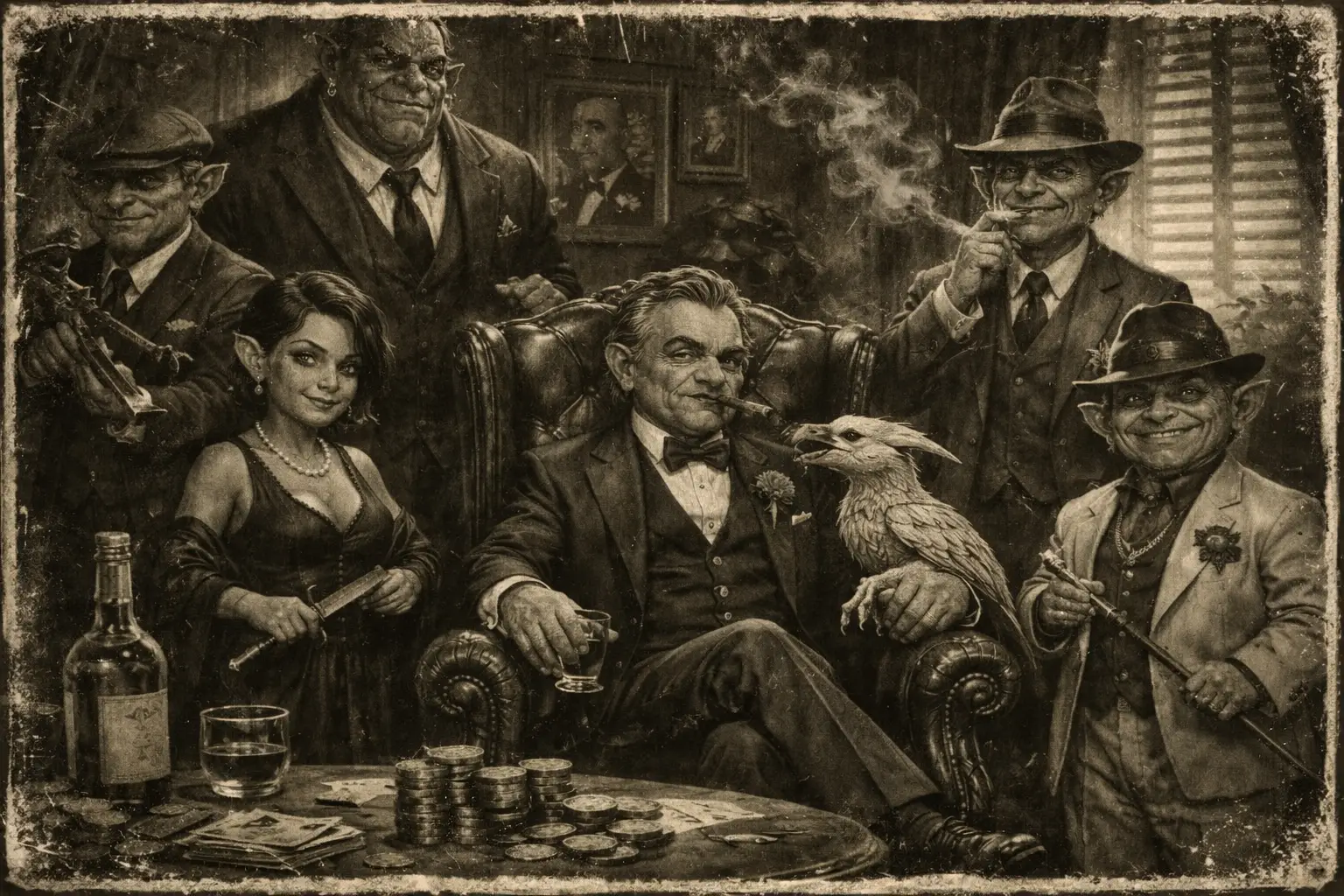
The Boromar Clan
Halfling criminal syndicate · Headquarters: Little Plains, Middle Menthis · Membership: ~108 core, hundreds of affiliates · Leader: Saidan Boromar
"They are immigrants who've made good, common people who've risen to rival the barons and kings. They give the people what they want, whether it's untaxed gambling, cheap spirits, or dreamlily."
In Callestan, where the alleys are narrow and the lanterns dim, a dwarf fence named Sundry runs a pawnshop in the Bazaar of Dura that deals in more than curiosities. He can move stolen goods across three wards in a single night and never touch a skycoach. The Watch officer who patrols his block has taken a Boromar bribe every Wir for eleven years, and both men consider the arrangement as natural as the rain. Sundry is not a member of the Boromar family. He has never met Saidan Boromar. But he pays his tithe, he avoids robbing locals, and in return the oldest and most powerful criminal organization in Sharn leaves him alone and ensures the Watch does the same.
This is how the Boromar Clan works. Not through terror or spectacle, but through a vast, embedded web of relationships, favors, and quiet understandings that have been accumulating for generations. What began as a family of halfling smugglers from the Talenta Plains has become one of Sharn's defining institutions — a syndicate whose patriarch attends the Tain Gala in Skyway, whose daughter sits on the city council, and whose network of extortion, bribery, and blackmail reaches from the slums of Lower Dura to the glittering heights above the clouds.
The Boromars are counted among the Sixty — the elite tier of Sharn's aristocracy. They own warehouses in Precarious and Cogsgate, taverns and inns across the city, tenements throughout multiple wards, and hold a substantial stake in the shipping trade. Their criminal nature is an open secret. In many districts, they are not perceived as a threat but as a feature: a source of untaxed gambling, cheap spirits, dreamlily, and predictable order in neighborhoods the Sharn Watch has never reliably served.
After generations at the top of Sharn's underworld, the Clan is now facing its most serious challenge: a sustained, escalating assault from Daask, the Droaamish criminal organization that has spent the last decade building a paramilitary presence in the lower wards. The Boromars have not yet found an effective response.
History
The Boromar Clan grew from halfling immigrant communities who came to Sharn from the Talenta Plains. Their origins were in smuggling and theft — practical, unglamorous work that required reliable networks and fierce internal loyalty to survive. The early patriarchs were not ideologues; they were logistics operators who understood that continuity of service was more valuable than any single score.
Over generations they expanded. Gambling came next, then debt and influence, then warehousing and shipping investment, then deeper integration into Sharn's civic and commercial life. The transformation was gradual enough that no single moment marks the Clan's ascent from syndicate to institution. By the time the early patriarchs were investing their earnings in legitimate properties, the family's criminal and commercial operations had become functionally inseparable.
The Clan still has ties to the Talenta Plains — once a year, Saidan sends a delegation bearing gifts and supplies to the old family on the grasslands. Talented warriors who want to see the city travel back with that delegation, and some of them end up among the Clawfoots, the family's personal guard. The Talenta Boromars do not have a very clear concept of what Sharn is; they understand it as a tower of the big folk, and the Boromar Clan as a group of clever hunters who use their wits to profit off them. Some think their city cousins have lost their way. Others think it sounds like a grand adventure.
Saidan Boromar, the current patriarch, grew up in Lower Dura and worked as a thief and assassin before taking over the organization. The Clan has never lost the street-level literacy of its origins, even as its leadership moves through the highest circles of Sharn society.
"One need not be tall to stand atop the highest tower." — Boromar family proverb
Membership and Structure
The Boromar Clan employs people of all races, but the inner circle is entirely halfling: 108 core members in all, including 32 members of the actual Boromar family. The remaining inner circle is made up of unrelated halflings, and the broader organization includes humans, gnomes, and others in administrative and street-level roles.
Joining the Clan requires sponsorship by a current member in good standing, followed by an interview with a Boromar family member. Halflings generally have an easy time gaining entry; other races typically serve a probationary period or perform a demonstrative service before being extended full membership. A member can expect a five percent discount on goods and services acquired through Boromar-connected vendors, access to safe houses across the city, and the ability to fence goods at no cost. Halfling members receive a ten percent discount at Jorasco houses of healing. When things go wrong, a member can call in a favor to have minor criminal charges dismissed — many members of the Sharn Watch are in the pay of the Boromar Clan and are willing to overlook a minor offense.
When violence is needed, the Clan generally prefers to hire freelancers — including members of the Sharn Watch and, when the job warrants it, agents of House Tarkanan — rather than expose family members to direct criminal risk. The Boromar family's personal security is handled by the Clawfoots, a unit of fifteen halfling warriors recently recruited from the Talenta Plains, commanded by Halak Boromar and headquartered in the Little Plains district of Middle Menthis.
FROM THE SHARN INQUISITIVE
SAVAGERY IN STYLE AT TAIN GALA
The annual Tain Gala, as everyone knows, brings the wealthiest and most prominent citizens of Sharn together in a grand display of opulence and power. But last night, it also provided a shocking display of violence, as Saidan Boromar — head of the Boromar family, which is allegedly tied to all manner of criminal activities throughout the city — was confronted by a would-be assassin. Boromar and his wife, Mala Boromar d'Jorasco, escaped unharmed thanks to the timely intervention of their bodyguard, a recent immigrant from the Talenta Plains whose fascinating culture and fierce demeanor were both in plain view last night. A Boromar spokesperson identified the bodyguard as Halak Boromar, head of the Clawfoots — the Boromar family's personal guard, named for the dinosaurs ridden by halflings in the Talenta Plains.
Operations
The Clan's primary income streams are gambling, smuggling, and organized theft, supported by a secondary network of extortion, blackmail, and political leverage.
Gambling. Gambling is legal in Sharn but taxed and regulated in ways that Boromar operations are not. Boromar gambling halls are cheaper to access, offer better effective returns to participants, and are free of crown paperwork. The finer establishments — nightclubs and private gaming rooms that serve the city's powerful elite — serve a secondary function as venues for bribery, intelligence collection, and high-level relationship management. The rougher halls in the lower wards function as planning spaces, storage for smuggled goods, and interrogation venues.
Smuggling. Smuggling has become an increasingly important business since the Last War disrupted traditional lines of trade and post-war embargoes created new categories of profitable contraband. The Clan's primary import is dreamlily, a narcotic with established demand across Sharn's wards. The Boromars also traffic in arcane and alchemical weapons, luxury goods restricted by embargo — including Aundairian wine, which Boranel's law prohibits selling in Breland — and a general range of goods whose value comes from moving them around official chokepoints. The Clan controls significant warehousing in Precarious and Cogsgate, where legal goods and contraband coexist on manifests designed to survive casual inspection.
Theft. Boromar-sanctioned theft follows an institutional rule: whenever possible, criminal acts against individuals should target tourists and travelers, not local residents. Pickpockets operating across the city work this policy as a matter of professional discipline. The Watch officer who receives a Boromar bribe can look away knowing that it is foreigners being robbed, not constituents. Stolen goods move out of the city through the same fencing and smuggling channels as other contraband.
Extortion and Political Access. The Clan's web of extortion is so thoroughly integrated into daily life in certain districts that residents simply treat it as an informal tax. Political access is monetized through council relationships: four of Sharn's seventeen city councilors have close ties to the Clan, including Councilor Ilyra Boromar, who reports directly to her father Saidan. The bloc votes consistently to prevent direct council action against the Clan. The Boromars have been bribing Watch captains for generations; councilors and Watch captains who have challenged the Clan have historically suffered swift and mysterious consequences, and this pattern is widely enough known that it functions as deterrence.
Allies
House Jorasco. The Mala Boromar d'Jorasco marriage created a formal relationship between the Clan and House Jorasco's halfling healers. Clan members receive free emergency healing; Saidan reimburses the house from treasury funds. In practice this functions as institutional medical support for an organization that regularly sustains combat casualties.
Sharn City Council. Four of seventeen councilors have close ties to the Clan, including Ilyra Boromar directly. Additional councilors fear the syndicate sufficiently to avoid open opposition even when not formally allied. The bloc has historically been sufficient to prevent sustained institutional action against Boromar interests.
Sharn City Watch. Boromar bribes to Watch captains are generational — so normalized that the Watch's non-interference with Boromar operations is largely taken for granted by both parties. A Clan member can arrange for minor criminal charges to be dismissed by calling in a favor with the right captain. Beyond the bribery, there is a practical argument: if the Boromar Clan collapsed, the underworld would erupt in anarchy as dozens of petty crime lords fought for territory. In many ways, the Watch depends on the Boromars to keep the underworld predictable.
The Aurum. Saidan Boromar holds membership in the Aurum's Gold Concord, providing the Clan access to elite patronage networks, high-society relationships, and the political insulation that comes with operating in those circles. Most interactions between the Aurum and the Boromar Clan are resolved by the dwarf Borian Haldorak, Aurum councilor for Upper Dura, and Ilyra Boromar.
House Tarkanan. A negotiated truce: the Clan does not require House Tarkanan to pay tribute, and House Tarkanan does not accept contracts against friends of Boromar. When the Clan needs clean, deniable violence, Tarkanan agents are available as freelancers.
Tributary Street Crews. The Little Fingers — child and adult halfling pickpockets operating in Middle Dura — pay a tithe to the Boromars and receive Watch protection in return. Similar arrangements exist with a range of smaller operations across the city. These relationships extend the Clan's operational reach without requiring direct membership; though the Boromar Clan itself has only a few hundred members, it has interaction with thousands of criminals throughout the city.
Enemies
Daask. The primary threat to Boromar stability. Daask has spent two years conducting escalating guerrilla raids against Boromar holdings, using mobile tactics and a paramilitary core that the Clan's conventional security cannot effectively counter. Daask agents go out of their way to harm up-and-coming Boromar operatives. The Clan's size and the static nature of its assets — warehouses, gambling halls, fixed routes — are liabilities against an opponent that stays mobile and strikes quickly. The Boromars have suffered significant losses, and the damage to their reputation for invulnerability may outlast the conflict itself.
Hostile City Council Faction. At least three councilors oppose the Clan out of genuine civic concern; two more are affiliated with rival organizations (the Aurum and the Tyrants) and oppose the Clan on competitive grounds. This faction has successfully blocked the deployment of city resources against Daask, preferring to let the two organizations damage each other.
Current Status
The Boromar Clan is not in immediate danger of collapse — it is a massive organization with centuries of embedded relationships and diversified assets. But it is in a more precarious position than at any point in recent memory. For centuries, it has been resting on its reputation of omnipotence — and this reputation is quickly being shattered. Even if Daask were destroyed tomorrow, the long-term damage to that reputation would still haunt the Boromars for years. The Clan has the gold, the relationships, and the institutional depth to survive. Whether it can adapt to a mobile opponent that does not share its preference for predictable, stable conflict remains the open question.
Saidan Boromar needs to find a way to counter Daask, and he needs to do it soon. A group of capable adventurers might prove far more effective than the soldiers Saidan usually hires for muscle work — but does the party really want to help the Boromar Clan?