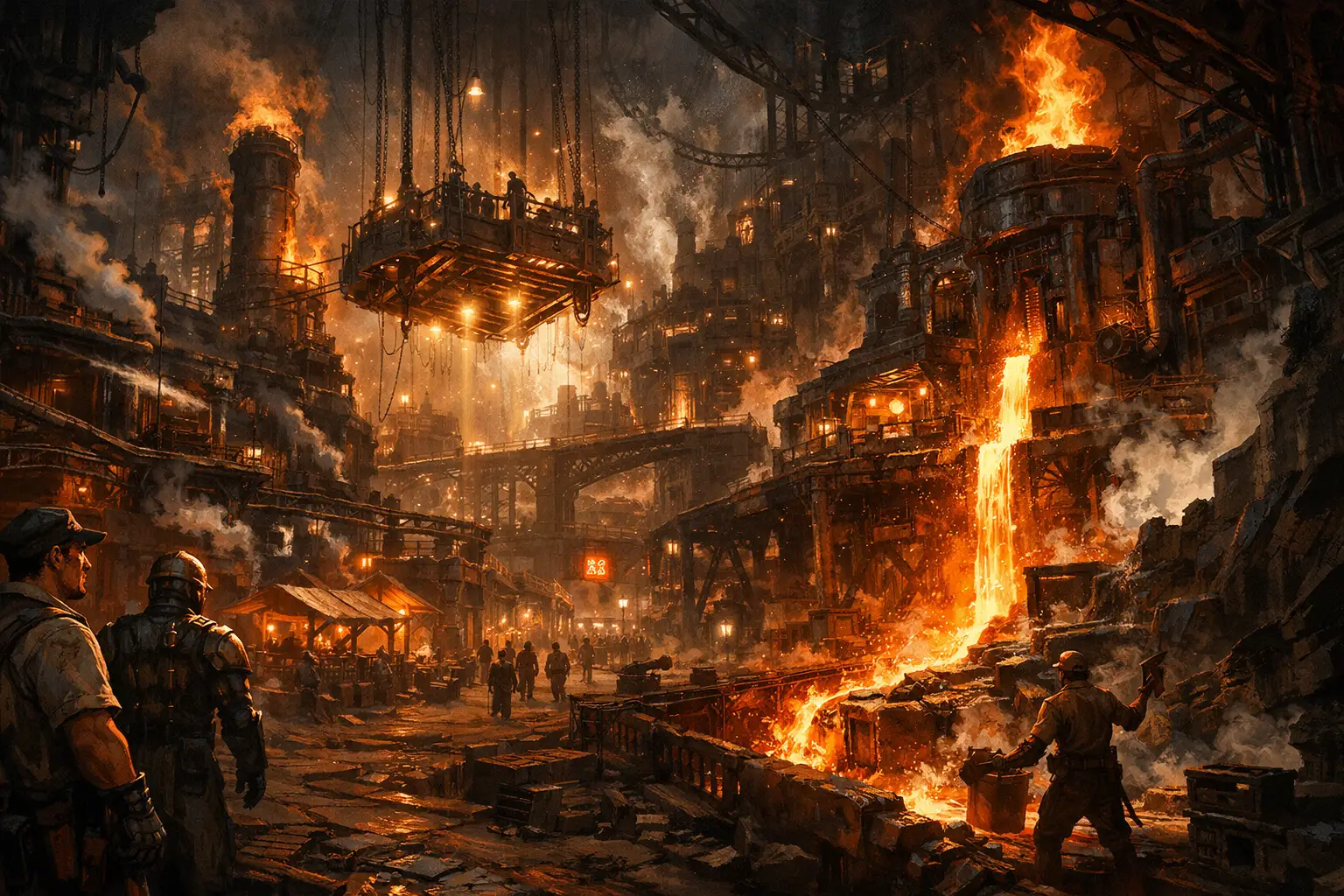
The Cogs
"Down in the Cogs, the city doesn't sparkle. It sweats." — Harlon "Soot" Venn, lift-hand
The Cogs are Sharn's buried engine room: a vast undercity of lava channels, ancient foundations, and industrial districts built into the bones of the plateau. They sit below the lower wards — part cavern, part canyon, part manufactured hellscape — where foundries burn, smelters roar, and the air tastes like hot metal and ash. If Upper Sharn sells glamour and Middle Sharn sells stability, the Cogs sell output: heat, power, steel, processed ore, and the cheap labor that keeps the towers above from slowing down.
The Cogs are not a "ward" in the civic sense. They are an industrial layer — split by tunnel networks, lift shafts, and the jurisdictions of whoever can hold a street. House Cannith interests, independent forges, clan-run workshops, and criminal outfits all overlap here, because the Cogs are where you can hide a project behind noise and smoke. You can also disappear. The Watch patrols the edges, but most enforcement below the lift-lines comes down to private security, gang order, and the simple fact that the environment punishes the careless.
The Cogs' population figure reflects only the Upper Cogs — Ashblack, Blackbones, and Khyber's Gate — and is almost certainly an undercount. A significant portion of the Cogs' workforce lives in the lower wards above and commutes down through the access shafts, and Khyber's Gate's population resists accurate census-taking by design. The bulk of Sharn's 1,500 warforged residents can be found in Ashblack and Blackbones, where they labor in conditions that make the nominal population figures misleading: warforged require neither food nor sleep, work continuous shifts, and are frequently not counted by the same metrics used for other residents.
Nolan Toranak holds the council seat for the Cogs. He represents the industrial interests of Ashblack and Blackbones — which is to say, he represents the nobles and merchant princes of Upper Sharn who actually own most of the foundries. Toranak generally aligns himself with whichever bloc seems most useful at any given vote, with one consistent exception: he harbors a deep personal hatred of the warforged, whose soldiers killed members of his family during the Last War. He has spent years attempting to have warforged reclassified as property in defiance of the Treaty of Thronehold, and funds organizations that share his position.
Origins: Fire and Catastrophe
The lava that powers the Cogs is not a natural phenomenon — or not entirely. During the War of the Mark, Lord Halas Tarkanan and the Lady of the Plague made their last stand in the early city. When defeat became inevitable, they unleashed the full power of their aberrant dragonmarks: Tarkanan's earthshaking ability collapsed the towers, and the Lady called up rivers of lava from the lake of fire far beneath. The resulting destruction reduced the original city to rubble and drove off every living inhabitant for five centuries.
When Galifar I rebuilt Sharn, House Cannith played a central role. Where others saw cursed ruins, Cannith engineers saw the opened lava channels as a resource. The lava burns hotter than natural fire — hot enough to work adamantine — and over the centuries Cannith helped Breland establish a massive industrial complex to exploit it. The ruins of the pre-Tarkanan city and the goblin settlement beneath it were sealed away beneath the new construction: King Galifar I had all passages to the old undercity closed with gates of metal and magic, and in time they were forgotten. What lies in those sealed depths — Old Sharn, the Depths, the ruins that predate even the human settlement — is largely unknown. The Cogs were built on top of that forgetting.
Geography and Access
Physically, the Upper Cogs are a honeycomb of passages, just wide enough for the carts and caravans that transport goods to and from the surface. The heat is palpable. Smoke and sulfur scent the air. Light is provided by everburning torches rather than everbright lanterns, often spaced far apart so that stretches of shadow fall between pools of orange light.
Access to the Cogs is mostly limited to two points: Lower Tavick's Landing and Lower Dura, where deep access shafts are maintained. These vertical chokepoints are watched — officially by the Watch at major lifts, unofficially by whoever controls the street around them. Most goods move upward; most trouble moves down.
The districts of the Cogs are not as cleanly delineated as those of the city above. Borders blur, jurisdictions overlap, and the heat and darkness mean that what matters is who controls the corridor, not what it's officially called.
Districts
Ashblack (Industry district) — The older of the two industrial districts, stretching out from Lower Dura toward the center of the city. Ashblack is defined by large-scale ore processing and heavy foundry work, and the walls are covered in a permanent layer of soot that gives the district its name. House Cannith's Forgehold — the true operational heart of the house in Sharn, and the site of a secret creation forge hidden behind illusions and arcane seals — lies buried within it. The heat, the noise, and the sulfurous air make Ashblack one of the most punishing places to live or work in the city.
Blackbones (Industry district) — Newer and marginally better-lit than Ashblack, Blackbones lies beneath Tavick's Landing and is home to the largest concentration of warforged residents in Sharn. Many labor here in conditions that test the limits of the Treaty of Thronehold's protections, but the district also contains the Red Hammer Inn — the city's only warforged-run social establishment — and the Pool of Onatar's Tears, a sacred smithing site that draws pilgrims from across Khorvaire. It is, in short, the Cogs district most likely to contain both exploitation and community in the same corridor.
Khyber's Gate (Undercity / tenement district) — Occupying the space between Ashblack and Blackbones where lava streams give way to older tunnels, Khyber's Gate is a tenement district carved from the ruins of a goblin city abandoned thousands of years ago. It is home to goblins, monstrous immigrants from Droaam, fugitives, and anyone else with no better option, and Daask controls it absolutely from their base in the restored Temple of the Six. The Watch has no presence here; the Sharnukaar tavern is the only reliably neutral ground in the district.
Authority and Control
The Watch does not truly police the Cogs; it contains them. Enforcement focuses on lift stations, major cargo routes, and incidents that threaten the city above — fires that climb shafts, sabotage of infrastructure, mass unrest, anything that risks attracting political attention in the towers.
Actual order on the ground is handled by overlapping powers with competing interests. House Cannith oversees its own enclaves and supply chains with private security and warforged guards. Independent foundry owners hire protection according to what they can afford. Daask controls the criminal economy of the Cogs outright and enforces its rules through violence, making it the most consistent authority in Khyber's Gate and the surrounding tunnels. Local crews and shift foremen operate informal governments within their particular corridors: deciding who works, who gets warned, who gets cut off from the next labor rotation.
The Cogs also carry a council representative: Nolan Toranak, a dwarf who technically represents the industrial interests of Ashblack and Blackbones. In practice the nobles and merchant princes of Upper Sharn own most of the foundries and Toranak aligns himself with whoever seems most useful on any given vote. His one fixed conviction is his hatred of the warforged — his children were killed by warforged soldiers during the Last War, and he has spent years quietly working to find ways to treat the constructs as property rather than citizens, in defiance of the Treaty of Thronehold.
The Warforged Question
The Cogs are where the warforged situation in Sharn is most visible and most fraught. The Treaty of Thronehold granted warforged the status of free citizens. The economics of the Cogs push back against this constantly. An employer who can work a warforged laborer without breaks, without meals, without pay if the right paperwork exists, has a significant advantage over one who cannot — and the Watch's absence from most of Khyber's Gate means that the treaty's protections are enforced only where someone has the power and motivation to enforce them.
Merrix d'Cannith operates on two simultaneous tracks: improving the conditions of warforged in the Cogs through the Red Hammer and his treatment of workers at the Forgehold, while secretly continuing to produce new warforged in violation of the same treaty. The warforged priest Smith works to give his community a theological and communal anchor that doesn't depend on either Merrix's patronage or the Lord of Blades' violence. Both efforts are running against the grain of the economic system that surrounds them.
What Lies Below
The Cogs themselves rest on older things. Below the industrial districts, below the sealed corridors of Old Sharn, below the goblin ruins that predate the human city, there are spaces that no one responsible has mapped. Expeditions funded through Morgrave University occasionally descend into these depths; their reports are rarely complete, and their sponsors are frequently misrepresenting their intentions. Strange things crawl up from the lower tunnels from time to time. The Cults of the Dragon Below have followers in Khyber's Gate — three competing sects, fighting each other as often as anyone else. At least two known rakshasas have established themselves in the undercity, largely unknown to the population above. None of this is officially the Watch's problem.
The Cogs are not inherently evil. They are indifferent. They take what you bring down — strength, skill, connections, desperation — and they grind the rest into slag.