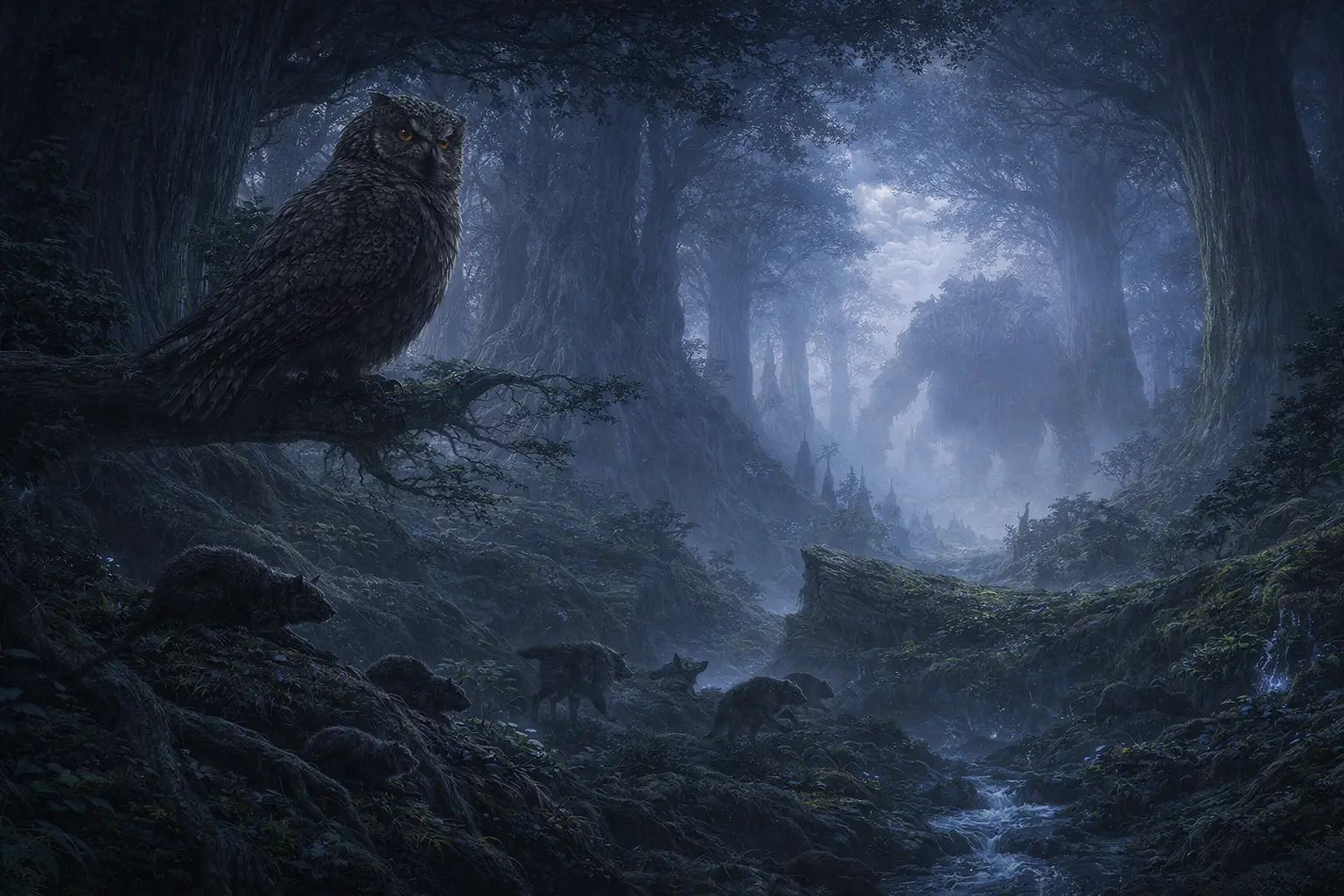
Lamannia, the Twilight Forest
Plane — Primordial Nature, the Elements & the Untamable Wild — Moon: Olarune, the Sentinel
Lamannia embodies primordial nature — untapped, untamable, and uninterested in the opinions of civilization. It is often called the Twilight Forest and depicted as a realm of colossal trees and massive beasts, but the forest is only one facet of a plane that contains every natural environment in its most intensified and exaggerated form. Windswept desert, raging ocean, endless plains, volcanic wastelands, frozen peaks — all can be found here, in layers that exemplify and amplify their features far beyond anything the Material Plane can produce. In other planes, environments are backdrops to a story the realm is telling. In Lamannia, the environment is the story. It does not need the help of fey or fiends to make its point, because the land itself is the point.
Some scholars assert that Lamannia served as a blueprint for the Material Plane — that here, the Progenitors perfected the ideas of storm and stone before applying them to Eberron. They believe the natural world is infused with the essence of Lamannia, and that druids and others who wield primal magic actually manipulate that Lamannian essence when they call upon the power of wind, growth, and beast. Whether or not this is literally true, there is no question that Lamannia is saturated with primal power; druids who travel to the Twilight Forest can be overwhelmed by the sheer force of nature that infuses the place, and even mundane travelers report that the air is cleaner, the colors more vivid, and the water sweeter than anything they have experienced on Eberron.
Lamannia lies close to the world, and it is one of the easiest planes to reach. Its manifest zones are relatively common, particularly in the Eldeen Reaches and the wilds of Q'barra, and the gateways they create are more reliable than those of most other planes. Its treasures are not forged from quintessence or inscribed on enchanted gold — they are natural objects imbued with elemental power: wood, stone, herbs, and plants, all stronger and more potent than their mortal counterparts. The Zil gnomes bind the elementals that dwell here to propel their lightning rails and airships. House Vadalis builds its enclaves in Lamannian zones to breed stronger livestock. Alchemists prize Lamannian herbs for potions of extraordinary potency.
But Lamannia is not a garden to be harvested. When you come here, there are many predators — and you are prey. Anyone who seeks to despoil the embodiment of nature will be hunted.
EXCERPT — TRAVELS IN THE TWILIGHT, BY TASKER TORRALYN D'SIVIS, EXPLORER'S HANDBOOK PRESS, 987 YK
I made camp on what I took to be a pleasant little island, perhaps half a mile across, with sandy soil and a few stands of broadleaf trees. The fishing was excellent — I pulled three silver trout from the shallows in as many minutes, each one the finest specimen of its kind I have ever seen. I was roasting the second when the island moved.
It moved slowly, thank the Sovereigns — a gentle rolling that sent my campfire sliding toward the water and my pack tumbling down the beach. I scrambled to the highest point and looked down, and that is when I saw the eye. It was the size of a barn door, ancient and patient, and it regarded me with no particular malice. I was sitting on a turtle. The turtle was the island. And I believe the island was larger than Korranberg Library's entire campus.
I have been back to Lamannia seven times since. The fishing remains excellent.
Universal Properties
Lamannia is a reflection of the natural world, intensified and exaggerated. The air is pure and clean, the water fresh and clear. Colors are impossibly vivid, and the plane is suffused with life — a realm in which any stone could be an earth elemental, any tree could be awakened, and the wind itself might be watching you. Vegetation is nearly always in bloom, and beasts are almost always in the peak of health. Except for a few layers such as the Rot, Lamannia reflects the ideal state of the natural world.
Extended Druidic Magic. When a creature casts a druid spell with a duration of one minute or longer while in Lamannia, the duration is doubled. Spells with a duration of twenty-four hours or more are unaffected. This effect may extend to other characters who draw on primal sources of magic, such as Gatekeeper rangers or Greensinger bards.
Indomitable Beasts. Beasts and elementals in Lamannia are hardier and more resistant to external influence. They have a bonus to Constitution and advantage on Wisdom, Intelligence, and Charisma saving throws. More critically, upon arrival in Lamannia, any elemental or beast that is charmed or bound in any way is immediately freed from that effect. This can be disastrous for an elemental airship that is thrown into the plane — the bound elemental that keeps it aloft is instantly released, with predictably catastrophic results.
Elemental Power. When a creature casts a spell that summons or conjures an elemental, it does so as if cast at one level higher than the slot expended.
The Land Provides. A creature has advantage on Survival checks to forage for food or shelter. In most layers of Lamannia, the vegetation is bountiful and the land sustaining — even in harsher environments like the Broken Land, the advantage at least gives you a fighting chance.
Primordial Matter. It is difficult to destroy or contaminate the matter of Lamannia. All nonmagical food and drink is purified, rendered free of poison and disease. Natural materials such as wood and stone are tougher than their counterparts on the Material Plane, harder to break and more resistant to weathering.
Standard Time. Time passes at the same pace as on the Material Plane and is consistent across all layers.
Layers
Each of Lamannia's layers highlights a particular aspect of primal nature. One might contain a single colossal mountain peak; another might be as large as Khorvaire — or even Eberron itself. The edges of a layer could be impassable physical barriers (a cliff face that reaches to the sky, an ocean that has no far shore), or they could wrap around on themselves so that a traveler who sails far enough returns to their starting point. Most layers follow a traditional day-night cycle, though they are not synchronized across the plane, and when the moon Olarune is visible, it is always full.
The portals connecting layers often allow travel in only one direction. Any deep pool of water may connect a layer to the Endless Ocean, but while you can reach the Ocean by diving into a pond in the Twilight Forest, there is no gate back to the forest on the other side. The Endless Ocean contains small islands, and exploring one often reveals that you have moved to an entirely new layer.
The Twilight Forest
The sky is hidden by a dense canopy that plunges the forest floor into perpetual twilight. The trees of the lower forest are impressive — over a hundred feet in height — though not as tall as the greatpines of the Towering Wood in the Eldeen Reaches. But as explorers press deeper, they encounter strange ridges and walls of living wood, some forming twisted wooden canyons. These are the roots of unimaginably colossal trees, vast titans wider and taller than the towers of Sharn. The Twilight Forest as mortals experience it lies in the shadow of a grander canopy that rises far above, and these enormous trees are home to megafauna and mightier beings still.
Wide cleared paths wind through the lower forest, but survival experts will recognize that these are not trails cut by humanoid hands — they are the paths of totems, creatures so large they crush the lesser forest beneath their colossal feet. The forest is filled with beasts: mundane and dire creatures in the lower levels, megafauna in the grand canopy above, and the occasional passage of totems. Multiple communities of lycanthropes are scattered through the lower forest — a clan of wererats has carved out a warren in the roots of a colossal tree, while a pack of wild wereboars feuds with werewolves descended from exiled templars. An ancient elf druid named Haral, who spends most of her time in the form of an owl, does her best to maintain order, assisted by a megafauna owl she calls Ruark.
Minor elementals are also present. A gust of wind, a pool of water, a rolling stone — in Lamannia, any of these things could be alive.
The Broken Land
The Broken Land is a volcanic region of high mountains and lava plains, racked by constant eruptions. Fire and earth elementals engage in an ongoing environmental conflict here: fire elementals flow outward with the lava as volcanoes erupt, while earth elementals work to contain the eruptions and rebuild shattered peaks, only to watch them erupt again. Few beasts manage to thrive in this layer, though some tough dinosaurs have clawed out a niche. Remnants of past travelers can be found here — a harsh and deadly landscape for stranded adventurers or those seeking a lost relic.
The Endless Ocean
This layer reflects the majesty of the ocean depths. It is home to a vast array of fish and aquatic beasts, tribes of primordial merfolk who wield druidic magic but craft no tools, and a wide range of water elementals — from simple sentient currents and weirds to massive leviathans and battling megafauna. The gnome Tasker encountered an island here that turned out to be a totem turtle. True islands are rare, and most are actually portals to other layers. Many points in the Endless Ocean are connected to manifest zones (mostly located in ocean depths) on the Material Plane.
The First Storm
A layer of plains and low hills permanently lashed by hurricane winds and storms that never end. Beasts huddle in caves and what little shelter exists, while all manner of elementals clash across the storm-lashed landscape. A massive elder tempest drives the heart of the storm — during the Sundering of Sarlona, an apocalyptic cult in Ohr Kaluun sought to bring this elemental to Eberron, believing it would destroy the world.
The Rot
Decay is part of nature, and the Rot reflects this truth. A relatively small layer filled with fallen, rotting trees, the corpses of megafauna beasts lie scattered across the swamp-like landscape, and giant insects and massive scavengers prey on the remains. A community of wererats thrives here, and a small outpost of the Children of Winter may have found their way to this place. While the Rot is a symbol of death and decay, it is entirely natural — undead have no place here, and any attempt to animate the massive corpses would violate the plane's fundamental nature. If Lamannia has a higher power, it would certainly direct forces to counter such an intrusion. While most layers are free from disease, disease itself is part of nature; a manifest zone tied to the Rot could spread plagues into surrounding regions.
Titan's Folly
During the Age of Giants, the Group of Eleven established a research station and mining camp in a layer of Lamannia, seeking to harvest the plane's abundant natural resources. After a decade of struggling against megafauna attacks and elemental-enhanced weather, the outpost was overwhelmed and abandoned. It is a testament to the arcane engineering of the giants that anything remains at all — though it may be that the ruin endures because it has become a symbol of nature reclaiming civilization. Vines and moss cover shattered walls. The bones of giants lie scattered through the remnants. Valuable and powerful treasures may still be hidden in the Folly, but explorers will have to contend with aggressive elementals, dangerous beasts, and traps left by the long-dead giants.
Denizens
A common story about Lamannia tells of an explorer who passed through a manifest zone and found herself on a vast mountain peak. Pressing upward, she was exploring a mysterious thicket when she was set upon by rats the size of wolves. She fought the rats but was on the verge of being overwhelmed — until a giant beak flashed down and snapped up a rat in a single bite. The wide "thicket" was not natural briar; it was the nest of a gargantuan roc. This is Lamannia: everything you know about nature, but bigger, stronger, and profoundly disinterested in your convenience.
Beasts
Lamannia's primary inhabitants are beasts — both creatures you might encounter in the wilds of Eberron, and massive creatures that serve as iconic representations of their type: the idealized incarnation of Bear, Wolf, Serpent, or Roc. Any natural creature can be found here; some sages assert that the presence of a creature in Lamannia is what defines it as natural.
Lamannian beasts fall into four categories. Mundane animals are identical to their Eberron counterparts — if these are the first things you encounter, you might not even realize you have left the Material Plane. Dire animals are creatures of remarkable size; in the Twilight Forest, most owls are giant owls, and they prey on giant weasels and rats. Megafauna are gargantuan beasts — the roc is one example, and those found on Eberron have typically been drawn through manifest zones during coterminous periods. A pack of gargantuan wolves, a megafauna serpent with the statistics of a purple worm, a megafauna swordtooth titan — the possibilities are staggering. And then there are totems: beasts beyond the tactical scale, creatures that can be measured in miles. The gnome Tasker tells of an island that was a turtle and a pack of lycanthropes living in the fur of a roaming wolf the size of a mountain. Totems are not natural creatures; they do not eat, and their origins are a mystery. Most sages believe they are immortal spirits projected by the plane itself — possibly the same totems that druids, barbarians, and shifters draw upon for primal power. No one has ever successfully harmed or communicated with a totem.
Most Lamannian beasts are no smarter than their Eberron counterparts, though some possess intelligence similar to that granted by the awaken spell. Even these awakened beasts generally follow their natural instincts and live wild lives. The giant owls of Sharn may own shops and run for city council, but the giant owls of Lamannia are content to hunt. It is possible to find creatures that speak Common or a Primordial dialect, but most have little interest in long conversations. And do not forget that dinosaurs are natural beasts — while a megafauna owl is impressive, the megafauna version of a swordtooth titan is a sight that tends to end conversations permanently.
RECOVERED FIELD NOTES — HOUSE VADALIS SURVEY EXPEDITION, TOWERING WOOD MANIFEST ZONE, ELDEEN REACHES, 993 YK. NOTES FOUND PINNED BENEATH A STONE AT THE ZONE’S EDGE. NO MEMBER OF THE EXPEDITION HAS BEEN LOCATED.
Day 3. Plants in the zone are 40-60% larger than regional baseline. Soil samples show nothing unusual. Water from the central spring is the cleanest I have ever tested — no contaminants, no pathogens, no trace sediment. It tastes the way water tastes in a dream where you are very thirsty. Marten says it’s the best water he’s ever had. He keeps going back for more. I told him to stop. He went back anyway.
Day 5. The rabbits here are the size of small cows. They are not scared of us but neither are they territorial. They watch us. Not the way animals watch — the way something watches that is deciding whether you are interesting or ignorable. We are still being ignored. I am not comforted by this.
Day 7. Found tracks this morning. Not rabbit tracks. Something with a stride longer than I am tall. The tracks went through camp. Between the tents. Past the fire. Whatever it was, it walked through while we were sleeping and did not wake a single person. Kessra says her tripwire alarms were still set. They were not triggered.
Day 9. The spring connects, at its deepest point, to somewhere else. Our diver surfaced in an ocean. She says the moon was full — Olarune — and it should not have been. She says she could not find the bottom. She was under for two minutes. She will not go again. She will not say what she saw looking back up at her from below.
Day 11. Marten is missing. His bedroll was empty this morning. No tracks leading out of camp. No sign of struggle. A few drops of blood some paces from his roll.
Day 12. We are leaving. As we packed, I noticed that the rabbits were sitting in a circle at the edge of the clearing. Sixteen of them. Watching. Not eating. Not moving. Just watching us leave with their dark, wet eyes, patient as stones.
I do not recommend we establish a permanent observation post. I do not recommend we return. I am ordering a full re
Elementals
After beasts, the most common inhabitants are elementals. Unlike the anthropomorphic genies, mephits, and humanoid elementals of Fernia and Syrania, Lamannia's elementals are the pure, living essence of the elements — unburdened by any humanoid desire. Standard earth, fire, air, and water elementals are present, but they come in a staggering range of sizes and forms: tiny globs of crawling lava in the Broken Land, apocalyptic leviathans in the Endless Ocean, and the elder tempest that drives the First Storm.
The Zil gnomes commonly summon and bind these elementals to propel lightning rails and airships. While intelligent, Lamannian elementals are utterly alien. They have little concept of time and perceive the world purely through the balance of elements. Their sole desire is to express their element: to burn, to flow, to fly. Many have an antagonistic attitude toward spirits of other elements, which drives the deadly conflict between fire and earth in the Broken Land. This poses difficulties for mortals, as elementals tend to perceive humanoids primarily as inconveniently mobile globs of water. While a character who speaks Primordial can attempt communication, establishing common ground for negotiation is extremely difficult. Still, there are legends of wandering druids who "befriended earth and air," so anything is possible.
Humanoids
The merfolk of Eberron — such as the Kalamer of the Thunder Sea — trace their origins to the Endless Ocean of Lamannia, and their primordial ancestors remain there. These Lamannian merfolk are closer to their elemental roots than their Eberron cousins: equally intelligent, but driven by primal instinct. They wield druidic magic but craft no tools and build no structures. Other humanoid natives follow the same pattern — any race with a strong primal connection could be tied to Lamannia, but all avoid the trappings of civilization.
Over a century ago, during the Silver Crusade, many lycanthropes fled to Lamannia through manifest zone portals in the Eldeen Reaches. While on this plane, a lycanthrope cannot spread the curse to anyone other than their offspring, and the unnatural impulses of the curse — the bloodlust, the drive to prey on innocents, the loss of control — are suspended. They may take joy in the hunt, but they are not driven to evil and remain in full control. Packs and communities of lycanthropes are scattered across the layers: most are descended from those who fled the crusade and who now embrace their primal nature, rarely assuming humanoid forms. Others descend from afflicted templars who chose exile over death and strive to preserve the beliefs and traditions of their ancestors.
A handful of druids and rangers have crossed into Lamannia and chosen to remain in this primal paradise. Some run with lycanthrope packs, spending their days in wild shape. Others act as planar shepherds, seeking to minimize the impact of dangerous manifest zones and help unwary travelers.
Greater Powers
There are no celestials or fiends in Lamannia. Yet explorers frequently report a feeling of being watched, and there are times when seemingly random events appear guided by an unseen hand. When outsiders have sought to establish industries in Lamannia — mining camps, lumber operations — they have been attacked by megafauna or elder elementals, or struck by especially vicious turns of weather that seem almost directed. It is possible this is the work of the totems, which may have great influence over their layers. Or there could be a greater power that watches over the entire plane. Some scholars assert that the moon Olarune is the consciousness that governs Lamannia, and Eldeen shifter traditions that predate the Wardens of the Wood also reflect this belief. Shifter druids hold that Olarune created the shifters, and that the first lycanthropes were her champions.
Planar Manifestations on Eberron
Manifest Zones
Lamannian manifest zones are relatively common and usually share one or more of the plane's universal properties. They are typically found at the heart of regions that resemble the connected layer — zones tied to the Endless Ocean are found underwater, while those linked to the Twilight Forest appear in the Towering Wood, the King's Forest, and other vast woodlands. It is relatively common for these zones to serve as gateways to Lamannia, though passage may require a lunar alignment or a coterminous period. This works in reverse as well: creatures can be pulled through to the Material Plane, from hostile elementals to deadly megafauna.
Zilargo has a number of valuable zones with the Elemental Power property, and both House Cannith and the Twelve are eager to find more — though such zones are dangerous, as elementals sometimes spontaneously manifest, linger for a few hours, then dissipate. Bound elementals can break free from their bonds in Lamannian manifest zones, which is especially unfortunate if that elemental is responsible for keeping an airship aloft.
Plants and beasts near Lamannian zones are often significantly larger and healthier than their counterparts elsewhere, and many House Vadalis enclaves are built in these zones for exactly this reason. Zones with the Primordial Matter property can be valuable community resources — purified food and water, exceptionally durable wood and stone. The prison of Dreadhold is built in such a zone.
Some zones, however, actively resist civilization. Weather, rampant vegetation, and accelerated decay can combine to destroy structures and overgrow the ruins within weeks. A town in the Blade Desert thrives beside a small Lamannian lake that provides fresh water and inexhaustible fish. A tribe of shifters in the Eldeen Reaches lives in the branches of three massive trees. A breed of giant rabbits, unknown elsewhere in Khorvaire, lives in harmony with the residents of a small Eldeen village. These are the gentler gifts of the Twilight Forest.
Coterminous and Remote
Lamannia traditionally becomes coterminous for a week around the summer solstice, and remote for a week during the winter solstice. While coterminous, the effects of Lamannian manifest zones are enhanced: fertility of plants and animals increases in regions of unspoiled nature, beasts conceived in these periods are often exceptionally strong and healthy, and spells targeting beasts or elementals with durations of one minute or longer have their durations doubled.
While remote, fertility rates drop. Beasts born in these periods are often weak or sickly. Animals are uneasy, and spells affecting beasts or elementals have their durations halved.
Lamannian Artifacts
Lamannian vegetation is prized by alchemists. Herbs and roots from the plane produce exceptionally potent potions, and many types of Lamannian vegetation have innate magical effects — there are bushes in the Twilight Forest that naturally produce goodberries. Lamannian lumber can have unusual properties, mirroring the densewood and bronzewood found in Aerenal. Lamannian wood and stone can serve as powerful focuses for primal magic, for creating figurines of wondrous power, or for tools designed to summon and bind elementals.
The treasures of Lamannia are not gilded crowns or enchanted blades. They are the branch that will not break, the herb that cures what lesser medicines cannot, the stone that holds an elemental's soul. They are the plane's answer to a simple question: what would nature produce if nature were perfect?