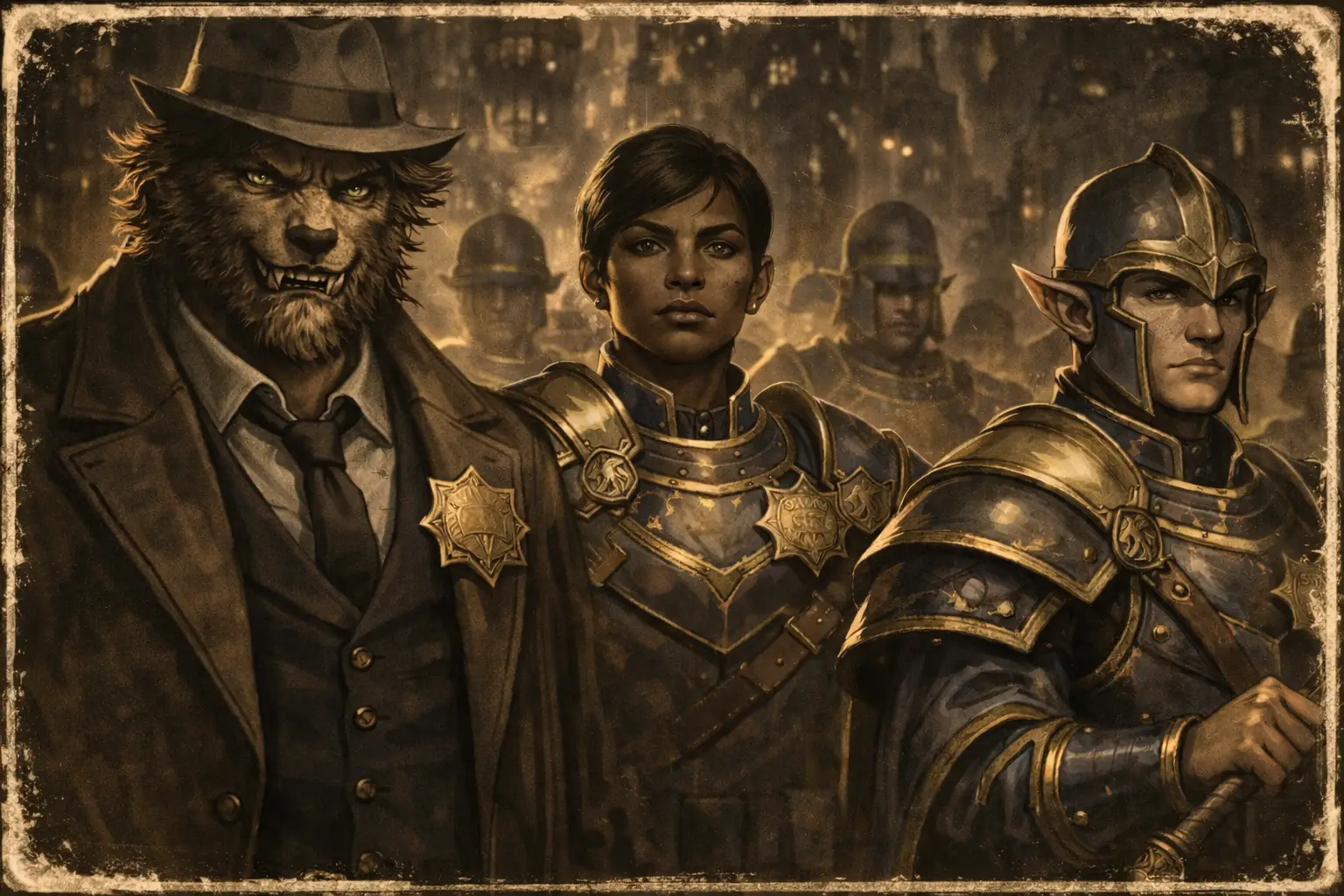
The Sharn City Watch
Municipal law enforcement · Headquarters: The Citadel, Ambassador Towers · Garrisons: Daggerwatch, Warden Towers, Sword Point, Black Arch · Commander: Lord Commander Iyan ir'Talan
"A common viewpoint among the citizens of Sharn — and close enough to the truth. But there's an important undercurrent. Although most officers of the Watch take bribes, that doesn't mean all of them don't care about their city."
In Precarious, a dwarf tries to smuggle a portable hole filled with treasures pillaged from Xen'drik past the guards of the Sharn Watch. In Clifftop, a patrol of guards calls on two dueling barbarians to throw down their weapons; the fierce warriors just snarl and rush at each other once more. In the court of Upper Central, a magistrate orders the Justiciar of Aureon to blind the prisoner in preparation for his sentence of perpetual darkness. The law is a force to be reckoned with in Sharn — even in places where the Watch is notoriously ineffective, those who would break the law still need to be wary of zealous guards resistant to bribes or threats.
The Sharn City Watch is the city's public law-enforcement arm: uniformed patrols, district garrisons, and commanders responsible for keeping order across a metropolis of a million and a half souls that never stops expanding upward and outward. It enforces the Galifar Code of Justice, which remains the law of Breland and provides the framework for criminal prosecution, property rights, and civil procedure throughout the city. But in practice, the Watch is not one consistent presence. In the upper wards it is visible, responsive, and practiced at protecting wealth and reputation. In the lower wards it is undermanned, slower to respond, and forced — or willing — to look the other way.
Most citizens judge the Watch not by its charter but by whether it arrives when called, and whether it arrives as help, a shakedown, or not at all. Those answers vary more by district than by any policy the Lord Commander has ever issued.
Structure and Administration
Central administration of the Sharn Watch is housed in the Citadel — the hulking fortress in Ambassador Towers that also contains Sharn Prison and the headquarters of the King's Citadel. The bulk of the Watch operates out of four garrison districts:
Daggerwatch (Upper Dura) Warden Towers (Middle Menthis) Sword Point (Middle Central) Black Arch (Lower Tavick's Landing)
Each garrison operates under its own commander with considerable leeway in interpreting Watch policy. This local autonomy is the structural reason the Watch behaves so differently from one district to the next. A garrison reflects its commander: their priorities, their debts, and their appetite for compromise.
Any commander can call on the Blackened Book, the Goldwings, or other specialized divisions for support. In serious enough situations they can contact the Redcloak Battalion or the King's Citadel. In practice, these escalations are rare. The commanders of the Watch are generally only interested in maintaining the status quo and protecting the wealthy; as long as things are quiet on the surface, the Watch rarely goes searching for trouble. Most commanders prefer to use personal agents — people with no attachment to the Watch or any other arm of the government — to quietly resolve situations rather than invite outside scrutiny into their districts.
Culture
The Watch includes people from all walks of life: veterans of the Last War, retired adventurers, lifelong residents of the city, and immigrants who have become Brelish citizens. It is hierarchical and practical, and its culture is shaped more by who commands a garrison than by any institutional ethic. There is a seventy-five percent chance any given Watch officer is taking bribes from the Boromar Clan or some other wealthy patron. This does not mean those officers feel no loyalty to their district — many take bribes from the Boromars because they believe, genuinely, that the Clan helps keep Sharn functioning and that the chaos of its collapse would be worse than its continued operation.
The guards of the Dura Bazaar have an understanding with the gang of pickpockets known as the Little Fingers. As long as the thieves target only tourists and foreigners, the Watch will dismiss any charges brought against them. Why should an officer of the Sharn Watch care if some Aundairian with more gold than sense gets robbed? But if the Little Fingers pick on a local, they're asking for trouble. The relationship works both ways — the pickpockets are privy to things the Watch officers aren't, and they often warn the Watch about suspicious people or activities they witness.
Watch officers do exist who are entirely crooked and care nothing for the law. At the other extreme, some officers are entirely honorable and place the law above all else, and most of those are willing to risk their lives to save an innocent bystander from a rampaging Daask troll. But most members of the Watch are pragmatists who put the needs of their clients uppermost, the needs of the citizenry second, and generally don't take action against locals.
The Watch also carries the social residue of the Last War. Guards can be professionally indifferent to national origin or background, but others bring personal grudges into the street — particularly toward groups associated with wartime enemies or long-running prejudice. Brelish veterans who became guards after Thronehold can be harsh toward Cyran refugees. The Guardians of the Gate — devoted to their city but willing to use force well in advance of necessity — have drawn repeated complaints for their treatment of the population in High Walls.
SHARN WATCH PERSONALITIES
When encountering a random Watch officer, they might be: a disgruntled veteran of the Last War who has seen everything; a lifelong Sharn resident who loves discussing rumors and debating the city's best haunts; a layabout who tries to do as little work as possible; an eternal optimist who encourages victims of crime to have hope and look on the bright side; an investigator who loves to get to the bottom of a mystery; a rookie with no experience in facing danger who is a bundle of nerves; a brawny meathead who believes all problems can be solved with force; a greedy opportunist who's always angling for a bribe; an uptight perfectionist who appears to do everything by the book; or an unfriendly interrogator who assumes everyone spills their secrets to the Tyrants.
Specialized Divisions
The Blackened Book — An elite corps of abjurers and diviners tasked with investigating and containing magical threats. Since the beginning of the Last War, sorcerers and magewrights who displayed talent for abjuration or divination have been pressed into the service of the Brelish Crown, and the Blackened Book is the result of that investment. Members are generally dedicated to their work and resistant to bribery, though the cases they pursue are ultimately determined by their superiors — a case a powerful patron wants quietly closed will not see Blackened Book attention regardless of its severity. The division is headquartered in the Warden Towers district of Middle Menthis, within the garrison of the Sharn Watch. Its current leader is Lady Warden Maira ir'Talan, a skilled diviner whose competence is not in question.
The Guardians of the Gate — Formed during the Last War to monitor foreign nationals and immigrants. Their mandate expanded sharply after the Mourning drove waves of Cyran refugees into Sharn; they now closely oversee the district of High Walls. Chosen from the best soldiers in the Watch, the Guardians are genuinely devoted to the city. Their commander is Captain Daja Brei, a career soldier whose family has served with the unit since it was first formed. Daja firmly believes that the Guardians are all that stand between order and chaos, and she acts with draconian force if a situation threatens to endanger the city. Her subcommander, Lieutenant Kestran Dal, is a dour dwarf who is if anything even more paranoid than the captain. The civilian branch is led by Tethyn Olar, an elderly man who has made a tidy sum from graft and bribery — the wheels of the system can turn quite slowly without a little gold to grease the process. The Guardians' top investigator is Guardian Six, a changeling who spends most of her time in Lower Tavick's Landing maintaining half a dozen identities to monitor events; some of the other guardians distrust her because of her race, but her talents have proven invaluable.
The Goldwings — An air cavalry unit deploying Vadalis-trained hippogriffs to patrol Sharn's upper airspace, scout for trouble across districts, and respond to crimes committed in flight. One of the Watch's most visible and broadly respected arms, not least because it operates in terrain where ground-level corruption is harder to sustain.
The Redcloak Battalion — An exceptional unit of soldiers called upon when a situation requires extreme military force. The Redcloaks are heroes of the Last War, and now that the fighting is over most of them don't appreciate being used as local police. They are absolutely faithful to Breland — trying to bribe a Redcloak is a good way to lose a hand. However, like the Blackened Book, the Redcloaks are elite troops that act only when mustered by a captain of the Watch, and typically they won't be asked to respond to a situation if it's not in the interests of those who control the Watch. Their commander is Captain Khandan Doi, a local legend who served in the Brelish army throughout the Last War, was knighted by the last king of Galifar, and swore an oath to the first queen of Breland. He enjoys drinking and gambling but takes discipline seriously, and expects his soldiers to show complete loyalty to their country and king. Due to his experiences in the war, he has a deep dislike for Thranes and followers of the Silver Flame, but rarely lets these feelings interfere with his duties.
The Wharf Watch — Despite the name, they oversee trade and taxation throughout the city, not merely the docks. They have a particular interest in smuggled goods and interact regularly with house-linked shipping infrastructure.
The Cog Guards — The Watch's only consistent presence in the Cogs, assigned specifically to the reservoirs, lava tube accesses, and critical sections of the sewer systems. Residents of the Cogs who are not near those installations should not expect to see them. They are positioned less to keep the peace among the civilians of the Cogs and more to ensure that the creatures stalking the ruins of Old Sharn stay in Old Sharn.
"In the upper wards, the Watch works for the wealthy. In the middle wards, it works for the Boromar Clan. In the lower wards, it doesn't work at all." — Common saying in Sharn
Key Relationships
Sharn City Council. The Watch answers to the council, and funding, promotions, and priorities track council pressure. Seventeen councilors represent the city's wards, but their loyalties run to their backers before their constituents. Four councilors have close ties to the Boromar Clan — including Ilyra Boromar, who reports directly to the syndicate's head — and vote as a bloc to prevent direct action against Clan interests. The council has also refused to commit Watch resources against Daask, preferring to let the monstrous guild erode the Boromars. The Watch is not unaware of this calculus.
The Boromar Clan. The relationship is long-established and largely taken for granted. The Boromars have been bribing Watch captains for generations. The Watch has never successfully dismantled the Clan partly because of those bribes and partly because of genuine calculation: if the Boromar Clan collapsed overnight, dozens of petty crime lords would immediately begin fighting for territory. Many officers would rather manage the devil they know. Councilors and Watch captains who have historically chosen to fight the Boromars have suffered swift and mysterious deaths. The lesson has not been forgotten.
Daask. A newer pressure and a different problem. Daask's willingness to use open violence forces public response in a way the Boromar Clan's managed corruption does not. When Daask actions become visible in districts the city cannot afford to ignore, commanders are pushed toward responses they would rather avoid. The ongoing feud between Daask and the Boromars puts the Watch in an uncomfortable position: council allies of the Boromars want Daask crushed; council opponents have blocked Watch resources from being used against it. The Watch's actual response has been to do as little as possible and hope the violence remains contained in the lower wards.
The King's Citadel. The Citadel's members are the direct agents of the Brelish Crown and stand above the Sharn Watch. They have the authority to take control of any investigation and to command the service of any guard or sentinel. Typically the Citadel leaves the daily routine of law enforcement — including the conflicts between the criminal organizations of the lower towers — in the hands of the Watch. The Citadel is concerned with forces that threaten the entire city or the kingdom: foreign spies, mad necromancers, ancient fiends. Unlike the Watch, the Citadel does not ask for help — it demands it, and any Brelish citizen who refuses is committing an act of treason. Most commanders resent this deeply and avoid calling the Citadel even in situations that probably warrant it.
Sentinel Marshals. Nine Sentinel Marshals of House Deneith are stationed in Sharn, all also serving in the Defender's Guild. These elite agents are authorized to enforce the law across all the Thronehold nations — they can pursue fugitives into Aundair or Thrane where the Watch cannot. They are not regular law enforcers; they are freelance specialists called in for jobs that require their skills and cross-border authority. A Sentinel Marshal walking down the street who sees a robbery is not obligated to do anything about it — they enforce the law for gold, hired as auxiliaries by local authorities.
Adventurers and Independents. An uneasy relationship that varies by commander. Some view adventurers as uncontrolled violence and a liability. Others maintain contacts in Clifftop and Deathsgate specifically because adventurers offer cheap, deniable capability for cases the Watch cannot or will not pursue through official channels. The Watch hires adventurers to catch adventurers more often than is publicly acknowledged. Most commanders have personal agents of exactly this kind: people with no formal connection to the Watch who can quietly resolve problems that official channels would only complicate.
How the Watch Responds
Response speed and quality in Sharn track wealth and political attention with near-mechanical consistency. When a crime is committed in Skyway, any of the upper or middle wards, Lower Central, Lower Tavick's Landing, or Precarious, members of the Watch arrive to intervene and investigate as soon as possible. In Cliffside, Lower Menthis, and Lower Northedge, the few Watch members in those locations address crimes in order of priority. In Lower Dura and the Cogs, the Watch's response is typically very slow.
Upper Sharn is a particularly dangerous place to break the law. Even if the Watch doesn't care about justice, they are well paid to protect the people of the district — a party that gets rough with someone in Upper Menthis will find the response swift and decisive. The lower wards are a different proposition entirely.
Major crimes are triaged by influence. If a case threatens the city's image, involves a wealthy victim, or draws council attention, resources appear quickly. If it does not, resolution depends on who is on shift, what they owe, and what they stand to gain or lose by acting. For major cases, the Watch employs inquisitives who use their investigation skills, urban tracking, and network of contacts to identify and locate fugitives. For the most serious crimes, experts from House Phiarlan or House Tharashk are brought in, and scrying or locate creature spells are employed.
When official channels are insufficient or inconvenient, the Watch operates through relationships: informants, informal arrangements with criminal organizations that keep violence contained below the threshold of public attention, and contracted-out capability in the form of adventurers and private investigators. These choices are not always honorable. They are often efficient.
The common citizen of Sharn experiences the Watch as a fact of the city's geography — present where it is worth something to be present, absent where it is not.
FROM THE SHARN INQUISITIVE
A LIFE OF WATCHFUL SERVICE
Brelish folk often forget that the Guardians of the Gate have a civilian branch that handles administrative issues and special customs investigations. Tethyn Olar has led that arm of the Sharn Watch for more than a decade. Many immigrants owe their safe and comfortable lives in our city to this man, but claims have surfaced recently charging him with corruption, saying that he took money from immigrants in exchange for a faster path into Sharn. Olar has refuted those claims with this statement: "Look at the lower wards to see the vast number of poor immigrants the Gate allows to enter the city. Those with wealth tend to be more responsible and quicker to put their paperwork together, but none with worthy cause to be here are barred."