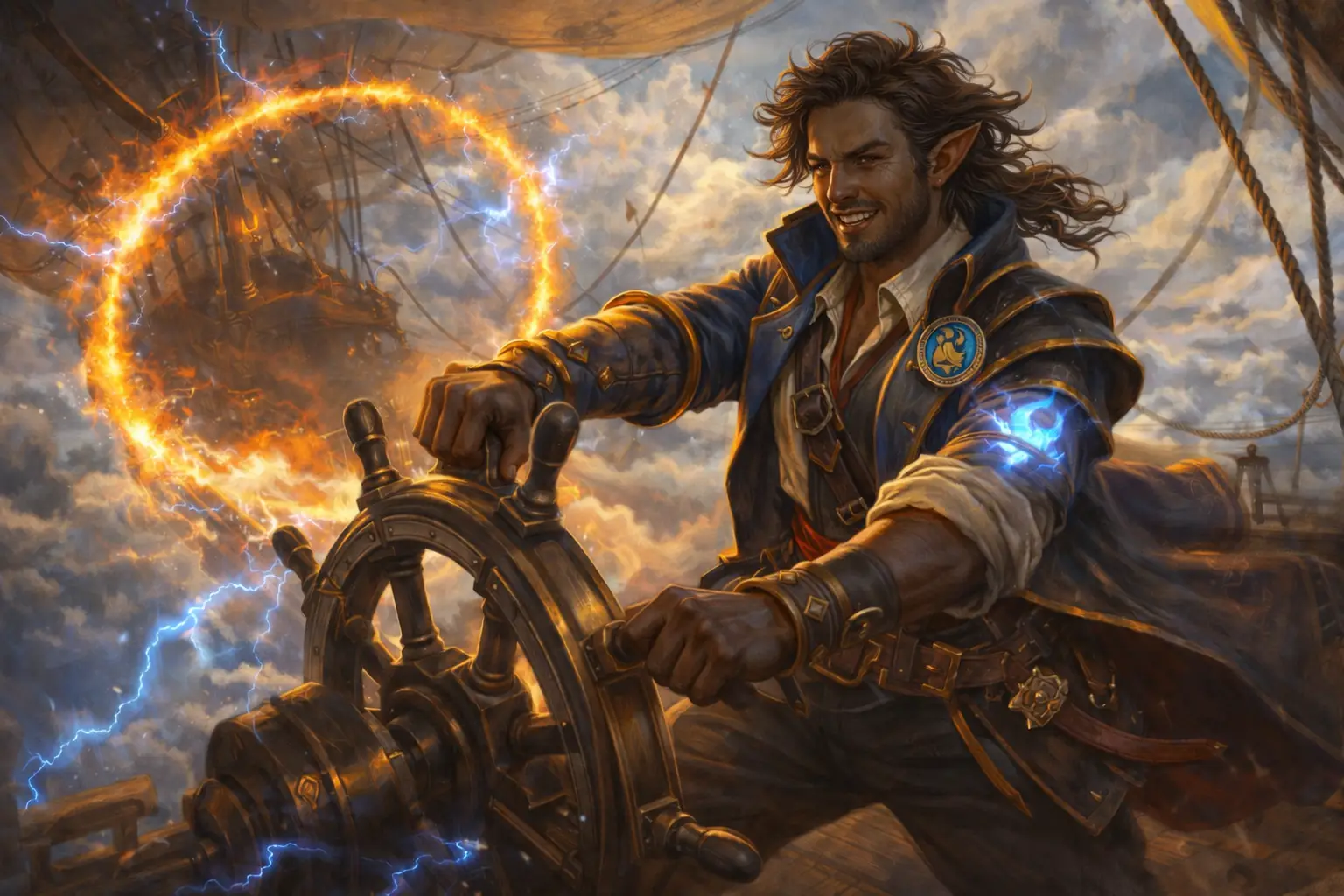
House Lyrandar
"The crystal shows love Lyrandar. How many times have we seen a dashing Lyrandar captain facing off against pirates, dancing on the wind, landing blows with their rapier and rapier wit? That's the story we're sold — they're daring, they're bold. The House wants us to like them, to admire their adventurous spirit, to trust they'll take us where we want to go. But just you look at the seal of the Windwright's Guild. You see the ship, riding the water or the wind. But around it and below it lies the Kraken, its tentacles reaching out to seize the world. Lyrandar has always been driven by ambition. They began with their feet caked in river mud, and now they've laid claim to the sky. I know, I know. You think I spend too much time reading the Voice of Aundair. But I tell you this: the sky won't be enough for House Lyrandar."
Mark: Storm | Race: Half-Elf (Khoravar) | Symbol: The Kraken Leader: Baron Esravash d'Lyrandar | Headquarters: Stormhome, Aundair | Guilds: Windwrights Guild, Raincallers Guild
There is a storm inside every Lyrandar heir. It is born at the moment the mark manifests — a pressure in the chest, a crackling awareness of wind and water and the raw elemental force that binds them. A Cannith heir can mend. A Sivis heir can send messages. A Phiarlan heir can weave illusions. But a Lyrandar heir's mark can flow out of them with explosive force, and it takes intensive training in a fortified storm suite before a newly manifested heir can be trusted not to shatter every window in the enclave. Once that training is complete, a Lyrandar heir runs no risk of accidentally unleashing their power — but releasing a thunderclap is an exhilarating feeling, and many do it to accentuate a dramatic point, to express joy, or to punctuate an argument. They are, however, carefully aware of their personal space. A thunderclap strikes everyone within five feet.
House Lyrandar bears the Mark of Storm — the dragonmark of wind, weather, and elemental air and water. Composed primarily of half-elves who call themselves Khoravar — "Children of Khorvaire," a name that expresses a deliberate identity: not half of something, but a people wholly their own — the house dominates airship travel, sea and river transport, and weather-based services across Khorvaire. Elemental galleons cross oceans faster than any mundane vessel. Airships — barely a decade in widespread service — have already undermined the lightning rail's dominance of overland travel. Raincallers end droughts, seed rainfall, and clear storm fronts for clients ranging from farmers to field armies. Many other houses depend on Lyrandar ships to move the goods their own guilds produce. This dependence has nurtured a characteristic pride within the house; a Lyrandar captain considers herself the equal of any king or queen, and the house considers itself the rightful heir to the skies and seas of Khorvaire.
Leadership rests with Baron Esravash d'Lyrandar, one of the youngest leaders in the house's history, operating from Stormhome — the house's private island enclave off the coast of Aundair. For many of the house's members, Stormhome is more than a headquarters. It is the closest thing the Khoravar have to a homeland (for now).
"Dominion over the air. Dominion over the water. Fortune for my family, and fortune for my future." — From the Oath of Lyrandar
Origins & Lineage
House Lyrandar's recorded history traces back roughly two millennia, to the earliest communities of half-elves along the River Aundair. The Mark of Storm manifested among lineages who would come to call themselves Khoravar — a name drawn from the old tongues meaning "Children of Khorvaire," expressing a deliberate claim: we are not the offspring of two peoples. We are our own.
House tradition holds that the mark first appeared on two half-elves who could not have been more different. Lyran lived in the slums of Daskaran among families who had no love for their hybrid children — rejected by both human and elf communities, surviving on the margins. Selavash was one of the so-called River Elves of Thaliost, descended not from the Aerenal but from elves who had emerged from the Towering Wood — unjustly stigmatized as vagrants and criminals. The two received a vision from the Sovereigns Arawai and Kol Korran, charging them to harness wind and water and take their rightful place in the world. Whether or not this account is literally true, what followed is historical fact. Lyran and Selavash traveled up and down the River Aundair, recruiting downtrodden half-elves, performing miracles with their dragonmarks, and building a shared identity from the fragments of two peoples. Selavash organized dragonmarked sailors and taught them to fill sails with conjured wind; Lyran gathered those who could sense the currents of storms and taught them to shape the weather. The first Windwrights and Raincallers grew from these early bands.
Opposition came quickly. The priests of Daskara condemned Lyran and Selavash as servants of the Six, and many River Elves rejected Selavash out of old vendettas or stubborn independence. But the Khoravar grew in number, and the region came to depend on the services these early guilds could provide. House legend holds that when the Firstborn grew old, they sailed into what is now Scion's Sound with their most accomplished heirs and dove into the waters of the Bitter Sea, never to be seen again. Those who returned declared themselves the children of Lyran — the Lyrandar. In the century that followed, Lyrandar vessels extended their reach across Khorvaire, and as the War of the Mark began to brew, the house joined the alliance of dragonmarked families that would become the Twelve.
The most infamous episode in early house history is known as Gravan's Grasp. While Galifar Wynarn waged his war of unification, Patriarch Gravan d'Lyrandar invaded the island of Orthoss, proclaiming his intent to bring the eastern islands under the Kraken banner — a naked violation of the house's supposed neutrality, driven by the same ambition that has defined Lyrandar from its founding. The Twelve demanded Lyrandar stand down; when Gravan refused, heir Cassala d'Lyrandar defeated him in a duel of lightning and wind on Orthoss itself — a battle that, by legend, devastated the port of Blackrock. Under Cassala's leadership the house withdrew, and Galifar rewarded her courage. In 347 YK, House Lyrandar was granted an indefinite lease to the island of Stormhome, which the house has since transformed into a city-state in all but name.
The Mark of Storm
The Mark of Storm grants its bearers innate mastery over elemental air and water. At its most basic, the mark provides resistance to elemental conditions and an intuitive facility with wind and navigation. At lesser manifestations, an heir can conjure gusts, fill a sail without wind, and suppress or redirect local weather. Greater manifestations allow an heir to shape weather in localized zones and conjure elemental force — air or water — drawn from the storm they carry within them.
The mark's spells follow two paths. Feather fall, levitate, and wind wall are tied to the wind; fog cloud, sleet storm, and control water are tied to water. Most Lyrandar heirs have an affinity for one path or the other — a typical Lyrandar NPC commands one set but not both. Exceptional heirs, including any player character, can command the full range. The ability to conjure elementals is common to both paths, but heirs are usually only able to conjure the type of elemental associated with their affinity (air or water). Shatter is a focused form of thunderclap, something any heir can master with effort — but many do not bother, because it requires an aggressive outlook, and heirs pursuing a peaceful life may not want to wield such destructive power.
Heirs describe the mark as a storm inside them — something born at manifestation that presses continuously to be released. Every Lyrandar enclave maintains a fortified storm suite where newly manifested heirs are kept in isolation until they learn control, and where any heir can return to safely unleash their power without risk to bystanders. The training is intensive. Due to this training, Lyrandar heirs are acutely aware of their personal space — a thunderclap strikes everyone within five feet, and while a trained heir runs no risk of accidental discharge, the temptation to release one is always present. The feeling is exhilarating. Many heirs use it to make a point.
Piloting elemental vessels depends entirely on this connection. The Wheel of Wind and Water — the helm device aboard Lyrandar airships and galleons — allows a marked heir to exercise ongoing telepathic command over the bound elemental propelling the ship. Only a dragonmarked heir with the Mark of Storm can use the wheel; it is not merely a key but an active rapport between pilot and spirit, maintained through months of intensive training. For a Lyrandar heir, being able to cast feather fall once per day is a useful safety net — but it is the ability to pilot an airship that drives the industry of the house. The elemental galleon itself emerged from a collaboration between the Twelve, House Sivis, and the gnome binders of Zilargo, combining Lyrandar's ability to commune with elementals and Zilargo's expertise in binding them independently to ship systems — producing the iconic elemental ring.
Guild Operations
The Windwrights Guild
The Windwrights Guild has managed shipping across Khorvaire since before the rise of Galifar, encompassing passenger vessels, dedicated cargo ships, river routes, sea lanes, and airship lines. The guild operates across three divisions — River, Sea, and Air — along with a fourth administrative branch called the Bounty Division, which manages logistics, scheduling, ship and canal construction, and the house's broader investments.
River routes are the backbone of the guild's oldest business — there are far more rivers and towns in the Five Nations than appear on standard maps, and Lyrandar boats run between all of them. Sea galleons remain the house's historic strength: elemental galleons with water elemental rings that cross oceans at ten miles per hour, faster than any mundane vessel. Air travel is the newest and fastest-growing division; the first airships entered service only in 990 YK, and the house is pouring resources into producing ships and building docking towers as quickly as capable shipwrights and soarwood supplies allow. Soarwood — the buoyant timber from Aerenal that gives airships their lighter-than-air hulls — is exceedingly scarce, and the Aerenal elves limit their annual harvest. The discovery of a new supply of soarwood could literally change the world, and even convincing the elves to part with more of it would be an achievement worth a handsome reward from House Lyrandar.
Captains within the guild are either licensed — owning their own ships and paying five percent of profits to the guild in exchange for the Kraken seal — or bound, sailing house-provided vessels on schedules set by the guild, with the house taking ten percent of all proceeds. Every bound vessel requires a Lyrandar captain; elemental galleons and airships cannot be reliably operated by anyone without the Mark of Storm. A standard airship reaches twenty miles per hour in clear skies carrying up to thirty tons of cargo. Airships cannot actually land — the struts holding the elemental ring protrude ten feet from the hull — so passengers and cargo are lifted by elevator at docking towers in major cities, or by rope ladder at smaller stations and in open terrain.
The Raincallers Guild
The Raincallers Guild provides localized and regional weather manipulation: ending droughts, dissipating storms, seeding rainfall, and ensuring favorable conditions for clients ranging from individual farmers to field armies on the march. Individual traveling Raincallers can shift local weather temporarily, but for permanent or wide-area changes the guild employs Storm Spires — towering eldritch machines that require a Khoravar with the Greater Mark of Storm to operate, and that can influence weather over a hundred-mile radius. Only a few hundred heirs in the world are capable of operating one.
The guild also advises on irrigation, canal, dam, and reservoir construction, making Raincallers as much engineers as weather-workers. Their philosophy is one of dominion over nature rather than harmony with it — a stance that puts them in chronic tension with the Wardens of the Wood and the druids of the Eldeen Reaches, who argue that Lyrandar's long-term manipulation of weather patterns produces catastrophic cascading consequences. When a storm spire pushes a cold front away from a city, the problematic winds and precipitation go somewhere else — possibly inflicting extra damage on a rural community or disrupting the natural cycle that replenishes aquifers downstream. Easier winters can be devastating for ecosystems adapted to harsh ones. The druids argue that some of the most dramatic natural disasters in the history of the Five Nations may have already been set in motion by Raincaller meddling. The guild dismisses all such claims. Rumors of weather extortion — Raincallers warning of storms they themselves intend to cause unless compensated — have followed the guild for generations.
Political Relations
By law and the traditions of the Korth Edicts, House Lyrandar remains formally neutral. During the Last War, the house honored this restriction while profiting from its unique position, providing transport and weather management to all belligerents without formally siding with any. Lyrandar is a business. It provided transport services to all nations during the war; a Cyran force and an Aundairian force might both charter airships on the same day, and the house saw no contradiction in this. The neutrality is the shield, and it maximizes profits; choosing sides narrows markets.
In practice, Lyrandar wields considerable political and economic influence. Its control over Khorvaire's airship and galleon traffic gives it leverage in regional negotiations that no nation can comfortably ignore. Despite the restraints of the Korth Edicts, the house has established quasi-sovereign holdings. Stormhome is technically Aundairian soil — Queen Aurala is a personal friend of the Matriarch — but is administered entirely by Lyrandar with its own civic guard, courts, and trade policies. Aundair's grant of Stormhome is itself a violation of the Korth Edicts, and nothing has been done about it.
Following the Day of Mourning, House Lyrandar was invited to fill the administrative void in Valenar — a nation of Tairnadal elves who are soldiers, not bureaucrats. The house provides the civilian infrastructure the Tairnadal lack, supports Khoravar immigration, and trains unmarked heirs as stewards, mediators, and administrators. High King Vadallia wears the crown, but Lyrandar stewards hold considerable authority in its ports and agricultural regions. The Tairnadal have no great attachment to cities and view the entire nation as disposable — which means Lyrandar, which is deeply invested in Valenar as a potential Khoravar homeland, may be building something the Tairnadal do not fully appreciate or intend to keep. Many within the house believe Valenar is slowly becoming the Khoravar nation Gravan d'Lyrandar dreamed of centuries ago. These arrangements continue to spark debate among legal scholars — and whether anyone could stop Lyrandar if it chose to press further is a question no one can confidently answer.
Internal Politics
The defining internal tension of House Lyrandar is the question of ambition: how far is far enough? Some heirs emphasize commercial growth and aggressive expansion of the airship network. Others stress stewardship of elemental traditions and Khoravar cultural heritage. Leadership under Baron Esravash attempts to balance both — pursuing new routes and fleet expansion alongside a genuine commitment to Khoravar identity and the house's evolving role in Valenar. Lyrandar is generally a friendly house, but if someone started developing airships anyone can fly, people like Calynden would go to great extremes to eliminate that threat.
Several institutions operate alongside the house's guilds:
Sela's Path is the house's own religious tradition, grounded in the Pyrinean interpretation of the Sovereign Host but with unique Lyrandar customs. It holds that the Mark of Storm is a blessing from Arawai and Kol Korran, and that the Firstborn — Lyran and Selavash — continue as spiritual intermediaries between the Khoravar and the Sovereigns, much as Tira Miron is the Voice of the Flame. In recent decades Sela's Path has sent priests to Valenar to establish shrines and support Khoravar immigrants building new lives there. The devotees of Sela's Path say that Lyran himself speaks through Baron Esravash.
Lyran's Gift is the house's arcane research division, devoted to finding new ways to channel the Mark of Storm. Its artificers have experimented with lightning turrets, stronger wind wards, and individual techniques for heirs to channel the mark more efficiently. Collaboration with the Twelve has historically been vital to Lyrandar's technological advances, but voices within Lyran's Gift consistently dream of breaking the house's dependence on Cannith and Zilargo.
The Stormwalkers are a small corps of elite operatives drawn from across the house's branches, typically maintaining cover identities — a licensed sea captain, a wandering Raincaller, a missionary of Sela's Path. They are employed when the house has objectives that violate Galifar law or the formal neutrality mandated by the Korth Edicts. During the Last War, Stormwalkers ran arms shipments through blockades and extracted fugitives from enemy territory. Lyrandar maintains a small fleet of submersible elemental vessels assigned to these operations. If exposed, Stormwalkers are disavowed and condemned by the Matriarch.
The Hurricane Harvest is a malevolent sect that has been rooted out and eradicated multiple times throughout the house's history, and has rebuilt itself in shadow each time. Its devotees hold that the Firstborn were not blessed by Arawai and Kol Korran but chosen by the Devourer, charged to unleash the fury of the storm upon the world. The sect teaches that Lyran and Selavash transformed into krakens when they dove into the sea, that they guide the sect from the depths, and that members who master the mark's destructive potential can achieve the same immortality. On a small scale, Harvesters use the mark's violence as sacrifice to the Devourer. Their larger ambitions run toward apocalyptic storms, raised tsunamis, and the eventual ruin of Khorvaire itself.
Notable Holdings & Infrastructure
Stormhome (Aundair) — The house's central enclave, a flourishing island city administered entirely by Lyrandar despite sitting on Aundairian soil. It served as a nest of intrigue during the Last War and remains a celebrated vacation destination, with House Ghallanda maintaining resorts for wealthy patrons. Key sites include Slate Keep (the trade school that trains Lyrandar sailors), Dolmaen Yard (a shipyard for elemental galleons), the Tower of the Firstborn (a shrine to Arawai, Kol Korran, and the founders), Kraken Keep (seat of the Matriarch), and the Pole — the largest airship docking tower in Khorvaire, incorporating an arcane workshop where the house's researchers explore new applications of the Mark of Storm.
The Old Harbor (Daskaran, Thrane) — Lyrandar's stronghold from its earliest days, predating the rise of the Church of the Silver Flame and Thrane itself. Its shipyards specialize in river boats and barges, and the community remains deeply tied to the traditions of Sela's Path. This is where the house was born, and the heirs who work here carry that weight with quiet pride.
Lyrandar Tower (Sharn, Breland) — One of the tallest towers in Sharn, serving as the city's primary airship dock. Its upper levels have been repurposed entirely to support airship traffic, with House Deneith maintaining a security outpost, the Silverstreak Skycoach Company operating within, and dining establishments catering to travelers. Solia d'Lyrandar oversees the house's extensive Sharn operations, which extend to additional offices in Cliffside, Lower Dura, and Lower Tavick's Landing. The Lyrandar enclave in Dragon Towers is relatively small — only because so much of the house's business happens elsewhere in the city.
Falconer's Spire (Stormreach, Xen'drik) — Both a house enclave and an airship docking tower, with a Lyrandar shipyard under construction. Viceroy Calynden d'Lyrandar — known as "the Kraken" — heads the enclave and pursues new elemental binding techniques recoverable from Xen'drik's ruins, with the long-term goal of reducing the house's dependence on Zilargo. Both House Lyrandar and Zilargo would pay a party's weight in gold for the right to study a recovered giant-era airship.
Valenar Holdings are split between Taer Valaestas, where Lyrandar heirs serve as administrators and magistrates supporting Tairnadal operations, and Pylas Maradal on the southwestern coast — the primary facility for elemental airship construction, positioned for proximity to Aereni soarwood. Storm Spires established around Pylas Maradal have brought rain to the surrounding desert, transforming the region into Valenar's breadbasket. Sela's Doctrine, based there, trains unmarked Lyrandar heirs in diplomacy and administration for placement across the nation. Seneschal Haela d'Lyrandar works to make Pylas Maradal a center for Khoravar culture broadly, welcoming immigrants and supporting their artists and artisans.
"The sky won't be enough for House Lyrandar."