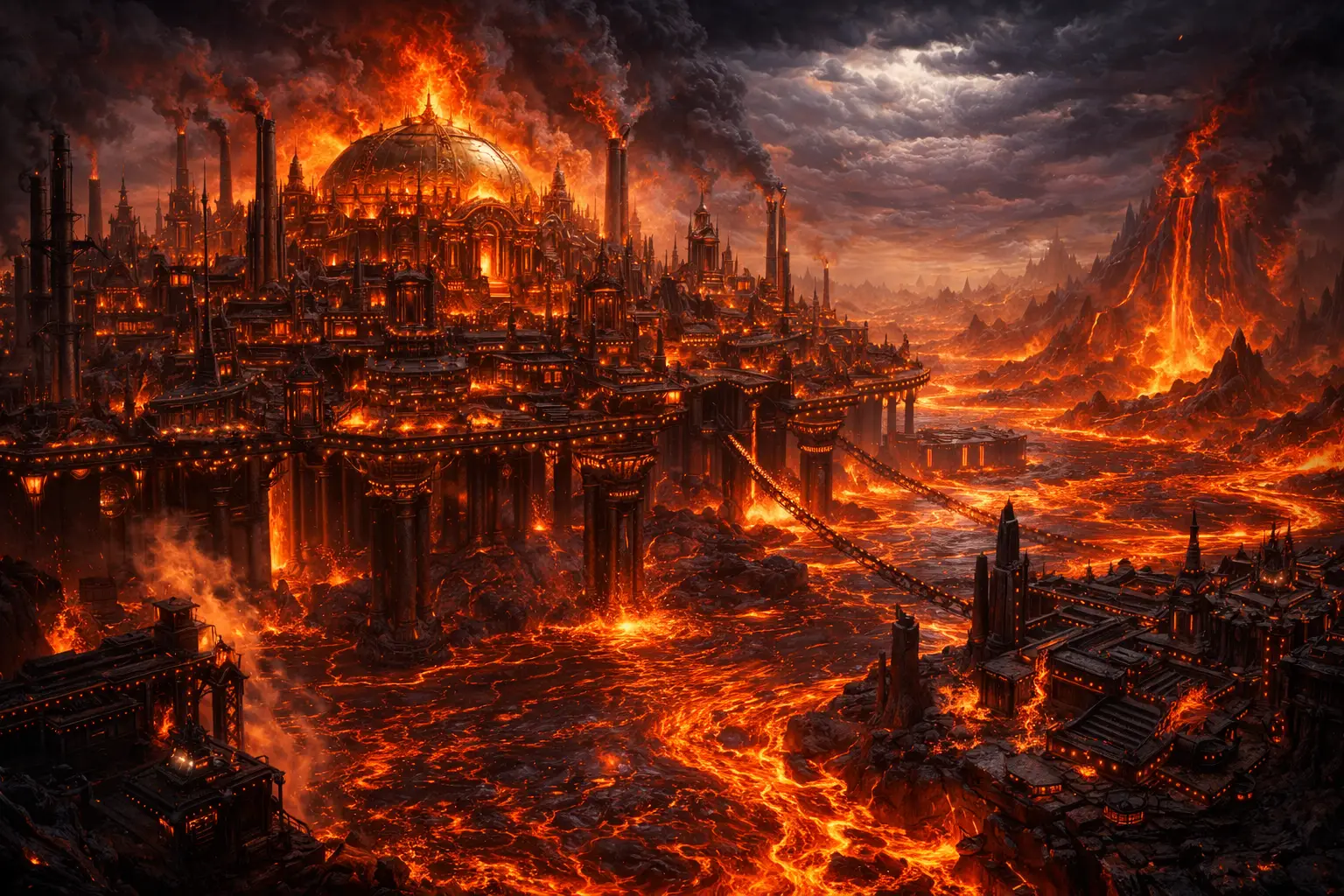
Fernia, the Sea of Fire
Plane — Fire, Passion, Industry & Spectacle — Moon: Eyre, the Anvil
A flight of red dragons takes to the air above a castle of obsidian and brass, circling the spires in a dazzling spectacle of synchronized flame. Below them, an endless ocean of magma stretches to every horizon, its surface broken by islands of basalt where efreet lords hold court in mansions that would make the palaces of Galifar look like country estates. Somewhere in the deep halls beneath the lava, a dao artisan puts the finishing touches on a sword that has taken three centuries to forge, while above her, an army of tireless azers hammers out ten thousand brass fittings before the next gala begins. Welcome to Fernia. The party is about to start.
It would be simple — and wrong — to call Fernia the Plane of Fire. Lamannia is the source of natural, elemental flame: its volcanoes erupt and its fire elementals burn with the raw force of the wild. Fernia is something more particular and more interesting. It is the plane of everything fire represents — not just the element, but all the ideas mortals see when they stare into the flames. It embodies wild destruction, the forest that burns eternally and the city consumed by firestorm. It embodies industry, the forge-fires that smelt ore into steel and shape raw metal into marvels. And it embodies passion, spectacle, and reckless consumption — the burning emotions that cannot be contained, the dazzling display that demands the eye's attention and the heart's surrender.
Fire draws the gaze, but where there is magma, there is also earth. The azers stand at the border between flame and stone, harvesting ore to feed their hungry forges. And in the deep caverns beneath the Sea of Fire, the dao polish jewels and admire their treasures in halls lined with a thousand swords. Even in these deeper layers, the air sears the lungs of creatures that lack the proper protection — but for adventurers willing to brave the heat, wonders and wealth await in the halls of fire and stone.
Fernia explores all the symbolic associations of fire, both benevolent and destructive, and is not inherently evil. The campfire that holds back the darkness, the hearth that warms a family, the forge that arms a nation — these are as much Fernia's domain as the wildfire and the burning city. Angels of the hearth dwell here alongside demons of conflagration, and the efreet — lords of conspicuous consumption — preside over all of it with the casual cruelty and dazzling generosity of aristocrats who have never known want.
RECOVERED EXPEDITION NOTE — FOUND PRESSED INTO A BRASS INGOT NEAR A FERNIAN MANIFEST ZONE IN THE BYESHK MOUNTAINS, DROAAM
To whoever finds this: We made it through. The air tastes like standing too close to a forge and the sky is the color of a furnace door, but we are alive and the zone held. The salamander who met us at the portal was polite — almost courtly — and asked if we had been invited. When we said no, it looked disappointed but not hostile. It said the Pasha is always looking for novelty, and that we should make ourselves interesting or leave before we became fuel. We are choosing to be interesting. Wish us luck.
— Excerpt from the expedition journal of Kara Veldarren, Wayfinder Foundation, 994 YK (status: returned safely; declined all subsequent planar expeditions)
Universal Properties
The sweltering heat of Fernia can kill unprotected creatures with alarming speed, and it burns through mortal metabolisms at a punishing rate. The following properties apply across the entire plane.
Deadly Heat. The plane's baseline temperature is lethal to unprotected mortals. For every hour a creature spends in Fernia without protection from the heat, it risks harm; in areas of particularly intense heat — and there are many — the interval drops to every minute. All creatures gain resistance to cold damage while on the plane, and creatures that are normally resistant to cold become immune to it entirely.
Empowered Fire. Fire magic feeds on Fernia's essence. When a creature casts a spell of 1st level or higher that deals fire damage, the spell strikes as though cast at one level higher than the slot expended.
Fires of Industry. Fernian flame is not merely hot — it is productive. A creature using tools that incorporate Fernian flame in place of mundane fire finds its work enhanced, gaining advantage on the associated ability checks. This applies to everything from baking bread with cook's utensils to forging adamantine plate with smith's tools, and it is the primary reason House Cannith so aggressively seeks out Fernian manifest zones.
Burning Bright. Life and death happen fast in Fernia. Whenever a creature makes a death saving throw, it must make an additional saving throw, keeping the results of both rolls. When a creature gains a level of exhaustion, it gains an extra level; when it reduces a level of exhaustion, it reduces it by an additional level. Whether you live or die in Fernia, the outcome arrives quickly.
Standard Time. Time passes at the same pace as on the Material Plane, and is consistent across all layers.
Layers
Fernia is dominated by the vast layer known as the Sea of Fire, a seemingly endless ocean of magma larger than any single sea in Eberron. The Sea wraps around on itself — head north from the efreeti estate of High Hearth and you will eventually find it again, but the journey may take a month of travel. Islands of basalt and obsidian break the molten surface: some are inhabited, crowded with palaces and foundries and teleportation circles traced in continual flame, while others are barren spires that have never known a visitor.
Salamanders sail the blazing sea in ships forged from blackened steel, and azers fly above it in balloons woven from brass. Many of the islands hold teleportation circles with a destination word inscribed in Ignan; any spellcaster proficient in Arcana can activate a portal by expending a spell slot of 3rd level or higher, though unless they speak Ignan, they will have no idea where it leads. Smaller layers — infernos, campfires, and other isolated domains — can usually be reached through burning circles on the islands of the Sea of Fire, or via tunnels in the Deep Halls beneath.
Where the sky can be seen at all, it is almost always obscured by ash and smoke.
The City of Brass
The sole metropolis of Fernia, the City of Brass is the glorious capital of the efreet — a place of marvels that beggars the imagination of any mortal who has walked only the streets of Sharn or Flamekeep. At its heart, a towering statue of an efreeti holds aloft a sphere of continual flame the size of an airship; the statue reshapes itself to match the appearance of whichever efreeti currently dominates society, and both the statue and the efreeti it depicts are known as the Sultan. The current Sultan is Azhalar of High Hearth.
All efreet maintain mansions in the City of Brass, though at any given time many are dwelling in their island estates elsewhere in the Sea of Fire. A few dao are always in residence, showing off their latest creations and taking new commissions. The streets are filled with mephits running errands and salamanders on business both martial and domestic. Visiting mortals are a curiosity — most elementals are too absorbed in their own affairs to take much time on them, though a mortal who proves interesting will quickly find doors opening.
The City of Brass is ringed with teleportation circles linking it to all of the major estates and foundries across the Sea of Fire.
Efreeti Estates
Each of the noble efreet holds a sprawling palace or mansion on its own island in the Sea of Fire. These estates are studies in opulence that strain the limits of material possibility, filled with dao-crafted wonders, sculptures of metal and flame, synchronized fire-fountains, and treasures acquired from across the planes. While not so grand as the City of Brass itself, any one of these estates would put the finest manor houses of Khorvaire to shame.
Foundries
The foundry islands are models of industry — some focused on physical engineering, with vast gears and wheels slowly turning and chains rising and falling; others on arcane industry, with blazing glyphs and fields of shimmering energy. The azers work here at all hours, producing mundane goods, martial equipment, and magical items for the efreet and their servants. The foundries never sleep, and the sound of hammers on metal is as constant as the heat.
Deep Halls
Beneath the foundries, tunnels extend down below the Sea of Fire into the primal earth. These are the domains of the dao. Each Deep Hall has a distinct style reflecting the sensibilities of the dao who dwells there: streams of lava and pools of fire run through the corridors alongside veins of metal and mineral. Some halls showcase the wondrous creations of their resident dao — a visitor might find walls decorated with a thousand swords, or a brass garden filled with cunning construct songbirds that sing in tones of heated metal. Other dao are paranoid, and their Deep Halls contain deadly and elaborate traps that would challenge the most experienced delver.
Infernos
Infernos are isolated layers that showcase a particular act of destruction by fire, frozen in an eternal loop. One inferno is a burning city, where devils direct bombardment and demons dance about spreading the flames within. In another, a lone balor oversees the devastation of an ancient forest. These fires never end; parts of each layer are rebuilt even as others are consumed, and the inferno continues forever — a perfect, terrible sculpture of destruction.
Campfires
At the other end of Fernia's emotional range, campfire layers reflect the comfort fire can offer. Some are literal campfires — a lonely light in the darkest wilderness, a place to rest and warm your hands. The most notable is an inn called the First Hearth, where the angelic barkeep Ashe offers warm drinks around the great fireplace from which the inn takes its name. Campfire layers are safe havens, free from the Deadly Heat property, and a perfect place for travelers to rest, recover, and perhaps hear a story or two from the other patrons. It is said that a curious brass key exists somewhere on the Material Plane that, when inserted into any door, transforms that door into a portal to the First Hearth — though who the key belongs to, and how often its power can be used, remains a mystery.
Denizens
Fernia is home to celestials and fiends — spirits that embody the symbolic aspects of fire — but its primary population consists of elementals of earth and fire. There are no native mortals or manifestations in Fernia: the elemental population is fixed, and when one elemental dies, a new one takes its place. New mephits spring spontaneously from open flame; the dao craft replacement azers from bronze; salamanders are reborn from the magma. The total population is stable, which means the efreet can afford to pit two legions of salamanders against one another in a grand martial display, confident that every soldier will eventually be reborn.
Efreet
The efreet are the brightest stars in the firmament of Fernia — aristocrats dwelling in sprawling mansions amid astonishing opulence, attended by countless elemental servants. Fire consumes, and the efreet are masters of conspicuous consumption. They are passionate and wild, quick to both anger and joy, casually cruel in ways that would horrify most mortals, and capable of destroying lives without a thought even as they celebrate the beauty of their own existence. They are not conquerors, because they already have everything they could possibly want; their elemental servants exist to serve, and the efreet consider them disposable.
The efreet have been competing with one another since the dawn of time, and their competition is primarily social. Passionate arguments can escalate into dramatic duels, and occasionally two efreet unleash their armies against one another in a grand display of fire and burning blood — but for the most part, the conflict is fought across an elaborate social calendar of galas, celebrations, and spectacles. At any given moment in Fernia, one of the efreet is hosting a grand celebration: the unveiling of a new work of art, the epic burning of an old one, or the thousandth anniversary of an efreeti's last rebirth. Sometimes the party needs no explanation at all.
If an efreeti is not hosting a gala, it is planning its next one — and always, always searching for ways to outshine every celebration that has come before. Often this means pushing the azers and dao to create new wonders, but efreet have vast wealth and the ability to travel the planes, which can bring them to the Material Plane in search of novelty. If a gala features a flight of red dragons performing synchronized pyrotechnics, remember this: dragons are not native to Fernia. The efreeti hired those dragons from another plane, and one can only imagine what it took to convince dragons of Argonnessen to perform as entertainment.
Efreet rarely have reason to deal with mortal adventurers, but if the characters have something to offer — or if they are interesting enough to be invited to a party as curiosities — an efreeti can make it well worth their time. An efreeti might serve as the patron of a warlock, granting the mortal power in exchange for a constant search for treasures, performers, and spectacles that could give the efreeti an edge in the endless social war. But any association with an efreeti is dangerous. They abide by the letter of any contracts they make, but adventurers would be wise to ensure those contracts include safety clauses. After all, efreet are spirits of fire, and they burn the things they touch. They care about nothing except their own status and amusement, and they destroy lives without a second thought.
The following are among the most prominent efreet, listed under the public names they use with mortals — their Ignan names are far longer:
Sultan Azhalar of High Hearth stands at the top of the social order. He has assembled the grandest armies in Fernia and favors displays of martial might, including exotic engines of war. His galas often feature gladiatorial matches or grand war games.
Pasha Shashraqa of Firefall stands just below Azhalar and is determined to unseat her rival. She is cultivating friendships with several dragons and considers herself a connoisseur of art; she could take an interest in the work of an artistically gifted adventurer.
Pasha Raqashtar of Gold Ash is the most cosmopolitan of the efreet. He has many friends in the Immeasurable Market of Syrania and enjoys betting on the outcomes of battles in Shavarath. His appetite for gambling could draw adventurers into his orbit, as he might make a wager with another immortal about the outcome of a particular adventure — then seek to put a burning finger on the scales.
Dao
Where do the many treasures of the efreet come from? Who built their glorious City of Brass? The dao are the answer to both questions. While azer laborers keep the foundries burning, it is the dao who pluck wondrous jewels and pure adamantine from the primal earth, and it is they who craft the grandest and most remarkable wonders. Each dao has a particular specialty — a unique style of art or artifice — and their techniques cannot be easily replicated, for much of what they do involves channeling the essence of Fernia itself. A dao who settles on the Material Plane will find its talents more limited than they are at home.
The dao are more stoic than the fiery efreet and do not throw extravagant parties, but they engage in fierce creative competition with one another, striving to craft the most glorious creations. This does not necessarily mean the most powerful; what matters is creating things that are most desired. The efreet pay the dao not in gold (the dao have no use for gold) but in barter, which creates a bizarre secondary market: the efreeti Raqashtar might offer a squad of elite salamander warriors in exchange for a wondrous crown. The dao has no use for the salamanders, but she knows that the efreeti Azhalar is collecting soldiers — and so the trade goes on.
Adventurers may seek out dao for their craft, but dao can also make compelling patrons. A dao may need a rare substance from the Material Plane to complete its latest work, or it might use a group of mortals as a focus group, seeking opinions on its latest creation.
Naja Ash sculpts fire, producing masterful artifacts and tools that channel or produce flame. She creates the majority of Fernia's azers and can create other elemental creatures, constructs, or unique blends of the two. She is the foremost expert on elemental binding in the multiverse, though it would take a great deal to convince her to share that knowledge with mortals.
Sar Saeran creates tools of war, from personal armor and weapons to grand siege engines. The Sultan Azhalar is his best client, but all of the efreet value his peerless work. He has spent eons trying to create the perfect sword, and often seeks out legendary blades on the Material Plane — sometimes to keep, sometimes to study for a few minutes, and sometimes to destroy.
Brass is the finest architect of the dao, responsible for most of the grand palaces of the efreet. She is always intrigued by unusual architecture and has visited Sharn on several occasions to study the towers. She is also celebrated for her sculptures, which range from tiny miniatures to towering colossuses — including magical marvels that begin as the former and transform into something far larger, not unlike figurines of wondrous power.
Lesser Elementals
Fernia is home to raw fire and earth elementals — abstract spirits driven by pure instinct, largely ignored by the efreet and dao. These primordial creatures want nothing more than to burn or surge, and they form the common population of the plane. While humanoid in form, they are deeply alien: immortal spirits shaped by their element and driven by singular purpose. An azer lives for the forge. A mephit delights in mischief. Most are content as long as they have the opportunity to pursue their purpose, though occasionally a lesser elemental develops an unexpected quirk that drives it toward something new.
The population of lesser elementals is limited, and their service is valuable. Efreet and dao frequently barter the labor of their elemental subjects, trading them between courts. Typically the elementals do not mind — but there have been cases of salamanders rebelling against a new lord, or mephits playing tricks on their new comrades out of sheer spite.
Azers are crafted from bronze by the dao and brought to life using Fernia's primordial spark. They are tireless laborers who love working with fire and metal, and while the dao create the greatest wonders, the azers do remarkable work in far greater volume. They can be assigned to any task involving fire, but there are few things more miserable than an azer assigned to bake bread instead of work with brass.
Mephits are capricious tricksters in the wild whose pranks can make life miserable for planar travelers. Those in the service of the efreet are generally more polite and well-mannered — though this changes quickly if an opportunity for mischief proves too good to pass up.
Salamanders are the primary servants of the efreet, serving as both soldiers and domestic staff. For every salamander officer carrying an ornate spear, there is a salamander butler carrying a brass tray. They are extremely proud, and within their ranks there is fierce competition over rank and position. Most are dismissive of mortals, but they can become jealous of adventurers who receive too much attention or favor from the efreet.
Fiends and Celestials
The fiends and celestials of Fernia embody specific symbolic aspects of fire. Fire is integral to their appearance — burning eyes, orange-red skin, wings and halos formed of living flame.
Angels represent the comfort fire offers: its life-giving warmth, the light that holds back the shadows, the hearth that draws a family together. The angels of Fernia are typically devas or other lesser celestials, and they generally seek to assist and comfort travelers when they can. It is an angel named Ashe who tends bar at the First Hearth, offering warm drinks and warmer welcome to anyone who finds their way to that lonely campfire layer.
Demons reflect the terrifying destructive power of fire — the wildfire that cannot be contained, the spark that brings down a mansion, the forest consumed beyond saving. They are wild, violent, and rarely a welcome sight for adventurers. Demons yearn to burn all wondrous things, and sometimes this leads them to target the grand mansion of an efreeti; during coterminous periods, they can also influence untended flames on the Material Plane or manipulate mortals into carelessness with fire. Common demons of Fernia include quasits, vrocks with burning wings, and terrifying balors. The most powerful among these — the balors — are not mindless forces but deeply specific spirits. A balor in Fernia might embody a particular kind of fire's cruelty: love lost in flame, or the screaming of those trapped in a burning building. Should such a balor be defeated, it will eventually return, because the idea it represents is eternal; tomorrow, loved ones will still die in fires, and the balor will reform in its burning castle to remind the world of that truth.
Devils represent the intentional use of fire as a weapon or to inspire fear — the burning iron used in torture, the screams of those dying on burning battlefields. They are rare in Fernia but exceptionally cruel, thriving on suffering and cajoling mortals into acts of arson or fiery torture on the Material Plane. Like demons, they can usually influence mortals only when the planes are coterminous, but occasionally a Fernian devil manages to slip through fire into Eberron. Imps, barbed devils, and pit fiends can all be found in Fernia's more terrible layers.
Planar Manifestations on Eberron
Manifest Zones
Manifest zones tied to Fernia share one or more of the plane's universal properties, and their effects range from hazardous to highly desirable depending on which properties manifest. Zones with the Deadly Heat property often exhibit unusual volcanic or tectonic activity and are generally shunned — but zones with the Fires of Industry property are aggressively sought by House Cannith, because in addition to granting advantage on tool-based checks, they often allow artificers to craft enchantments that cannot be replicated elsewhere, particularly those tied to evocation and flame.
A Fernian manifest zone can also provide unexpected benefits in harsh climates: the Karrnathi town of Ember, perched on the edge of the Icetop Mountains, is renowned for its pleasant warmth and therapeutic thermal pools, courtesy of a Fernian zone that has turned a frozen mountain pass into something approaching a resort. Other notable Fernian zones include the Fist of Onatar, an active volcano in the Mror Holds; the Volcanic Fields of Xen'drik, where inhabitants of Fernia sometimes cross over; and the Fantaran Hot Springs high in the Byeshk Mountains of Droaam, discovered by the Wayfinder Foundation.
Fernian firepeppers, a coveted ingredient among chefs across Khorvaire, grow only in Fernian manifest zones in Xen'drik. The giant civilization of Ju'qata, the ancient Suzerainty of the Haven Crown, drew heavily on Fernia for its magic, forges, and religious life — the hammerpriests of the city of Daomon regarded the dao as divine servants of Onatar, and the forges of that city burned with Fernian magma itself.
Coterminous and Remote
Fernia is traditionally coterminous once every five years during the month of Lharvion, and remote once every five years during the month of Zarantyr — exactly two and a half years after its coterminous period. While Fernia is coterminous, temperatures across Eberron rise sharply, and warmer regions that would normally be safe can become dangerously hot, taking on the Deadly Heat, Empowered Fire, and Burning Bright properties of the plane. On rare occasions during these periods, creatures caught in an area of exceptionally intense flame can find themselves pulled through to Fernia itself. Historical records note that during one coterminous period, temperatures in Sharn exceeded 105 degrees, and an efreeti named Ayim once led a force of ember guards through to Xen'drik during such a period, attempting to carve out a new kingdom before being defeated by the drow.
When Fernia is remote, intense heat loses some of its force, and fire-based magic is diminished.
Fernian Artifacts
The dao and the foundries of Fernia produce a vast array of wonders. Many of their creations are effectively trinkets — a gold model of a dragon that breathes actual fire, a brass music box that plays a melody of crackling flames — while others are far grander, including figurines of wondrous power and weapons of legendary potency. Fernian items are often made from brass, obsidian, or basalt, though the dao work with all metals and are limited only by their own ambitions.
Many Fernian artifacts relate to fire in some way — wands of fireball, flame tongue swords — but they are not limited to fire or evocation. The dao's craft encompasses the full range of magical artifice, and the fact that a blade was forged in Fernian flame does not necessarily mean it burns.
Two additional resources from Fernia deserve special mention. Cold fire is a form of continual flame that occurs naturally in the plane; the flames have the texture of warm putty and can be harvested and transported. Fernian ashes are created from the wood of rare trees found only in the Sea of Fire. They are a potent component of magic items tied to the evocation school, and a spellcaster who discards a pinch of Fernian ashes while casting a fire spell finds that the spell strikes as though cast at one level higher than the slot expended — effectively replicating the plane's Empowered Fire property on a single casting. Both cold fire and Fernian ashes can occasionally be harvested from Fernian manifest zones on Eberron, though not all trees in those zones will produce usable ashes.
ADVERTISEMENT — THE KORRANBERG CHRONICLE, SOCIETY PAGE, 12 OLARUNE 998 YK
LADY TAELIRA D'LYRANDAR cordially invites colleagues of distinguished taste to the THIRTEENTH ANNUAL FIRE BRIGHT AUCTION, to be held at the Lyrandar Enclave, Dragon Towers, Sharn. Among this season's lots: a matched pair of Fernian firepearl earrings (provenance: the dao Brass, acquired by Wayfinder expedition, 993 YK), a miniature gold dragon that breathes actual fire (artisan unknown, believed City of Brass), and a cask of wine aged in Fernian ash-oak, reportedly capable of warming the drinker from the inside for a full hour after consumption. Bidding opens at dusk. Formal attire required. Incombustible gloves recommended.