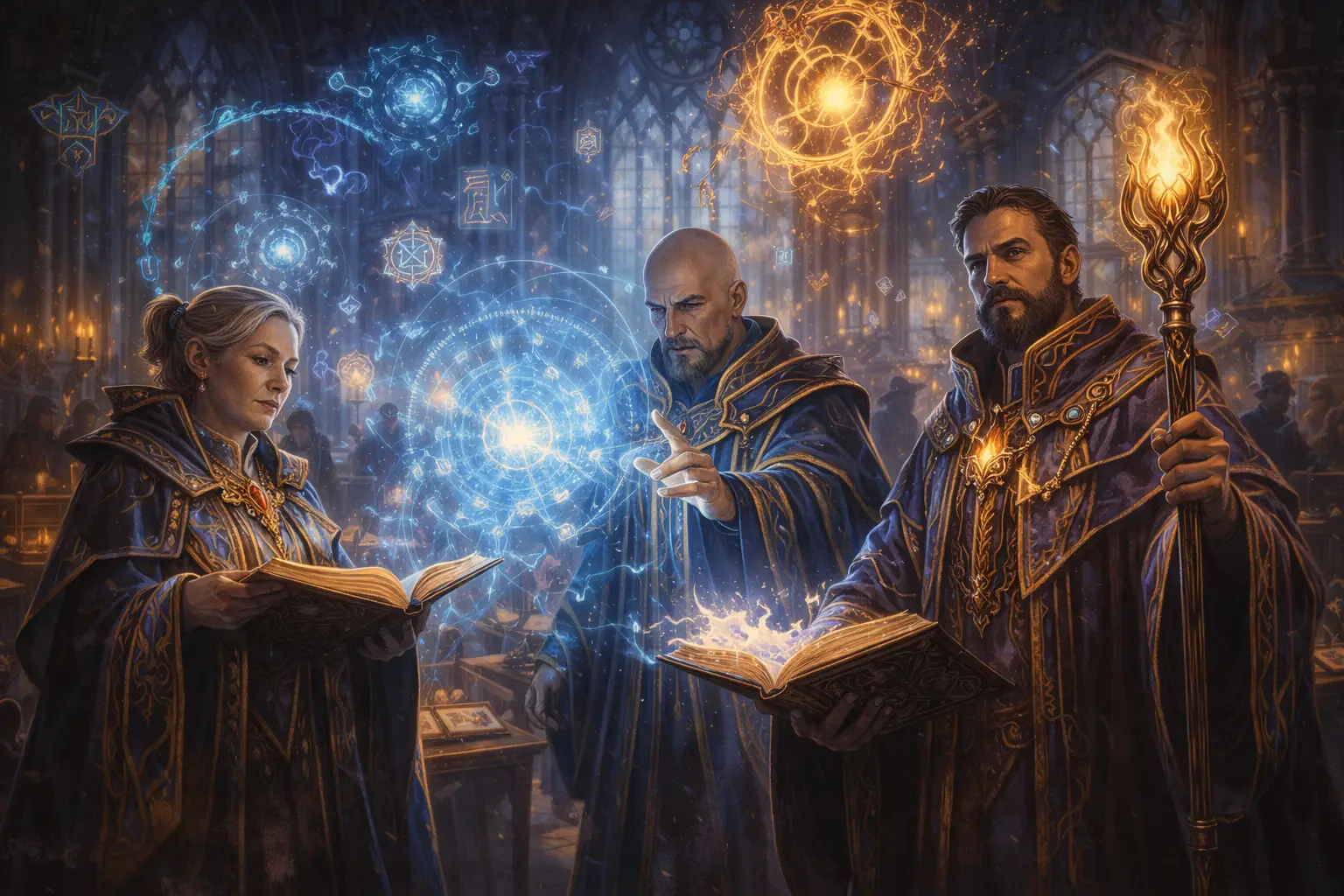
The Arcane Congress & Arcanix
Aundairian state institution of arcane research and education · Headquarters: The Floating Towers, above Arcanix village, Lake Galifar · Founded: 15 YK by Galifar I
"Throughout the golden age of Galifar, the Arcane Congress delved into magical mysteries for the good of all. Today, it only serves the people of Aundair, yet remains the largest institute of both wizardry and artifice outside of House Cannith."
Somewhere in the floating towers above Lake Galifar, a student is trying to cast fire bolt for the hundredth time today. Her instructor — a woman who can discuss the theoretical underpinnings of evocation for three hours without pause but cannot personally cast anything above second level — watches with the clinical patience of someone who has seen a thousand students struggle with this exact moment. Down in the village below, a farmer brings the day's grain delivery and does not look up. He has lived under the towers his whole life and long ago stopped finding them remarkable.
This is Arcanix: the finest school of magic in Khorvaire, the seat of the Arcane Congress, a cutting-edge research facility, an arcane citadel that floats above a farming village on the southern shore of Lake Galifar, and the beating heart of Aundair's conviction that knowledge is the only power that lasts.
The Arcane Congress is simultaneously a research institution, an academy, a state ministry, and a strategic military asset. Its members oversee all magical research conducted at Arcanix, advise Queen Aurala ir'Wynarn on all things arcane, train the next generation of Aundair's spellcasters, and host visiting colleagues from across Khorvaire. When Aundair needs a magical answer — new doctrine, battle spells, divinations, countermeasures, controlled experimentation — the Congress is where those answers are produced and argued over.
It is a massive institution with campuses across Aundair, though Arcanix is the most renowned among them, serving as the center for both cutting-edge research and the most advanced students.
History
Galifar I established the Arcane Congress in 15 YK, fourteen years after founding his kingdom. The mandate was explicit: to advance arcane science for the benefit of the Kingdom of Galifar as a whole, positioning the crown's own institution as a counterweight to the commercial and proprietary priorities of the dragonmarked houses. Where the Twelve served the houses, the Congress would serve the realm.
The Congress united the resources of Aundair's existing wizard circles — fraternal orders of spellcasters organized by school and tradition — though those circles continued to exist as independent organizations within the broader institution, and additional circles were established across Galifar over the centuries that followed. This structure persists today: the circles function as fraternities within the Congress, each with its own traditions and rivalries, while the Congress itself provides the institutional framework.
For nearly nine centuries under Galifar, the Congress fulfilled its founding purpose. Its most celebrated long-term project — and perhaps the most consequential achievement in the history of arcane science — was the development of the cantrip. Casual spells that can be used at will, including prestidigitation and mending, took centuries of sustained research into Aereni techniques and the nature of sorcery to perfect. When Galifar's soldiers still relied on sword and bow, this work was considered theoretical. It would not seem theoretical for long. The development of the everbright lantern, which brought permanent magical lighting to the cities of Galifar, was another product of this era — infrastructure magic, not spectacle, produced for the good of the realm.
In 512 YK, King Daroon commissioned the Starpeaks Observatory in the mountains near Askelios, now used by the Congress to study the moons, stars, and planes. The facility represents a dimension of Congress research that receives less attention than battle magic: long-horizon observation, planar scholarship, and work that does not have immediate tactical applications. The Keepers of Aureon's Veil, a semi-monastic order of diviners, maintain the Observatory and are respected for their exceptional work; when a Keeper addresses the full Congress, people listen.
When the Last War began in 894 YK and Galifar shattered, the Congress ceased to serve all of Khorvaire and became an instrument of Aundairian survival. Aundair was the smallest of the successor states and faced enemies on multiple borders. It responded by turning its greatest institutional advantage into a weapon. The Congress assembled the first regiment of arcane dragoons, equipped with war staves and battle rods, and deployed them as combat units — the beginning of the wandslinger tradition that would spread across all five nations over the following century. This was not a gentle transition; the Congress's research pipelines were militarized, its internal culture acquired a harder edge around national security priorities, and when the war finally ended, the institution was left with the question all war-adapted institutions face: what it is for now.
NOTICE — ARCANE CONGRESS ADMISSIONS OFFICE, TOWER OF INQUIRY
To the prospective student: Arcanix does not train magewrights. If you wish to learn arcane lock or prestidigitation as a trade skill, you want a guild school. We train arcane scholars — those who study the theories of magic and learn to perform it in ways no magewright could ever master. Most of our graduates will not possess the full versatility of a wizard. Many will master only ritual casting, or a handful of cantrips and a single reliable spell. A rare few will leave these towers capable of things that reshape the field. We cannot predict which you will be. If that uncertainty excites rather than discourages you, submit your application to the Provost of Admissions by the first of Olarune.
Arcanix: The Village and the Towers
Arcanix the village and Arcanix the institution are technically distinct, though the name applies to both interchangeably.
The farming settlement on the southern shore of Lake Galifar exists to feed the towers. It is an old village, one that has long been contested by Aundair and Thrane — and by the kingdoms of Thaliost and Daskara before either of those nations existed. Under Galifar, Arcanix was technically part of Thrane, though many of its inhabitants were Aundairians who had traveled to the village to study. The reason: Arcanix, mysteriously, seems to inspire people who seek arcane knowledge. It is not always dramatically evident — studying at Arcanix does not guarantee brilliance — but statistically, people are more likely to master the arcane arts if they study here than anywhere else in the Five Nations. No one has fully explained why.
When the Last War began, Aundair immediately seized the village and the surrounding territory, and moved the floating towers to secure it. This is the thing about floating towers — you can move them. The towers were a previous asset of the Arcane Congress, an established facility for arcane research and learning as well as a fortified citadel, and the Congress created them using information gleaned from studying the floating towers of Sharn. Placing them above Arcanix was a strategic decision: secure the territory, capitalize on whatever quality of the region enhances arcane comprehension, and ensure that Aundair's most important magical institution was also a defensible military installation.
The floating towers house Arcanix's schools, laboratories, libraries, and the residences of senior Congress members. Apprentices travel from across Khorvaire to train here — not only future wizards, but magewrights, sages, and artificers destined for civilian and state service alike. The towers are also one of Aundair's most recognizable landmarks and a point of genuine national pride; they are the visible proof that knowledge is power.
Whatever the effect of the region that enhances arcane comprehension, it works above the village as well as on the ground, and modern students study in the towers themselves.
What the Congress Actually Does
The Congress operates across four overlapping areas of work, which it does not always distinguish cleanly from one another.
Instruction. The Congress trains elite wizards and produces magewright capacity, though the distinction between what Arcanix teaches and what guild trade schools teach is important. At Arcanix, students study the theories of arcane science — they learn to perform magic in ways fundamentally different from magewrights, and to cast spells that magewrights could never master. But the professors at Arcanix are not all fully operational high-level wizards; many are arcane scholars who understand the theory profoundly but whose personal spellcasting is limited to ritual work or specialized spheres. An NPC evoker on the faculty might cast only evocation spells and simply not understand conjuration. This is normal. Even at low levels, player characters are remarkable; the versatility of a PC wizard reflects a talent and an understanding of arcane principles that most students never master.
Most Arcanix students fall somewhere in the middle — they can do a little magic, mastering a few cantrips and perhaps a single spell, but they lack the brilliant insight that makes a full wizard so flexible. These graduates become wand adepts, war mages, or arcane scholars who serve in the Royal Eyes, the Knights Arcane, or civilian government roles. Arcanix also hosts a War College that focuses on practical battlefield magic: training in combat cantrips, arcane sparring, concentration drills, tactics, and strategy.
The Arcane Congress has been developing its own trade programs for magewrights, though this is something the dragonmarked house guilds actively discourage.
Research. The Congress pursues new spells, new applications, and applied arcane engineering. All schools of magic can be studied here, but Aundair is particularly noted for its diviners, abjurers, and conjurers. Its most celebrated recent achievement is the wand of magic missiles, perfected only twelve years ago — an uncommon item requiring no attunement that can be used by any creature, breaking the longstanding barrier that restricted combat wands to trained spellcasters. House Cannith has not yet replicated this technique. These wands are primarily found in Aundair or in the hands of Aundairians; examples found elsewhere are typically surplus or salvage from the Last War.
Thanks to the Arcane Congress, Aundair has experimented with a wider range of arcane weapon designs than any other nation. Congress-designed war staves and battle rods are produced in small batches, resulting in more standardization than Lhazaar privateers manage but far more diversity than Cannith's mass-produced models. Aundairian staves tend toward elegance — beauty is considered an important factor in design. It is also possible to encounter Aundairian staves blessed by a particular archfey, though these are never mass-produced and may carry unique limitations: a staff that can only be used by a particular bloodline, or one that requires the artillerist to share a secret or tell a story to reload it.
State Advising. Congress members advise the Aundairian crown on all matters magical, which in practice overlaps heavily with intelligence work. The Royal Eyes of Aundair specialize in divination magic, and there is a known pipeline between Congress divination talent and national-security tasking.
Strategic Projects. During wartime, research blurs into weapons development. The arcane dragoon program was a Congress initiative. The Ashbound — who have raided Aundairian arcane academies — are classified by Aundair as a terrorist organization, and the Congress has sponsored freelance expeditions to take the fight to them within the Eldeen Reaches. The Congress also explored ways to weaponize floating tower technology during the Last War; their techniques were used in the attack on Sharn's Glass Tower, which collapsed on 9 Olarune 918 YK and devastated the district of Godsgate below it.
The Wizard Circles
Wizard circles are not companies — they are fraternal orders. The equivalent of a company would be the dragonmarked houses or the Arcane Congress itself. The circles are essentially specialized societies within the broader institution, and they do not simply have recruiters at Arcanix — they have chapters there. A student at Arcanix will likely be recruited into a circle during their studies, and that affiliation will shape their career, their approach to magic, and their professional network for the rest of their life.
Membership in multiple circles is uncommon but not unheard of, and some circles maintain active rivalries. Among the most notable:
The Keepers of Aureon's Veil — A semi-monastic order of diviners who maintain the Starpeaks Observatory. Reclusive but deeply respected.
The Golden Seal — An abjuration order, originally part of the Arcane Order of Aureon, split off in 312 YK and charged with maintaining the mystic defenses of the Congress and replicating the abilities of the Mark of Warding. Wizards of the Golden Seal first perfected the common glyph of warding spells used in the Five Nations. Small but elite, its members gained considerable prestige during the Last War.
The Guild of Endless Doors — Based in Passage, this guild of conjurers catalogs manifest zones that can serve as planar portals and is determined to unlock the secrets of teleportation. They pioneered the forms of misty step and teleportation circle currently taught at Arcanix, and have constructed a handful of teleportation circles — though the program is still early and struggling, with only a handful of circles and two or three members capable of using them. They have feuded with the Guild of Moonlight and Whispers, and some believe House Orien has sabotaged their research.
The Lodge of the Eternal Flame — Located in Thaliost, this order of evokers specializes in pyromancy. Their lodge sits on a small manifest zone tied to Fernia, and the "Eternal Flame" is a manifestation of that connection.
The Order of the Ethereal Blade — A circle that welcomes Eldritch Knights, Arcane Tricksters, and others who blend martial and mystical techniques. Its members have chapters across multiple other circles, functioning as a sort of intramural league.
The Children of Siberys — One of the newest circles, based in Arcanix, notable in that it does not actually involve wizards. It is composed of dragonblood sorcerers who use the trappings and techniques of arcane science to focus their innate gifts.
The Arcane Initiative
Queen Aurala ir'Wynarn has instituted the Arcane Initiative, an aggressive series of programs intended to advance mystical infrastructure and battle magic development. The Congress is its primary engine. Aundair produces more magewrights and wandslingers than any other nation in Khorvaire; the Initiative is designed to widen that lead further and ensure that Aundair's arcane superiority — the asset that let a small nation hold its own through a century of war — translates into postwar dominance.
What the Initiative means in practice: accelerated research timelines, increased crown funding, and pressure on the Congress to produce results with immediate strategic applications. Whether this is good for long-horizon research is a matter of internal debate. Some within the Congress welcome the funding and the sense of national purpose; others worry that the Initiative is pulling the institution away from the foundational theoretical work — the kind of patient, decades-long inquiry that produced the cantrip — in favor of things that can be demonstrated to the queen in a season.
Internal Culture and Arcane Theory
The Congress is not a single-minded order. It is a high-status community built from competing circles, departments, and personal schools of thought, rewarding achievement, novelty, and demonstrated control of difficult magic while producing predictable internal politics over funding, lab access, research credit, and proximity to the crown.
The Congress shares Aundair's national disposition: wit over brute force, finesse over blunt power. Aundairian culture holds a particular devotion to Aureon, the Sovereign of law and lore, and this shapes the Congress's self-image as a body that pursues knowledge within appropriate structures — in contrast to the houses' commercial priorities or Morgrave University's reputationally compromised expeditionary approach.
The dominant school of arcane thought at Arcanix is Siberyan theory — the most widespread form of magic, used across the Five Nations and in Aerenal. Siberyan theory holds that arcane energy is the residual primordial power of the Progenitor Siberys, whose ring of dragonshards circles the world. Aundairian and Aereni wizards both use verbal components that invoke the same fundamental words of power, but their techniques differ sharply: Aereni methods are highly formalized and precise, taking decades to master, while Arcanix helps students develop idiosyncratic techniques — figuring out what resonates with them personally. This works, but the Aereni find it disturbingly sloppy. Morgrave University, for its part, takes individualization even further, encouraging students to personalize their verbal and somatic components in ways that Arcanix considers borderline irresponsible.
Externalist theory — which draws magical energy from the planes rather than from Siberys — is also taught at Arcanix; the two approaches are not in direct opposition, and a Siberyan theorist does not deny that Externalist magic works, only that it is an inferior approach. Sympathetic magic, which uses physical constructs to channel arcane energy, is generally considered a primitive form of Siberyan magic and is not taught at Arcanix; practitioners are often self-taught hedge mages or members of isolated traditions.
Arcanix-trained mages may refer to disguise self as "Margana's masque," invisibility as "Margana's veil," and minor illusion as "Margana's mirror" — named for Margana Lain, an early Aundairian arcane pioneer who made dramatic breakthroughs in illusion and enchantment magic. According to legend, Margana would weave images in a mirror, then pull them out into the world. In the present day, the ir'Lains are a proud Aundairian dynasty; Darro ir'Lain is Second Warlord of the Realm and Commander of the Knights Arcane.
Key Relationships
The Aundairian Crown. The Congress is the crown's primary magical advisor and a cornerstone of Aundair's identity. Mutual dependence: the crown needs Congress capability; the Congress needs crown protection and funding. The relationship survived the fracturing of Galifar and the reorganization of the Last War, and it remains the defining political fact of the institution.
The Royal Eyes of Aundair. Close operational overlap, particularly around divination. Congress-trained specialists are a known talent pipeline for Aundair's intelligence services.
House Cannith and the Twelve. The Congress was created in explicit tension with the houses — state arcane capacity versus proprietary mark-centered monopolies. The relationship is described as a "friendly rivalry" in public, but it is a real competition over who defines the future of magic. The wand of magic missiles — a Congress innovation that Cannith cannot yet replicate — is the current concrete proof of what that competition looks like. Both the dragonmarked houses and the Arcane Congress send recruiters to Arcanix.
The Wizard Circles. The circles are the Congress's fraternal infrastructure — its chapters, its rivalries, its internal social fabric. A student's circle affiliation often matters more to their daily life than their formal position within the Congress hierarchy.
Morgrave University. The Congress views Morgrave with a mixture of disdain and grudging respect. Morgrave's faculty is eclectic, its facilities are no match for Arcanix, and its methods are considered slipshod. But Morgrave still produces an impressive number of wizards and artificers, driven by a tradition of encouraging students to personalize their techniques in ways that occasionally produce startling results.
What Was Lost
The Congress was founded to serve all of Khorvaire. It does not. Whether this is a temporary condition of postwar politics or a permanent transformation is something its senior members argue about and do not resolve. Apprentices who arrive at Arcanix expecting the institution of Galifar's golden age find something more complicated: a world-class arcane institution in service to one nation's strategic ambitions, operating under the pressure of the Arcane Initiative, with wizard circles jockeying for influence and the Twelve's recruiters prowling the same halls as the Royal Eyes.
The village below the towers still grows grain. The towers still float. The students still struggle with fire bolt. And somewhere in the faculty, there are scholars who remember that the Congress's greatest achievement was not a weapon, but a cantrip — a piece of casual magic that changed the world by making life a little easier for everyone in it.