Most play takes place outside formal character creation and combat. Adventuring procedures govern how the group organizes itself, resolves uncertain actions, tracks time and resources, moves through the world, handles exposure and exhaustion, travels, and pursues or evades other groups.
Party Organization
At the start of an expedition, journey, watch, or other extended operation, record any arrangement that could matter:
Characters present.
Travel or marching order.
Who carries important equipment.
Navigator and route responsibility.
Watch assignments.
Animal or vehicle handlers.
Communication plan.
Record only arrangements that can affect play. A party leader and fixed adventuring roles are optional. Each player controls their own character unless another rule explicitly says otherwise (see Player Characters).
When a party splits, track each group according to the same passage of time. Resolve scenes separately when necessary and keep consequences synchronized closely enough that movement, communication, rest, pursuit, and off-screen events remain coherent.
Dice Rolling
Resolve a Test in this order:
Build the dice pool from the character's approach, add all permitted bonuses, and subtract all applicable cumulative dice penalties. Penalties can reduce the final pool to 0 or below. For example, a pool of 5 dice with 5 dice of penalties becomes 0; with 7 dice of penalties it becomes −2. Both rolls are nullified unless the Advancement exception applies (see Difficulty).
If at least 1 die remains after all modifiers, designate two dice in the final pool as Hazard Dice, or all dice if only one or two remain, then roll all dice together. Magical casting increases the number designated according to Risk (see Magic > Casting a Working). If the final pool is 0 or less, resolve the action without rolling as described under Difficulty and Penalties; no Mishap occurs.
Count each 6 as 1 success.
An uncontested Test passes with at least one natural 6. In a Contest, compare total successes with the opposing roll. After determining success or failure, check any failed Test with no successes for a Mishap (see Hazard Dice and Mishaps).
Build the normal pool from AEGIS: Attribute + Environment + Gear + Ingenuity + Skill. Add a relevant Specialty when it applies.
Attribute: Add the Attribute that best represents how the character is approaching the task.
Skill: Add the relevant Skill. An untrained Skill contributes 0 dice when the task can plausibly be attempted without specialized training.
Environment: Add +1 die when surrounding conditions provide a tangible advantage. Neutral conditions add nothing.
Gear: Add +1 die when equipment provides a tangible advantage beyond the tools required to attempt the task.
Ingenuity: Usually add +1 die when the player's approach creates a real advantage by exploiting the situation in a clever, unexpected, or unusually effective way. The Game Master awards the bonus when that advantage comes from the player's approach.
Difficulty
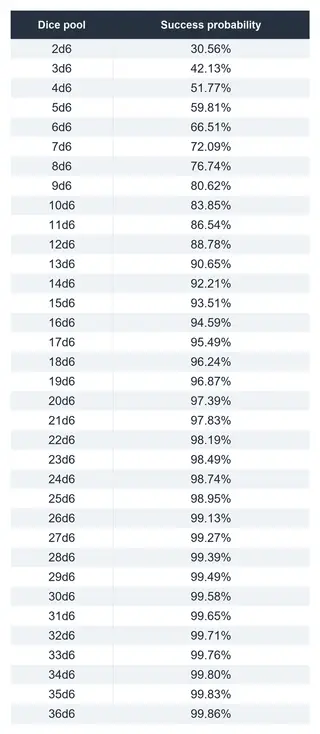
Difficulty is fixed at 1 for every uncontested Test, whether called for by the Game Master or required by the rules. One natural 6 on any die in the pool is sufficient to pass; no sixes means failure unless automatic success has been declared. During play, a player may spend one banked Advancement to automatically succeed on one Test (roll) of their choosing. The player must declare the expenditure before the roll is made. See Player Characters > Character Advancement.
Fixed Difficulty: 1 for every uncontested Test. Apply penalties to the dice pool before rolling.
Complications: −1 die for each distinct factor that materially makes the task harder, unless a specific rule lists a different penalty. Applicable penalties are cumulative. These Test modifiers do not affect fixed random rolls such as Hit Location or Injury rolls, or passive Armor Rolls, unless a rule specifically says otherwise.
Do not count the same underlying complication twice. A specific penalty replaces the generic penalty for that factor. Common complications include poor visibility, long range, unstable footing, time pressure, and severe weather.
Zero or fewer dice: if penalties leave 0 or fewer dice, no roll is made. A voluntary action cannot be attempted; a required Test, such as one imposed by an Injury or environmental exposure, automatically fails. There is no minimum one-die roll. A nullified roll cannot win a Contest; if both rolls are nullified, neither side succeeds. A predeclared Advancement can still guarantee success on an otherwise possible action (see Player Characters > Character Advancement). No dice are rolled, so a nullified roll cannot produce a Mishap.
Success probability (Difficulty 1)
Hazard Dice and Mishaps
Before rolling a Test, finish calculating its pool after all bonuses, penalties, and pre-roll expenditures. Ordinary Tests designate two existing dice as yellow-and-black Hazard Dice, or all available dice when only one or two remain. Every natural 6 counts as a success. Magical casting uses blue-and-black Affinity and red-and-black Control Hazard Dice under Magic > Casting a Working. Designating Hazard Dice never adds dice or changes the pool’s size.
For an ordinary Test, every die is hazardous when the final pool contains only one or two dice. A one-die magical casting uses a red-and-black Control Hazard Die. With zero or fewer dice, no roll or Mishap occurs; apply the normal nullified-roll and Advancement rules.
On an ordinary Test, a failed roll produces a Mishap when it contains no successes and every Hazard Die rolled shows 1. At least one die must be rolled. With two Hazard Dice, both must show 1; with one, a single 1 qualifies. Ones on ordinary dice do not trigger a Mishap. Magical casting instead uses the type of Hazard skull on a failed zero-success roll to distinguish a control failure from an invocation fizzle (see Magic > Hazard Dice in Magic). Apply only the procedure appropriate to the Test.
Any natural 6 in the pool prevents a Mishap, including a 6 on a Hazard Die. Hazard Dice never cancel successes. A Test granted automatic success by a predeclared Advancement cannot produce a Mishap, regardless of the faces rolled.
In a Contest, the opposing side must exceed the acting side’s success total. Equal or fewer successes means the opposition fails. On an ordinary Test, a failed opposing roll with no successes produces a Mishap if at least one die was rolled and every Hazard Die shows 1, including when both sides rolled zero successes. Magical casting and countercasting use their own Hazard procedure. A failed roll with one or more successes produces no Mishap.
A Mishap causes an additional adverse consequence beyond ordinary failure. The Game Master determines the consequence and its severity from the attempted action, equipment, and circumstances. Apply the normal failure result as well. A Mishap does not change the success totals, Margin of Success, or the established damage calculation.
Hazard Dice apply to character Tests called for by the Game Master or required by the rules, including Stamina Tests and infection checks, and to both sides of a Contest. Initiative rolls, fixed random rolls such as Hit Location, Injury, and healing-time rolls, and passive Armor Rolls do not use Hazard Dice and cannot produce Mishaps.
Adjudicating Mishaps
A Mishap is a misadventure: an unexpected complication that adds drama and tension to a failed action. Resolve the ordinary failure, then introduce a consequence that changes the situation and gives the characters something to respond to. Its purpose is to keep the unfolding adventure eventful.
Choose a consequence that follows from the attempted action and the established circumstances. Draw on the terrain, equipment, nearby people, time pressure, or opposition already involved. A Mishap can reveal a danger, attract attention, consume time or supplies, compromise a position, or create a difficult choice. Describe what happens in concrete terms.
Match the severity to the stakes. A routine setback may cost time or create an awkward encounter; an action taken amid serious danger may have more serious consequences. Use the character’s established competence when describing the failure. Bad luck, changing conditions, and an opponent’s timely intervention can complicate even a skilled character’s efforts. Avoid treating a Mishap as an automatic catastrophe or an occasion to humiliate the character.
Give the players a meaningful next decision. A blocked route may require a detour, a lost item may be recoverable at a risk, and an alerted witness may have to be persuaded or evaded. Present the new circumstances and let the players decide how their characters respond. Let the setback create another decision or avenue of action, with consequences that remain consistent with the world.
Apply the ordinary failure once, then add a distinct complication. Prefer one clear development to a pile of unrelated penalties. Injury, broken equipment, or lasting loss should follow from a credible danger in the situation; they are not default Mishap results. Apply any relevant rules when resolving the resulting danger, while preserving the original roll’s success total, Margin of Success, and damage calculation.
Examples of Mishaps
Thievery: The lock remains closed, and footsteps approach along the corridor. The characters must decide whether to keep working, hide, or withdraw.
Navigation: The group takes the wrong branch of a trail and reaches a washed-out crossing as daylight fades. They must choose between a difficult crossing, a detour, or making camp.
Persuasion: The official refuses the request, and an interested bystander overhears enough to ask inconvenient questions. The characters must decide what to reveal and how to handle the attention.
Combat: The attack misses, and the struggle overturns a lantern beside dry furnishings. The spreading fire creates a new danger that either side can respond to.
Stamina: The character suffers the normal effects of exposure and drops a carried item into an awkward place while seeking shelter. Recovering it competes with the need to get out of the weather.
Contests
Identify the acting side and the opposing side before rolling, then resolve the Contest as follows:
Each side builds its own pool and applies all permitted bonuses and cumulative dice penalties. Apply the zero-or-fewer-dice rule, including the Advancement exception, before comparing successes (see Difficulty). A nullified roll cannot win; if both rolls are nullified, neither side succeeds. Any side with at least 1 die remaining designates its Hazard Dice, rolls, and counts every natural 6 as one success.
The opposing side must roll more total successes than the acting side to win the Contest. Count every success, including the first. Equal or fewer successes means the opposition fails; there is no tied result.
On an ordinary Test, failed opposition with no successes produces a Mishap if at least one die was rolled and every Hazard Die shows 1. This also applies when both success totals are zero. Magical casting and countercasting use the separate Control and Affinity Hazard procedure in Magic. Failed opposition does not turn a failed original Test into a success.
Margin of Success
On a successful uncontested Test, Margin of Success (MoS) = total successes − 1. In a Contest, MoS = winning total − losing total. Apply MoS normally wherever a rule uses it, including Damage = DV + MoS. Dice penalties have already reduced the pool; do not subtract them again from successes or MoS.
Movement
When moment-to-moment positioning matters, normal Movement is up to AGI ÷ 2 hexes (AGI × 5 metres) per Turn, leaving the Action available. As a full-round action, combine the Action and Movement to move up to AGI hexes (AGI × 10 metres) in that Turn. One combat hex represents 10 metres. Use the metre distances when playing without a hex map (see Combat > Movement).
Outside combat, do not convert every journey into individual Turns. Use the travel rates for sustained movement and apply the actual route, terrain, weather, encumbrance, available transport, and other conditions. Short obstacles or uncertain movement can be resolved with an appropriate Test.
Time
HEX tracks time at several scales. A Turn is approximately 6 seconds and is the standard unit for combat and other moment-to-moment action. A Day contains four fixed, six-hour Shifts: 0000–0600, 0600–1200, 1200–1800, and 1800–2400.
The calendar below is specific to Veyrath.
Veyrath uses a five-day Week: Aurel, Vardon, Mercan, Selen, and Domar. Each Month contains 5 Weeks, for 25 Days. The ten Months are Primar, Secundar, Tertiar, Quartar, Quintar, Sextar, Septar, Octar, Novar, and Decar. A Veyrathian local year therefore contains 250 days, equivalent to about 0.68456 Galactic Standard Cycles. A Cycle contains exactly 31,553,280 seconds: ten Phases, 100 Spans or 1,000 millicycles. Each Phase contains ten Spans, and each Span contains ten mils. Phases serve as month-like intervals and Spans as week-like intervals, independently of planetary months and weeks. One Cycle equals 1.4608 Veyrathian years. Global ages and durations use Cycles; planetary entries show both Cycles and local years.
The campaign year is 1287 AB. AB stands for Anno Baraldi and counts the years since the Baraldi Dynasty came to power in the old Arvessan Empire. Although the Empire dissolved in 1013 AB, 274 local years (about 187.6 Cycles) earlier, its successor states continue to use the Baraldic Imperial Calendar. A standard written date gives the weekday, day of the month, month, year, and era, such as Mercan, 12 Septar 1287 AB.
Exertion and Rest
Exertion represents a character deliberately pushing beyond their normal limits. It can be used for a short burst of effort on a roll or to continue working or travelling beyond an ordinary daily schedule.
Pushing a Roll
A character may spend Stamina before a roll to push an effort beyond normal limits.
Cost: spend 1 Stamina per +1 die.
Limit: Stamina cannot be spent below 0.
Exertion Stamina loss is not damage and does not trigger an Injury.
Exertion cannot modify fixed random rolls such as Hit Location or Injury rolls, or passive equipment rolls such as Armor Rolls (see Combat > Hit Location; Combat > Injuries; Combat > Armor).
Sustained Work and Travel
Human sustained work and travel:
Up to 4 consecutive Shifts without rest: no Stamina loss from missed rest.
At the start of the fifth consecutive Shift without rest, lose 1 Current Stamina. Lose 1 additional Current Stamina at the start of every subsequent Shift without rest: 2 lost in total by Shift 6, 3 by Shift 7, and so on.
Completing a Rest Shift resets the consecutive-shift count. Recover lost Stamina using the Rest and Sleep rules.
Use specific rules for animals, nonhuman creatures, and machines.
Rest and Sleep
Daily Rest Shift:
Required: 1 per Day for humans.
Sleep: at least 6 uninterrupted hours.
Remaining time: low-demand activity only; no work.
At the end of a completed Daily Rest Shift, restore Stamina equal to current END, up to Total Stamina (see Combat > Stamina), and reset the consecutive-shift count. Going without rest costs 1 Current Stamina at the start of each Shift after four consecutive Shifts without rest. This loss is cumulative, stops at 0 Current Stamina, and causes no Injury or Attribute Damage.
Additional Rest Shifts restore Stamina equal to current END and reset the consecutive-shift count. They do not require sleep. Work prevents a Shift from qualifying as Rest. Passive watch or observation duty may still qualify when it consists primarily of waiting and observing.
Current Stamina cannot exceed Total Stamina.
Encumbrance
Maximum-effort deadlift = STR × 100 kg.
Carrying Capacity:
Without backpack: STR × 12 kg.
With backpack: STR × 18 kg.
Count everything worn or carried, including clothing, armor, weapons, the backpack, and its contents. Use a listed mass when one is provided. If an item is listed only by a qualitative bulk description, use a reasonable estimated mass for the specific item or load. An item’s Bulk cannot exceed the Bulk of the container holding it. The GM has final say on whether an item fits.
Maximum sustained load: 3 × Carrying Capacity.
A character carrying no more than their Carrying Capacity suffers no encumbrance penalty.
Encumbered: carried mass > 1× and ≤ 2× Carrying Capacity. Effects: −1 die on physical actions; Movement and travel speed × ½; lose 1 Stamina per Shift of travel.
Heavily Encumbered: carried mass > 2× and ≤ 3× Carrying Capacity. Effects: −2 dice on physical actions; Movement and travel speed × ¼; lose 2 Stamina per Shift of travel.
Greater loads may be lifted or shifted briefly when physically plausible, but cannot be carried for meaningful travel.
Hydration
Ordinary daily fluid requirement:
Human male: 3 litres per Day.
Human female: 2 litres per Day.
These figures count drinks only. A normal diet supplies additional water through food.
Coffee, tea, juice, milk, and other beverages contribute the water they contain toward the daily fluid requirement.
Track hydration in litres. For encumbrance, 1 litre of water ≈ 1 kg. Heat and other conditions can increase requirements (see Adventuring > Environmental Hazards > Heat).
Dehydration
Moderate Dehydration: less than half the required fluid intake during a Day. Effect: −1 die on all actions and Tests except Stamina Tests. Persistence alone does not advance the condition.
Severe Dehydration: two consecutive Days of near-total fluid deprivation, or one full Day with no fluid. Effect: −2 dice on all actions and Tests except Stamina Tests. After 6 consecutive Shifts at Severe Dehydration, lose 1 Stamina; lose 1 additional Stamina at the end of each later Shift while Severe or Deadly.
Deadly Dehydration: three consecutive Days with no fluid. Effect: −3 dice on all actions and Tests except Stamina Tests. Continue the Stamina loss from Severe Dehydration.
Dehydration Stamina loss is not traumatic damage and does not trigger an Injury merely by reducing Stamina to 0. If a character at 0 Stamina would lose further Stamina from dehydration, each point instead causes 1 END damage. END lost this way is Attribute Damage. A character whose END reaches 0 dies.
Recovery from Dehydration
Recovery begins only after adequate fluid intake resumes and abnormal fluid loss is controlled.
Recovery period by worst tier reached:
Moderate: 1d6 Shifts.
Severe: 2d6 Shifts.
Deadly: 3d6 Shifts.
The dehydration dice penalty remains until the recovery period ends.
Stamina lost to dehydration may be restored normally through Rest Shifts once adequate hydration has resumed. END lost to dehydration is Attribute Damage and does not recover as part of the dehydration recovery period; it is restored only under the normal Attribute Damage rules.
Food
An adult human normally requires 1.5 kg of adequate food per Day. Track food by actual mass. Any suitable combination of foodstuffs can meet the requirement. Nutritionally inadequate food may count for less than its full mass when it cannot reasonably sustain a person.
Hunger and Starvation
To account for partial meals as well as complete fasting, track accumulated food deficit. At the end of each Day, compare the adult requirement of 1.5 kg with the amount of adequate food consumed and add any shortfall to the character's food deficit. Every accumulated 1.5 kg of deficit is equivalent to one Day without food for determining hunger.
A healthy character can accumulate a food deficit equal to END × 1.5 kg before becoming Hungry. A Hungry character suffers −1 die on all actions and Tests.
When the accumulated food deficit reaches twice this amount, END × 3 kg, the character becomes Starving. A Starving character suffers −2 dice on all actions and Tests in total.
For every additional 1.5 kg of food deficit accumulated after becoming Starving, reduce Total Stamina by 1. This reduction is temporary. Total Stamina cannot be reduced below 0 by starvation.
Once the character resumes consuming at least 1.5 kg of adequate food per Day, food deficit stops increasing. The Hungry or Starving dice penalty remains until the character has completed one full Day of normal eating. Temporary Total Stamina lost to starvation recovers at a rate of 1 point per Day of normal eating.
Rations
One standard Ration equals 1.5 kg of adequate food plus 3 litres of fluid. It therefore represents 4.5 kg of provisions before the mass of containers is added. Under ordinary conditions, one Ration supports one adult human for one Day.
Environmental requirements modify the relevant component rather than changing what a Ration contains. In cold conditions that double food requirements, one adult consumes two Rations' worth of food per Day. In Moderate Heat, one adult consumes two Rations' worth of fluid per Day. In Severe or Deadly Heat, one adult consumes three Rations' worth of fluid per Day.
Players may track provisions as Rations or as individual foodstuffs and fluids in kilograms and litres. To convert loose provisions into Rations, divide adequate food mass in kilograms by 1.5 and available fluid in litres by 3; the smaller result, rounded down to whole Rations, is the number of full Days of standard field endurance available.
The standard Ration includes 3 litres of fluid and therefore meets the higher ordinary human fluid requirement. Characters with a lower baseline requirement may have surplus fluid. Heat, exertion, illness, or other conditions that increase fluid requirements may reduce actual field endurance below the listed number of Rations.
Environmental Hazards
Environmental Stamina loss is non-traumatic (see Combat).
While Stamina remains, environmental exposure reduces Stamina normally.
At 0 Stamina, each further point of environmental Stamina loss causes 1 END Attribute Damage instead.
Unlike conventional damage, environmental Stamina loss does not trigger an Injury merely by reducing Stamina to 0.
END 0 is fatal.
The temperature thresholds below assume approximately 50% relative humidity. Drier conditions are more forgiving, while wetter or more humid conditions are harsher. The Game Master should account for substantial differences in humidity or wetness when judging exposure.
Stamina Tests
A Stamina Test uses Endurance + Willpower as its base pool and requires one success to pass. Skill, Specialty, Environment, Gear, and Ingenuity bonuses do not apply. Subtract any dice penalties that affect Stamina Tests, honoring each condition's stated exclusions. Other bonuses apply only when their rule permits them. Designate Hazard Dice within the final pool and resolve any Mishap normally (see Hazard Dice and Mishaps).
Heat
Heat exposure is graded by severity according to the effective ambient temperature.
Moderate Heat: 30°C+. Effect: −1 die on all actions and Tests except Stamina Tests. Stamina Test: once per Shift; failure loses 1 Stamina. Field fluid requirement: 6 litres per Day.
Severe Heat: 40°C+. Effect: −2 dice on all actions and Tests except Stamina Tests. Stamina Test: once per hour; failure loses 1 Stamina. Field fluid requirement: 9 litres per Day.
Deadly Heat: 45°C+. Effect: −3 dice on all actions and Tests except Stamina Tests. Stamina Test: every 15 minutes; failure loses 1 Stamina. Field fluid requirement: at least 9 litres per Day.
Heat Mitigation
Moving to meaningfully cooler conditions reduces or ends exposure as circumstances warrant.
Removing clothing to underwear or equivalent reduces the number of dice lost to the Heat penalty by 1, to a minimum of 0.
The same clothing reduction doubles the interval between Stamina Tests.
Modified intervals: Moderate 16 hours; Severe 2 hours; Deadly 30 minutes.
Cold
Cold exposure uses the same severity structure. While subject to Moderate, Severe, or Deadly Cold, an adult human's food requirement doubles from 1.5 kg to 3 kg per Day.
Moderate Cold: −5°C or colder. Effect: −1 die on all actions and Tests except Stamina Tests. Stamina Test: once per Shift; failure loses 1 Stamina.
Severe Cold: −20°C or colder. Effect: −2 dice on all actions and Tests except Stamina Tests. Stamina Test: once per hour; failure loses 1 Stamina.
Deadly Cold: −40°C or colder. Effect: −3 dice on all actions and Tests except Stamina Tests. Stamina Test: every 15 minutes; failure loses 1 Stamina.
Cold-Weather Gear
Ratings: Moderate, Severe, or Deadly.
Gear rated for the current Cold tier or higher negates that tier's dice penalty and Stamina Tests while properly worn.
In Heat, cold-weather gear increases effective Heat severity by one tier: Moderate becomes Severe; Severe becomes Deadly.
Additional insulation in Deadly Heat is beyond the listed scale and is adjudicated by the Game Master.
Falls
Fall damage = 1 Stamina damage per metre of vertical distance.
If the character can react, make an AEGIS Test, normally AGI + Maneuver. Each success negates 1 fall damage.
A character who cannot react receives no mitigation Test.
Apply remaining damage as one discrete traumatic source; it can trigger an Injury (see Combat > Stamina; Combat > Injuries).
Only vertical distance determines fall damage.
Intentional Jumps
For a deliberate jump or drop with a prepared landing:
Ignore the first 2 metres of vertical drop.
Each additional metre causes 1 Stamina damage.
Then make the normal AEGIS mitigation Test; each success negates 1 damage.
The 2-metre allowance does not apply to a slip, push, unexpected fall, or other loss of control. A character who can still react may make the normal mitigation Test. Horizontal distance causes no fall damage; use a separate Test when clearing the horizontal distance is uncertain.
Breath Holding
A human can hold their breath for a number of minutes equal to their current Stamina.
Fire and Smoke
Fire and other intense heat sources can cause burns. Burns are resolved by degree rather than with the normal 2d6 Injury tables. A heat source's Burn Rating is the degree of burn it produces on bare skin after one full Turn of exposure.
Burn Rating
Burn Rating 1: First-degree burn. Severe radiant heat; very hot surfaces or liquids near the lower burn threshold.
Burn Rating 2: Second-degree burn. Intense radiant heat; very hot liquid; substantial but indirect flame exposure.
Burn Rating 3: Third-degree burn. Direct sustained flame; boiling liquid; steam; burning fuel or clothing.
Burn Rating 4: Fourth-degree burn. Molten material; red-hot metal held against the body; cutting-torch or furnace jet; similarly extreme heat.
Exposure duration
1 Turn: listed Burn Rating.
2 consecutive Turns: +1 degree.
4 consecutive Turns: +2 degrees.
8 consecutive Turns: +3 degrees.
Exposure can deepen a burn to fourth degree only when the source is capable of fourth-degree destruction. Burns cannot exceed fourth degree.
Fire & Armor
If the affected Hit Location has at least 1 Current AV, reduce the Burn Rating by 1 for the first Turn of exposure, minimum 0. Do not make an Armor Roll.
After the first Turn, ordinary armor provides no further reduction against continued exposure.
Specialized heat-resistant equipment may extend this protection as specified by the item.
Clothing or armor that ignites no longer protects against the burning material. Burning clothing is a Burn Rating 3 source until extinguished.
Extinguishing
Ordinary burning clothing or similar surface fire can be extinguished by spending 1 Action to stop, drop, and roll.
Adhering incendiaries or other persistent burning material are not automatically extinguished this way. The material must be removed, smothered, immersed, or otherwise extinguished by an appropriate method.
If the outcome is uncertain, make an appropriate Test. Each unique complication that materially makes extinguishing harder imposes a cumulative −1 die penalty; one success passes.
Burn effects
First-degree burn: no mechanical penalty. Healing Time: 1d6 Days.
Second-degree burn: −1 die on all Tests. Healing Time: 3d6 Days.
Third-degree burn: −2 dice on all Tests. Healing Time: Indefinite without definitive medical care.
Fourth-degree burn: −3 dice on all Tests. The affected Hit Location is unusable. A fourth-degree burn to the Head, Neck, or Torso leaves the character completely immobilized. Healing Time: Indefinite without definitive medical care.
When multiple Hit Locations are burned, their dice penalties are cumulative where applicable. Subtract the penalty from each burned Hit Location from any Test affected by that burn.
Successful definitive medical care may establish a Healing Time appropriate to the treatment and extent of a third- or fourth-degree burn.
Infection: When a burn requires an infection check, apply its burn-severity dice penalty: first-degree 0, second-degree −1 die, third-degree −2 dice, fourth-degree −3 dice (see Combat > Injuries > Medical Treatment & Healing > Infection). Do not count the same burn-severity penalty twice.
Smoke
Heavy smoke causes 1 Stamina loss per minute of exposure. While Stamina remains, reduce Stamina normally. At 0 Stamina, each further point of smoke exposure loss causes 1 END Attribute Damage instead. Smoke exposure is non-traumatic and does not trigger an Injury merely by reducing Stamina to 0. END 0 is fatal.
More toxic gases use greater Stamina loss or a shorter exposure interval as appropriate to the gas.
A character who can avoid inhaling the smoke may use the Breath Holding rules (see Adventuring > Environmental Hazards > Breath Holding).
Travel
Use the Travel Quick Reference for planning rates. Listed km/h values are route averages; km/Shift assumes one six-hour Shift and is rounded to the nearest kilometre. Human and animal rates already include routine pauses, feeding, watering, and rest. Railways and vessels may continue through successive Shifts when crews, fuel, schedules, and conditions permit.
Veyrath-specific modes and prices are listed here and in the Veyrath Equipment List. Food, lodging, stabling, feed, port charges, and similar expenses are separate unless the service normally includes them.
Travel Quick Reference
Mode | Average km/h | km/Shift | Typical Cost |
On foot |
| 23 | Supplies only |
Riding horse |
| 38 | Horse $75; tack $17 |
Dust-Strider |
| 53 | Dust-Strider $100; tack $28 |
Pack animal |
| 23 | Animal $20–$75; saddle $10 |
Handcart / wheelbarrow cart |
| 15 | $4–$8 |
Freight wagon, horse |
| 19 | Wagon $75–$150; horse $150 |
Freight wagon, ox |
| 15 | Wagon $75–$150; ox $50 |
Flatbill heavy freight |
| 15 | Flatbill $750; wagon $400; harness $75 |
Light carriage / private coach |
| 34 | $125–$800 + team |
Local cab |
| 30 | $0.25 short ride |
Hired carriage |
| 34 | $0.75/hour |
Stagecoach | 12.5 | 75 | $6.21/100 km |
Bicycle |
| 53 | $75 |
Rail, ordinary | 40 | 240 | $1.24–$3.11/100 km |
Rail, express | 60+ | 360+ | $1.24–$3.11/100 km |
Rowboat |
| 19 | $20 |
Sailing dinghy |
| 38 | $60 |
Fishing boat |
| 53 | $150 |
Steam river launch | 11.9 | 71 | $1,500 |
Small coastal schooner | 10 | 60 | $3,000 |
Steam tug, unladen | 18.1 | 109 | $10,000 |
Coastal steamship | 20 | 120 | $1–$5/4 Shifts |
Ocean steamship | 25 | 150 | $25–$300/passage |
Fast ocean liner | 30+ | 180+ | $25–$300/passage |
Land Travel
On Foot: The universal fallback. Foot travel can use paths and rough country that defeat wheeled transport. Travellers must carry their own baggage or arrange pack transport. Use the Travel Quick Reference for rate.
Riding Horse: Flexible personal travel on roads, bridle trails, and suitable open country. Horses require water, feed, rest, and regular care and cannot be ridden continuously. Use the Travel Quick Reference for rate and the Veyrath Equipment List for costs.
Dust-Strider: Fast open-country mount. Loose or irregular ground that would penalize a horse may impose a reduced or no terrain penalty. Deep mud, dense forest, ice, steep climbing terrain, and confined streets remove this advantage. A frightened Dust Strider (Dromaeus levis) runs rather than freezes. Suitable forage can reduce carried feed but never removes water or rest requirements. Use the Travel Quick Reference for rate.
Pack Mule, Pony, or Donkey: Carries baggage where wagons cannot travel. Multiple animals may form a pack train. Use the Travel Quick Reference for loaded rate and the Veyrath Equipment List for costs.
Handcart or Wheelbarrow Cart: Human-powered load transport for towns, worksites, camps, and short hauls. Steep grades, deep mud, and broken ground can remove the cart's advantage. Use the Travel Quick Reference for rate.
Farm or Freight Wagon: Standard road freight beyond rail and navigable water. Horse teams favor speed; ox teams favor cheaper draft power. Route quality and grade directly limit useful load and progress. Use the Travel Quick Reference for rates.
Flatbill Heavy Freight: Specialized heavy haulage beyond railheads and river landings. A trained Flatbill (Tractator latum) can haul about 5 tonnes of useful cargo on a purpose-built wagon over a serviceable route. Grade, footing, mud, and vehicle condition may reduce this substantially. High feed, water, purchase, and handling requirements make Flatbills uneconomical for ordinary transport.
Light Carriage or Private Coach: Private passenger transport with luggage capacity and weather protection. Range is limited by the horse team unless fresh animals are arranged along the route. Use the Travel Quick Reference for rate.
Local Cab: Ordinary hired urban passenger transport. Congestion and stops govern progress more than maximum speed. Use the Travel Quick Reference for planning.
Hired Carriage: Private road transport without ownership of the vehicle or team. It shares ordinary horse-team endurance limits. Use the Travel Quick Reference for rate and hire cost.
Stagecoach: Scheduled passenger, mail, and light-baggage service using relay horses and posting stations. Listed performance requires an operating stage route; failed stations, unavailable horses, or damaged roads can sharply reduce or halt service.
Bicycle: Fast personal transport on firm, reasonably level roads. Mud, loose surfaces, steep grades, and deep ruts reduce bicycle progress more severely than horse travel. A bicycle can be carried past some obstructions.
Rail: Dependable long-distance land transport on fixed track and schedules. Passenger class changes comfort rather than train speed unless a service is specifically class-restricted. Rail freight is approximately $0.50 per 45 kg carried 160 km, subject to route and cargo. Use the Travel Quick Reference for passenger rates and fares.
Water Travel
Rowboat: Simple shallow-water craft for rivers, lakes, harbours, ferries, and short coastal movement. Progress depends on sustained rowing effort; prolonged travel is physically demanding.
Sailing Dinghy: Local transport for sheltered coasts, rivers, lakes, and ship-to-shore movement. Progress depends on wind strength and direction, water conditions, and course.
Fishing Boat: Working craft built for crew, catch, nets, lines, and gear. It can carry modest cargo or passengers when necessary, but comfort and schedules are secondary.
Steam River Launch: Powered transport for rivers, lakes, canals, and sheltered coasts. Fuel, current, channel depth, shoals, and obstructions determine practical access.
Coastal Schooner: Economical coastal cargo and passenger transport without fuel demand. With a watch system, a schooner can remain underway through successive Shifts. Progress depends on wind and sea conditions.
Steam Tug: Powerful working vessel for moving barges and ships through harbours, rivers, canals, and difficult approaches. The listed rate is unladen; a heavy tow can reduce progress substantially.
Coastal Steamship: Scheduled passenger and cargo service between ports. Properly crewed and fueled, coastal steamships can continue through successive Shifts and are not dependent on ordinary wind direction.
Ocean Steamship: Standard reliable long-distance travel between continents and distant coasts. Ships operate continuously between coaling, provisioning, and port calls. Passenger class normally changes comfort rather than travel time.
Travel Conditions
Listed Shift distances assume conditions suited to the travel mode.
Moderately poor roads, rough terrain, adverse wind or current, congestion, and similar complications reduce progress.
Bad roads, deep mud, broken mountain terrain, severe weather, or strong adverse current may halve Shift distance or worse.
If a route cannot physically support a vehicle or vessel, slower travel does not make the route usable.
The Game Master determines actual progress from the route and conditions.
Evasion and Pursuit
When pursuit is uncertain, resolve it as a Contest (see Adventuring > Contests).
Choose each side's Attribute + Skill from its method:
On foot: usually Athletics.
Mounted: usually Animal Handling.
Vehicle or vessel: usually Vehicles.
Route, concealment, or terrain: Navigation, Survival, Stealth, or another justified Skill.
Apply speed, terrain, visibility, congestion, preparation, fatigue, vehicle condition, local knowledge, and similar circumstances through AEGIS bonuses and cumulative dice penalties as appropriate (see Adventuring > Dice Rolling; Adventuring > Difficulty). If one side has an overwhelming physical advantage that cannot realistically be offset, resolve the outcome without a roll.
Contest result:
Pursuer wins: close or maintain contact.
Evader wins: open distance, break line of sight, reach cover or difficult terrain, or achieve the declared escape objective.
Roll again only when the chase enters a new meaningful stage or circumstances materially change.
For long pursuits, use the travel rates and endurance rules in addition to any Tests required by specific obstacles or decisions.