I pride myself on being able to help newcomers to D&D have the best time possible. To that end, I've created a ranking of the best (and easiest) classes for beginners to start with.
Let's start with an overview of all the major classes in the Player's Handbook 2024 and some basic info about each class. Don't worry if this doesn't make sense to you now... this just for reference once you get to know all the classes a bit better.
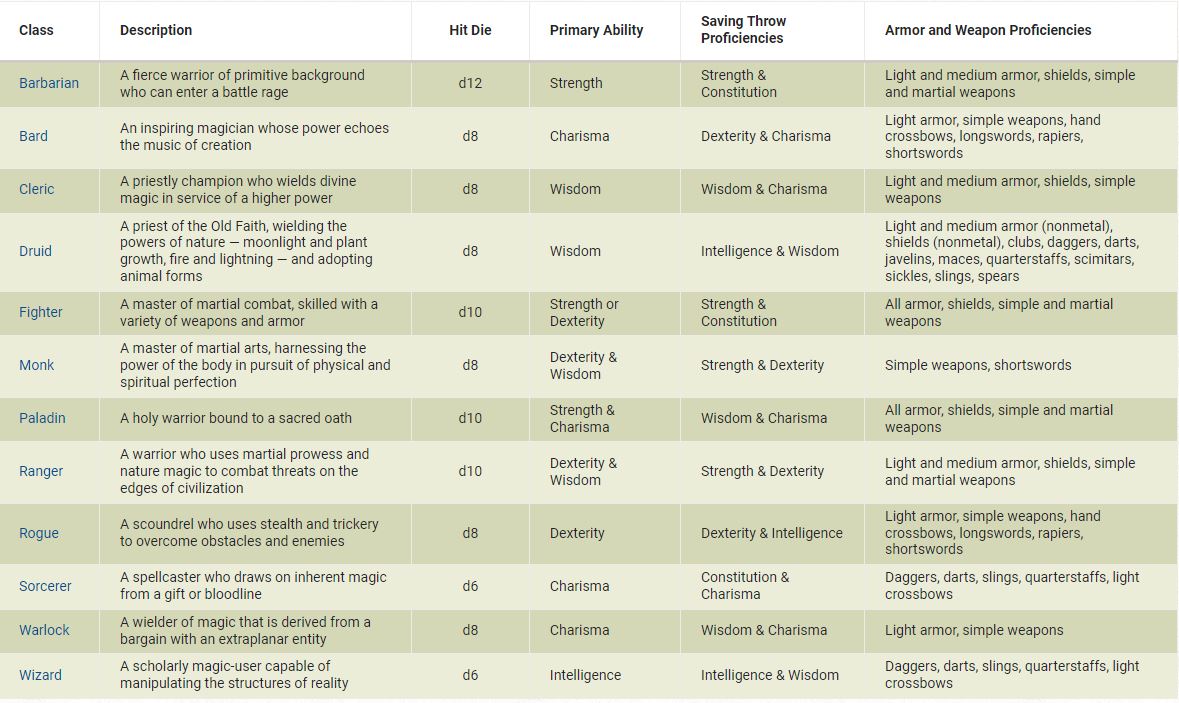
Okay.... now let's take a look at each of the classes with a brief summary. These are ranked on what I think would be the hardest for beginners to play to the easiest to play, but this is only my opinion. You, of course, are welcome to play which ever class that you like.
15. Bard
Bards tend to fill something of a support role in combat, particularly with their Bardic Inspiration ability. They're also full casters, with access to cantrips and a variety of spells. Unlike Clerics and Druids, they only know a certain amount of chosen spells at any given time.
Plus, Bards possess not-so-insignificant physical combat skills and thus have a lot to offer a player. However, it can also be difficult to keep so many abilities straight let alone leverage them in the most optimal ways. This is one of the D&D classes which ranks lowest since support classes can be difficult for first-time players.
14. Clerics/Druids
Both Clerics and Druids use Wisdom as their spellcasting stat and have access to all their class spells (of an appropriate level) at once, with a chosen few being prepared each day for use. As such, Clerics and Druids fill pretty similar roles in a party, as support. In combat, they use their many abilities to heal, buff allies, or debuff enemies.
Class-specific abilities like the Cleric's Channel Divinity (which has different options depending on their deity) and the Druid's Wild Shape can make this class a difficult D&D class for beginners. This combo might be best left for later campaigns.
13. Monks
Monks have some of the coolest abilities of any class with flavor that makes them a joy to throw around on a battlefield. Being high Dexterity characters, their abilities emphasize mobility when both attacking and defending. They can channel the ki energy in their bodies to trigger a quick flurry of unarmed blows, catching projectiles, and running up walls.
The downside to having all of these great abilities is that many new players will simply forget they have them at their disposal. For the intrepid newbie who wants more Monk assistance, check out YouTube user JoCat who has tons of useful and quick guides for D&D like the one from the image above.
12. Wizards
As the stereotypical spellcasting class for D&D, there isn't really anything wrong with playing a Wizard. They can be very versatile and have access to the largest amount of spells of any other caster. Not only do they learn new spells upon level up but Wizards can also copy spells out of the grimoires of defeated mages, so they end up with a large repertoire that expands at a reasonable pace.
Wizards best reward creative players, who can make the best use of their many spells and devise a way to keep their squishy character out of the line of fire. For newer players, this can be tricky.
11. Cleric
As mentioned earlier, support classes can present a challenge for beginner-level players. However, being a Cleric does mean that new players have a clear objective: to heal the team. This can also be used to build team camaraderie, in-game or in real life.
However, this requires choosing and then using a ton of spells. Keeping up with so many might prove frustrating for some newer players or serve as a refreshing change of pace for others.
10. Paladin/Ranger
Paladins and rangers are pretty similar when it comes to the kinds of features they get. Both are half-casters, meaning they're primarily martial fighters, but do eventually get access to a limited amount of magic.
They can be great picks for people who aren't sure what kind of character they want to play, but it's possible they'll lean toward one side or the other and use that experience when making a new character later. Moreover, it serves as a great entry into learning how to multi-class across the 5e options.
9. Rogues
Rogues, when played well, can be terrifying foes on a battlefield. Even when a player doesn't have a firm grasp of the class, they still tend to be very useful both in and out of combat. When it comes to abilities, Rogues have many options that can sometimes be difficult to remember, but most of the time, as long as players remember to use Sneak Attack, they'll be golden.
They're the best D&D class for beginners who want to play a martial class without swinging around a huge ax or getting in super close for a flurry of attacks. Plus, they're the trusty standby for everyone who wants to make a cool, broody antihero as their character.
8. Ranger
Any new player who also wants to have a pet companion in-game should start with the Ranger class. The class also allows for multiple weapon types, so players can choose between ranged or melee combat options.
Rangers also have the option of picking up spells, or players can choose to max into cantrips and other abilities instead. Similar to the Rogue, Rangers can build to accommodate many different playstyles and it's that versatility that makes them a great D&D class for beginners.
7. Paladin
Though a great class when mixed with the Ranger, the Paladin is also a solid beginner class all on its own. After all, Paladins have some of the highest armor across all classes which makes them great tanks. They also have access to healing magic for good measure.
As far as moral alignments and lore choices go, Paladins also present great opportunities for players interested in more than just combat stats. Those playing as the Paladin class must pledge themselves to various deities and can even be "oathbreakers" to fall under the "evil" alignment.
6. Sorcerer
Sorcerers function as a pretty straightforward spellcasting class. Unlike Wizards, who get their powers from book learning, Sorcerers have magic in their blood. They learn more towards elemental combat with a large variety of combat cantrips and heavy-hitting spells that are easy for most players to understand. Their Metamagic feature allows for some strategizing without being overwhelming.
There are also some fun options for the origin of the character's magic, like the Wild Magic subclass which has the potential for chaotic effects any time a spell is cast.
5. Barbarian
If all a player wants to do is take hits and dish out damage, the Barbarian is probably the class for them. Not only do they have the highest hit point pool of any class, but their Rage ability also grants them resistance to the most common forms of damage. They're basically designed to pummel the bad guys until they drop.
Being such a straightforward class, some new players may also choose to multi-class as barbarians. There are also Barbarian subclasses that can make the class more complicated and add more options. The basic Barbarian strategy of "rage and smash" still applies, making this one of the best D&D classes for beginners.
4. Fighter/Spellcaster
The Fighter seems like a dull class at first, but it's the most customizable class in most RPGs, including the D&D universe. Players can multiclass a Fighter with literally any other class depending on their stats, which makes multiclassing one an interesting prospect for a character who already has some basic knowledge when it comes to character creation and gameplay.
The spellcasters in D&D use Wisdom, Intelligence, or Charisma depending on the class. If you have a Fighter with a high Wisdom ability score, for example, he might make a good Fighter-Cleric. One with a high Charisma could be a Warlock or a Bard.
3. Warlock
Warlocks are the best spellcasting D&D class for beginners. They have access to many fewer spells and have fewer spell slots than the other magical classes. However, those spells hit harder and regenerate faster. Warlocks regain their spell slots on a short rest as opposed to a long one, so they don't have to ration their magic as strictly as a Wizard usually does.
In addition, the aesthetic is totally beautiful. Warlocks sell their souls to some eldritch being in exchange for mystical powers and now they can do stuff like read minds and summon tentacles from another dimension. Mission status? Sick.
2. Fighter
This is the class for new players and the archetypal choice for the entire game. Fighters excel at one thing (take a guess) and there happens to be quite a bit of combat in any D&D adventure. That's why gear can play an important role with any class, but especially for the Fighter.
As they gain levels, Fighters become more resilient, more versatile, and most importantly they gain the ability to hit people more often. If a player is ever unsure what class would be best, it's hard to go wrong with a good old stock-standard Fighter.
1. The One Players Want To Play Most
At the end of the day, D&D is about hanging out with friends, roleplaying, and having a blast while tuning out the real world for just a little while. As such, if someone wants to come out of the gate as a Bard-Wizard with no previous experience, that's their business. So long as the player isn't actively harming the experience, whatever class they choose shouldn't really matter.
A good Dungeon Master can adapt, right? In any case, picking up the Player's Handbook, bestiary, and boning up on class descriptions can help quite a bit. And remember that chart that at the beginning of the article? It's handier now... so yay!