Dolurrh, the Realm of the Dead
Plane — Death, Memory, Transition & the Gateway Beyond — Moon: Aryth, the Gateway
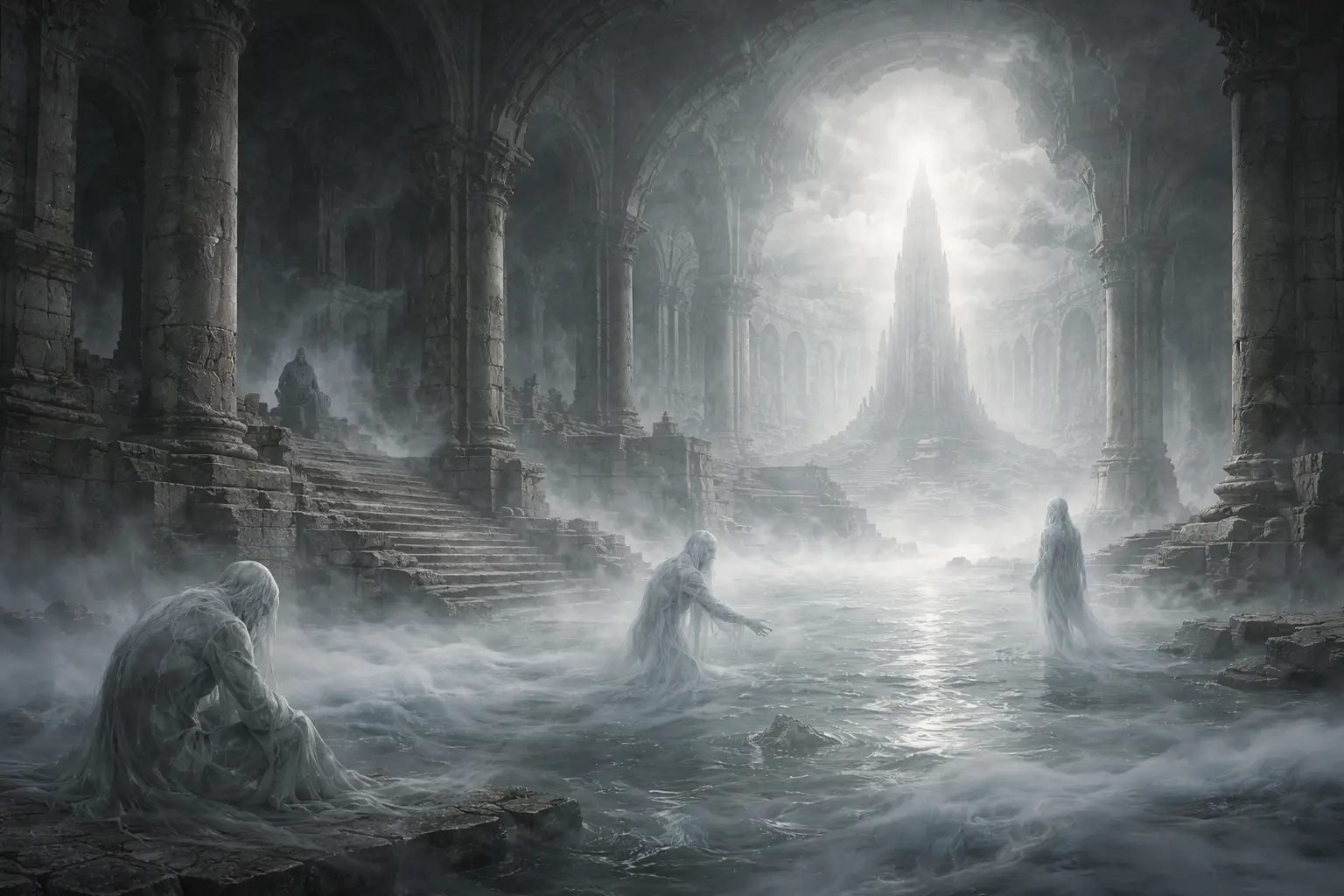
Endless caverns stretch through Dolurrh, bleak passages of gray stone. Wherever you go, shadowy figures reach toward you, imploring, but you feel only the faintest chill as their insubstantial fingers pass through you. Mist pools around your feet, and as you press forward, you realize this swirling mist is moaning. This is no natural fog; these are the remnants of souls who have forgotten themselves.
Dolurrh is not the embodiment of death or dying — both of those concepts belong to Mabar. Rather, Dolurrh is where mortal souls go after their bodies die: the place where memories fade and lives are forgotten, where the bright flame of identity is slowly, gently extinguished. Mortal spirits are drawn to Dolurrh within moments of death, and their memories begin to decay immediately. Within days, most spirits no longer have any desire to leave. Within weeks, most retain only the faintest echoes of their previous lives. Within months, even those echoes dissolve, and what remains is a husk — an empty form that eventually merges with others into a moaning mist of forgotten existence.
The sage Annolysse of Arcanix declared that Dolurrh must be the thirteenth plane, for it has no opposite. It does not embody an idea so much as it serves a purpose — gathering, collecting, and perhaps transitioning souls. Mortal actions are judged in Daanvi; by contrast, Dolurrh does not judge and it does not punish. It is simply the end of the journey — or depending on how one looks at it, the beginning of a new one.
The faiths of Aerenal and the Blood of Vol assert that Dolurrh is the absolute end of existence, the last echo of a life before it is completely gone. This belief drives the Aereni practice of sustaining their ancestors through positive energy and the Seeker conviction that mortals must find their own divinity before death claims them. But the followers of the Sovereign Host take a different view. When Dorius Alyre ir'Korran drew his classic planar map, he used the Octogram of the Sovereign Host to represent Dolurrh, declaring it the door through which all mortals must pass to join with the Sovereigns. In this view, what appears to be memory fading is actually the soul ascending to a higher form of existence — rising to a level of reality no mortal can experience. The Vassals say the faithful finally join the Sovereigns. Followers of the Silver Flame say noble souls strengthen the Flame. What remains in Dolurrh is only a husk — cast-off remnants, like an abandoned snakeskin.
This is, ultimately, a matter of faith. Whether the other side of Dolurrh is oblivion or paradise, no one ever returns from it to say.
FRAGMENT — CARVED INTO A STONE BENCH IN THE CATACOMBS OF DOLURRH. LANGUAGE: OLD COMMON. TRANSCRIBED BY EXPLORER VELLIS TAIN, WHO NOTED THAT THE BENCH WAS OCCUPIED BY A SHADE TOO FADED TO SPEAK.
I was someone. I had a name that meant something to the people who said it. I had hands that made things. I had a voice that told stories. I had a child who laughed when I came through the door.
I know these things because they feel true. But I cannot remember the name, or the things, or the stories, or the laugh. I cannot remember the door.
If you are reading this, you are not yet like me. Write something down. Write your name. Write the name of the person you love. Write it somewhere that stone will keep it, because you will not.
Universal Properties
Everything about Dolurrh is gray and gloomy. Even the brightest colors seem faded, the most joyful sounds seem dull. A heavy weight settles on travelers the moment they arrive, making even the simplest tasks feel challenging — and there is a constant pull, tugging at memory and emotion, a desire to just sit down and let it all go.
Eternal Ennui. When a creature enters Dolurrh, it immediately gains one level of ennui — a special condition that mirrors exhaustion but affects all creatures, including undead and those normally immune to exhaustion. This level cannot be removed by rest or any other means while in Dolurrh, and is immediately removed when the creature leaves. Ennui is separate from exhaustion; if a creature has both, the higher total determines the effects. A creature that reaches six levels of ennui has its will completely broken and can take no purposeful action; if this happens to a living creature, its physical body dies and it becomes a husk bound to Dolurrh forever.
Inevitable Entrapment. The plane's pull grows stronger over time. Periodically, creatures must resist its effects or gain additional levels of ennui, with the difficulty increasing each time. Each failed save also means rolling disadvantage on subsequent checks. Undead cannot recover from ennui while in Dolurrh — a fact that makes the plane particularly dangerous for vampires, liches, and other sentient undead who might otherwise consider themselves immune to the mundane consequences of death.
Impeded Magic. Casting spells in Dolurrh requires effort; spellcasters must succeed on a check to cast spells of 1st level or higher, or the spell fails without expending the slot. Magic does not flow easily through a plane designed to wind things down.
Timeless. Time passes at the same rate as on the Material Plane and is consistent across all layers. Creatures can benefit from rest, suffer damage, and die. However, creatures in Dolurrh do not age, and do not need to eat, sleep, or drink.
Layers
Dolurrh is universally gray and gloomy. No mortal has seen its moon or sky; accounts describe a constant sense of being underground. Unlike most planes, the layers of Dolurrh do not embody different ideas — instead, they serve different functions in the grand machine dedicated to processing souls. The four layers described here are the only ones documented in the records of mortals who ventured to Dolurrh and returned. But there could be more: it is known that the Librarian has recorded the lives of dragons in the Vault of Memories, and sages theorize there may be a layer dedicated entirely to the spirits of dragonkind, whose souls may linger longer than those of simple humanoids.
The Catacombs
Endless tunnels of gray stone wind through the Catacombs — the destination of humanoid spirits. Some passages are painfully tight; others widen into grand halls with ceilings lost in darkness. The Dead are everywhere: shades pleading for release, husks keening in the shadows. The chambers of the Catacombs contain vast wells filled with moaning mist, and nalfeshnee demons herding shades into pens and scraping lemures off the walls. The Catacombs may be larger than Khorvaire, or even Eberron itself. A mortal could wander forever through these tunnels — at least until they are consumed by ennui. However, junction points that transcend the logic of distance connect distant regions of the Catacombs, and those who know the right symbols to follow can cross its vastness quickly or pass to other layers.
The Kennel
Similar in appearance to the Catacombs, the Kennel contains the shades and husks of beasts and monstrosities, tended by nalfeshnee and maruts. Here, explorers hear the howls of fading wolf spirits and see flocks of spectral birds flying through grand halls, alongside larger and fiercer creatures. Beast spirits rarely linger long in Dolurrh, as most have fewer memories to erase. But all dogs go to Dolurrh.
The Crucible
In this grand foundry, tended by shadar-kai and guarded by newly forged maruts, the immortal spirit known as the Smith of Souls refines the essence of faded spirits into husksteel — a material forged from the lingering scraps of memory and emotion. From husksteel, she crafts the armor and weapons of the shadar-kai and creates the maruts from the husks of brave souls. She also produces smaller, stranger items: trinkets, curiosities, and artifacts imbued with the emotional residue of the dead. The Smith wears a mask of black steel and an apron of dragonhide. When forging maruts, she takes the form of a giant; when crafting tiny trinkets, a gnome. It is said she collects the memories of mortal artisans and can replicate their works at her forge.
The Vault of Memories
The heart of Dolurrh is the Vault of Memories, a tower carved up through gray stone that is larger than any of the great towers of Sharn. On the lowest levels lies the Vault's library, where the spirit known as the Librarian interviews each shade and makes a record of its life before it fades. His power is such that an entire life can be confined to a single large page. Every sigil inscribed holds a crucial memory, and a creature proficient in Arcana can read the symbol to experience that memory firsthand. The many floors of the library hold countless books of preserved lives, tended by shadar-kai scribes. The Librarian is a massive hooded figure — his books are likewise enormous. It is said he can be in many places at once, allowing him to speak to every shade and capture the story of its life before it is lost.
In the halls above the library, the Queen of the Dead keeps her many treasures. What appear to be obsidian statues are actually shades, crystallized to prevent them from fading. Paintings and crystals contain memories she has chosen to isolate. Beyond these are countless trinkets and oddities collected by her shadar-kai over the vast scope of history. And higher still are the chambers of the Queen herself, where she sits in silent contemplation, listening to the whispers of the countless shades in her domain.
Denizens
In many ways, Dolurrh is a machine. The pull that draws spirits to the plane is a mechanical effect, part of the fundamental nature of souls. The denizens of Dolurrh are the cogs of that machine, here to keep the system running.
The Quick
The native creatures of Dolurrh are bound to the cycle of transition and all have roles to serve. All are immune to ennui.
Nalfeshnee patrol the Catacombs, dispersing melds and lemures and dealing with mortal intruders. They appear as large humanoids shrouded in gray mist and take evident delight in crushing mortals and pulling the shades from their corpses.
Maruts are powerful guardians forged from husksteel in the Crucible, tasked to preserve the cycle of life and death. They are occasionally dispatched to Eberron to intervene when resurrection magic is performed or when a lich or mummy is created. No one is entirely certain what triggers this deadly intervention — perhaps the resurrection defied the Draconic Prophecy, or perhaps the Queen of the Dead simply disapproved. Jorasco healers always cast augury before performing a resurrection; if the result is "woe," they refuse the job, lest a marut appear and destroy the patient, the healer, and possibly the entire building.
Shadar-kai are servants of the Queen of the Dead — shades who caught her attention and were granted new life in new bodies. Though their forms appear elf-like, they might have been any sort of humanoid in their previous existence. They serve in the Vault of Memories and occasionally act as the Queen's agents on Eberron, clashing with necromancers, collecting trinkets, or targeting specific mortals for reasons no outsider can determine.
The Dead
The spirits of those who have died are omnipresent in Dolurrh. Shades are mortal souls freshly arrived — they maintain a portion of their memory and original appearance, though they are insubstantial and cannot interact with physical objects. They can speak, and they may cry or beg adventurers for help, but most are incapable of taking action on their own. They are often found lost in thought, trying to remember something they have forgotten, or fixating on a past mistake. Shades are susceptible to ennui, and as it takes hold, their appearance blurs and their memories fade.
Husks are shades that have been overcome by ennui and possess only the vaguest memories of their mortal existence. Most retain a semblance of their shape but continue to fade over decades, eventually merging with other husks to form masses of moaning mist. Having no true consciousness, husks are immune to ennui's further effects. Occasionally, a group of husks clusters around a strong memory, forming an ectoplasmic mass called a meld that prowls in search of more scraps of memory.
Ghosts are formed when a shade clings to a particular memory with such intensity that even Dolurrh cannot eradicate it — perhaps a terrible mistake, a betrayal, or a bitter grudge. The rest of the spirit's memories fade, but this single ember remains, defining its existence. Ghosts are driven by a primal desire to return to Eberron, to haunt the place where they died or where their anchoring memory was forged. They can only find peace if their unfinished business is resolved.
The Lingering
Memories of joy do no harm in Dolurrh. But memories of pain, cruelty, and anger do not fade easily, and they can hurt others. This psychic residue builds up in the gears of the spiritual machinery. The least of these coagulations are lemures, formed from hateful memories or deeds. The emotional residue of hundreds or thousands of people can form sorrowsworn — the Angry, the Hungry, the Lonely, the Lost, and the Wretched — deadly manifestations of concentrated suffering. The Lingering are immune to ennui but are a waste product, not the plane's desired result; nalfeshnee, maruts, and other guardians destroy them whenever they are found.
The Queen of the Dead
The most powerful being in Dolurrh dwells in the great spire that rises above the Vault of Memories. Little is known about her motives or origins; curiously, she focuses on the Material Plane far more than most great planar powers do. Though she existed long before the elves, the Queen appears as an elf woman, her face hidden by a cracked alabaster mask, her robes of black feathers trimmed with silver. She can pluck shades from the cycle of entrapment and grant them new life as shadar-kai. She collects secrets and memories, plucking her favorites from the Librarian's records and keeping them in her personal collection. Sometimes she directly opposes mortal necromancers. At other times, she seems interested in killing specific people — perhaps to preserve their spirits, perhaps for reasons no mortal can comprehend.
Such direct action is extraordinarily rare, occurring perhaps once in a century. Most of the time, she remains silent in Dolurrh, unknown and unknowable. But her power within her realm is absolute. In the Age of Giants, the Cul'sir Dominion sent an army into Dolurrh to recover lost spirits — none of them returned.
Concerning Resurrection
Returning life to the dead is not a reliable service in Eberron. Many characters are capable of casting the necessary spells, but just because a spell can be cast does not mean it should be — or that it will work.
The first limitation is time. The longer a spirit remains in Dolurrh, the more ennui erodes its will. Any resurrection spell requires the spirit to want to return, and once a shade becomes a husk, it can no longer make that decision. Most religions maintain that this happens because the true soul has moved on — who wants to be pulled back from union with the Sovereigns? Practically, this means there is a window of roughly one to two weeks, depending on the strength of the target's will, before resurrection becomes impossible. Even before that deadline, a spirit might choose not to return. What do they have left to live for? Is it worth fighting the lulling weight of Dolurrh?
The second limitation is risk. Even if a spell succeeds, there is always a chance that the wrong spirit comes back, or that other spirits are pulled through the breach, or that a marut appears to enforce the natural order. Jorasco healers perform auguries before every resurrection and refuse the job if the omens are unfavorable.
The third limitation is the direct intervention of a higher power. The Queen of the Dead does not like having her collection raided, and while she tolerates the occasional stolen shade, those who push too far or too often learn that her tolerance has limits.
Rarely, the bravest and most foolish of adventurers venture into Dolurrh itself, hoping to find a lost spirit and bring it home. Rarely, they succeed. The Queen does not care about one or two thefts per century — but she noticed the Cul'sir army, and she dealt with it.
INTERNAL MEMORANDUM — HOUSE JORASCO, FAIRHAVEN HEALING HOUSE, 7 EYRE 997 YK
RE: Resurrection Services — Updated Protocol
As of this date, all resurrection requests must be preceded by an augury ritual performed by a licensed cleric of no less than fifth circle. If the result of the augury is WOE, the request is to be declined regardless of the client's social standing, wealth, or political influence. No exceptions.
The Rekkenmark incident of 676 YK — in which a marut manifested during a routine raise dead casting and destroyed the patient, the attending healer, and the east wing of the healing house — is not to be repeated. The settlement cost House Jorasco eleven thousand galifars and three senior healers, in addition to the reputational damage.
If a client is dissatisfied with a declined request, direct them to the Ghallanda liaison for grief counseling services. Do not argue. Do not explain the details of the Rekkenmark incident. Simply decline.
— Healer-General Torvann d'Jorasco
Planar Manifestations on Eberron
Manifest Zones
Manifest zones tied to Dolurrh rarely possess all of the plane's properties — travelers are not typically trapped by ennui simply by passing through one. But these zones are still close to the Realm of the Dead and exceptionally haunted, though not blighted as Mabaran zones typically are. Shadows move in disturbing ways. Travelers may hear whispers they cannot quite make out. The restless spirits of Dolurrh yearn to return to the Material Plane, and these zones make it easier for them to cross over — manifesting as ghosts, or animating the corpses of people buried in the zone, causing them to rise as revenants or zombies. Unlike Mabaran undead, Dolurrhi undead are not driven to harm the living; they are merely restless, defined by a single piece of unfinished business, and they often do not realize they are dead.
Some Dolurrhi zones have positive effects. In many, it is easier to return people from the dead, halving the cost of material components. In others, anyone with a personal connection to a deceased person can cast speak with dead as a ritual, even without spellcasting ability. The most dramatic manifest zones serve as gateways to the Catacombs themselves — though opening such a gateway typically requires a special ritual, a significant sacrifice, or a particular alignment of the moon Aryth.
Coterminous and Remote
Dolurrh has a slow planar cycle. Traditionally, once a century, it becomes coterminous for a full year; fifty years later, it is remote for a full year. Shorter phases tied to the movements of Aryth also occur.
While coterminous, it is easier for ghosts to slip from the Realm of the Dead into the Material Plane, especially around manifest zones. Resurrection magic becomes unpredictable — the wrong spirit might return, or unwanted entities might be pulled through.
While remote, traditional resurrection magic cannot pull spirits back from Dolurrh at all. The only way to raise the dead during a remote period is to travel to Dolurrh physically and retrieve the shade — an epic undertaking. Paradoxically, ghosts are especially common during remote periods, because spirits who die in the grip of great emotion can more easily resist Dolurrh's pull and remain on the Material Plane.
Dolurrhi Artifacts
The most common Dolurrhi artifacts are creations of the Smith of Souls, forged from husksteel — the fused essence of faded spirits. Despite the name, husksteel can appear as dark metal, slick black leather, dark iridescent cloth, or other substances. Each item is crafted from a specific memory or emotion that serves as its heart: a dagger whose edge is forged from a single moment of pain, a cloak formed from a secret, a ring shaped from the grief of a mother who outlived her children.
For magic items, the heart-memory should reflect the item's purpose. A husksteel cloak of elvenkind could be formed from a secret — it wants to hide you because the memory that made it needed to hide. A husksteel dagger of venom might be formed from a moment of absolute terror; when its power is invoked, it deals psychic damage and fills the target with the fear that created it.
Beyond forged items, Dolurrhi trinkets are largely curiosities: a hand mirror that periodically shows the reflection of a dead person, a monocle that reveals the last thing its previous owner saw before dying, a small leather journal containing a poem written by a beloved creator after they died.