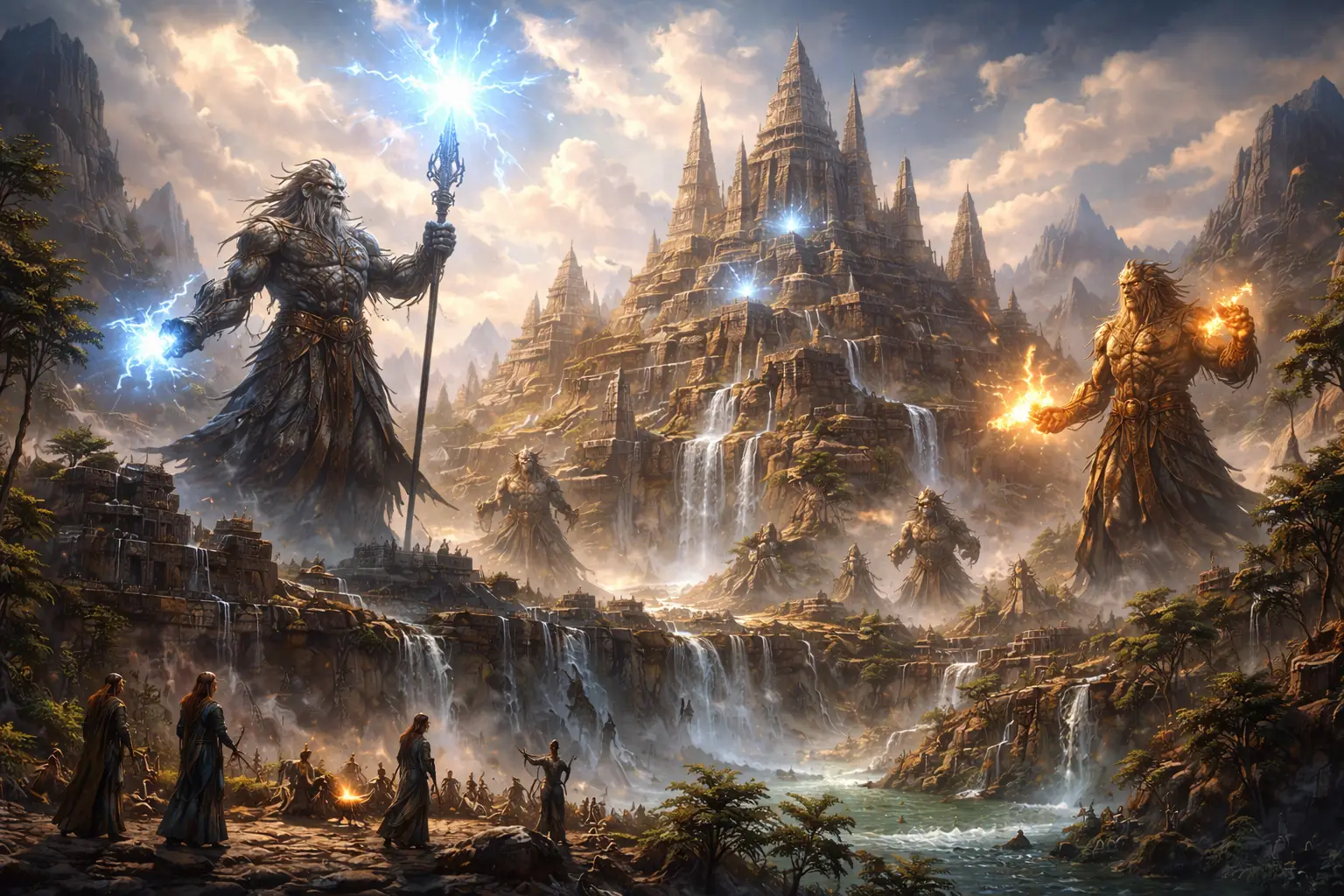
The Age of Giants
Period: ~80,000–40,000 Years Ago
In the wake of the Age of Demons, the dragons were the most powerful force in Eberron. Some dragons helped guide lesser creatures, including the giants of Xen'drik who once were servants of dragons, but were granted independence and taught mastery of arcane magic by their former masters. But as the dragons' increasing dominion caused a surge in the power of the Daughter of Khyber — an overlord who corrupts dragons and feeds on the evil they can do — the dragons were forced to withdraw to isolation in Argonnessen. They remain there to this day, in hopes of preventing her power from increasing further.
In their absence, multiple nations of giants arose on Xen'drik. They unlocked secrets of arcane magic still unmatched in the modern age. They built towers that touched the sky and seemingly endless cities. And over the course of tens of thousands of years, they destroyed themselves — with the dragons ultimately destroying what they had created.
"The giants mastered magic that we cannot replicate. They also did things with that magic that we are not stupid enough to attempt. These are related observations." — Arcanix lecturer, arcane history
The Giant Nations
Khorvairian common knowledge compresses the giants into a single civilization. In fact, there were multiple nations with distinct cultures and rival arcane traditions — different enough that understanding which giant civilization built a ruin can matter as much as understanding what it was built for.
The Sulat League specialized in elemental binding and magebreeding. They created the drow as living weapons to deal with rebellious elves, and it is thought that fire giants are remnants of the Sulat. Their archarcanist Il'Ara was devoted to the study of Risia and magebred her own lineage of frost giants over millennia. Sulat weapons and elemental binding techniques are among the most sought-after artifacts in Xen'drik — and among the most dangerous if they fell into the wrong hands in Khorvaire.
The Group of Eleven was an alliance of eleven city-states, each led by a powerful empyrean mage. Their diverse culture valued internal and external competition, believing it drove evolution. Each of the eleven studied a different plane — one devoted to Lamannia, another to Mabar, another to Thelanis, and so on. Their planar research produced knowledge that modern scholars can catalogue but not replicate.
The Cul'sir Dominion was ruled by mighty empyreans and sought to dominate all reality. They explored the planes as well as the world. In Sovereign Host tradition, the mightiest among the giants was the titan Cul'sir, whose power was so great that he pulled the thirteenth moon from the sky. The Cul'sir were the ones who fought the quori — and the ones who ended the war by destroying a moon.
What all three civilizations shared was scale. Giant architecture was built for beings three to five times the height of a human. Cities incorporated permanent enchantments, controlled planar interactions, and transportation networks connecting dominions across continental distances. The artifacts that survive — and many do, despite the passage of forty thousand years — demonstrate craftsmanship and theoretical sophistication that exceeds current Khorvairian capability. Elemental airships and the development of the warforged were both inspired by discoveries tied to the ancient giants.
"We found a Sulat binding array last season. Still operational. Still holding an elemental that had been trapped inside for approximately forty thousand years. The elemental was not pleased. Three members of the team did not come home." — Morgrave field researcher, expedition debrief
The Elves of Xen'drik
Elves were present in Xen'drik throughout the Age of Giants, and they were not guests. Elves today share a common ancestor in the form of the immortal Eladrin; elves from Thelanis. It is theorized that when a feyspire appeared on Xen'drik from a Thelanis manifest zone, the giants used the opportunity to attack and sack the gateway to the realm of the fey, and took hundreds of eladrin prisoners. After years of experimentation and magebreeding, the giants created elves, who were forced to lived as a slave population — used, commanded, and, when convenient, experimented on. Not all accepted such existence peacefully.
The Sulat League's response to rebellious elves was characteristic of giant problem-solving: they created the drow as living weapons, shadow-assassins turned back against their own people. The Sovereign Host tradition says Cul'sir "unleashed plagues upon the rebellious elves" and "made assassins of elven shadows and turned them back against their owners."
The resistance that developed under giant rule produced the ancestor-heroes that the Tairnadal still revere. The cultural commitments that would become the Undying Court began as a refusal to let the dead be forgotten. Those who escaped Xen'drik became the Aereni and the Tairnadal. Those who remained became the drow — not by choice, in most tellings, but by circumstance.
Three distinct drow cultures formed after the fall of the giants that still exist today. The Vulkoori are hunters dedicated to a scorpion god called Vulkoor; they hunt giants and other dangers in their lands. The Sulatar, led by powerful druids and wizards, cling to traditions of elemental shaping that date back to the Age of Giants. They live in a handful of obsidian cities and believe they are destined to cleanse the world in a fiery apocalypse. The Umbragen are descended from drow who fled into the depths when giant civilization fell. They wield sophisticated shadow magic in their unceasing battles against the daelkyr and other aberrations of the underworld.
The Quori War and the Severance
The crisis that ended giant civilization began with a conflict between the Cul'sir Dominion and the inhabitants of Dal Quor, the Region of Dreams. It is not known whether the Cul'sir attacked Dal Quor or whether the quori of the time sought to invade Eberron, but the two powers fought an extended war.
The giants' response was characteristic: overwhelming, effective, and catastrophic. They ended the conflict by destroying one of the moons of Eberron with cataclysmic magic, damaging the planar connection between Dal Quor and the world. Since then, the quori have been unable to physically travel to Eberron, and there are no longer any manifest zones to Dal Quor. The invasion was over. A moon was gone. And the consequences were only beginning.
Most people in the Five Nations know the idea that arrogant giants destroyed the thirteenth moon — it is a common folktale with many variants. Few consider it literal truth. It is literal truth.
"They destroyed a moon. Not a fortress. Not a city. A moon. To stop an invasion. And it worked. And then they threatened to do it again to stop a slave rebellion. That is when the dragons came." — Arcanix instructor, planar history
The Draconic Intervention
The destruction of the moon had devastating repercussions for giant civilization and they were, as a society, weakened for the first time in existence. In the upheaval, many Cul'sir subjects used the opportunity to rebel. But the largest uprising was that of the elves — both those oppressed by the Cul'sir and warrior elves who had never been conquered by the giants.
When the Cul'sir threatened to draw on their most dangerous magics once more to destroy the elves, the dragons emerged in force from Argonnessen. This was not a battle. It was a deliberate, sustained campaign to dismantle giant civilization and ensure it could not reconstitute itself. The dragons utterly devastated the civilizations of Xen'drik — giant and otherwise — then laid curses on the land that are beyond the comprehension of the modern age.
The Traveler's Curse warps space and makes travel in Xen'drik unreliable to this day. Explorers might follow the same path twice and end up in entirely different locations. Routes do not repeat. Distances shift. Xen'drik cannot be reliably mapped.
The Du'rashka Tul — "the madness of crowds" — causes civilizations that become too advanced or widespread to collapse into madness. Some believe this is why no city on Xen'drik has ever grown large enough to challenge the curse. Stormreach fears that continued expansion could trigger it.
The draconic curses are believed to be the reason the giants devolved from mighty titans into the hill giants and other diminished giants known today. The full extent of these curses is unknown, but the impact is unmistakable.
To this day, the scourge of the land prevents any advanced civilization from rising again. Xen'drik is in essence a vast dungeon — a continent that defies control, holds secrets that could shatter the world, and cannot be fully mapped or explored.
"Forty thousand years of recovery have not been enough. That is not a natural disaster. That is a sentence. The dragons did not destroy Xen'drik. They cursed it, specifically and deliberately, so that no one would ever make the same mistake again. Whether 'no one' includes the dragons themselves is a question the Conclave of Argonnessen has chosen not to answer." — Korranberg historian, Xen'drik studies
What Survives
Giants still roam Xen'drik, but they have never regained the glory of their ancestors. Even as individuals, they are in every way lesser to their ancestors: smaller, stupider, and unevolved. The drow cultures — Vulkoori, Sulatar, Umbragen — have adapted to a shattered continent on their own terms. And the ruins remain.
Giant infrastructure was built to last, and it has — long past the point where anyone remembers how to operate or deactivate it. Expedition teams from Morgrave, Cannith, and Tharashk encounter active systems regularly. The encounter is not always survivable.
The city of Stormreach is the primary gateway to Xen'drik's interior — once a haven for pirates and smugglers, now a thriving port built on the foundations of an ancient giant city. All the dragonmarked houses have outposts there. Ruins abound around and below the city. The Inspired lords of Riedra maintain their own port at Dar Qat, a fortress of glittering crysteel, equally interested in the continent's resources and equally unwelcome to outsiders.
"Every year, Morgrave sends expeditions into Xen'drik. Every year, some of them come back with artifacts that change the field. Every year, some of them don't come back at all. The university considers this an acceptable ratio." — Sharn journalist, investigative feature
Why It Matters
The Age of Giants matters to the present day for three reasons.
First, the giants mastered secrets of arcane magic as yet unmatched by humanity or the elves. A new discovery in Xen'drik could be as consequential as the ones that produced elemental airships and warforged. The continent is a source of powerful artifacts, spells, and eldritch machines — and a race to recover them could shift the balance of power in Khorvaire.
Second, the destruction of Dal Quor's connection to Eberron created the conditions for the Dreaming Dark — the quori conspiracy that now operates through the Inspired of Sarlona. The quori cannot physically travel to Eberron because of what the giants did. They are forced to use mortal hosts. The entire political structure of Riedra is a downstream consequence of the Cul'sir Dominion's decision to destroy a moon.
Third, the exodus of the elves from Xen'drik produced the Aereni, the Tairnadal, and the drow — three civilizations whose identities were forged in the same catastrophe and who have never fully reconciled with each other or with what happened to them. The cultural wound has not healed in forty thousand years. It is not clear that it ever will.
"The Age of Giants is the cleanest morality tale in Eberron's history, which is why you should distrust it immediately. The giants were not punished for being evil. They were punished for being dangerous. The distinction matters, because the dragons who destroyed them were not good. They were afraid." — Morgrave lecturer, ancient civilizations